AI Construction Software for Residential Builders: Use Cases, Cost, Payoff


I’ve watched home builders face challenges from every direction. Margins shrink faster than bids adjust, while material pricing moves weekly, and labor gaps force constant rescheduling. At the same time, homeowners expect cleaner communication, faster answers, and fewer surprises.
That pressure changes how projects are run. It’s no longer enough to be good at building. You have to manage information, costs, and decisions with more precision than most residential teams were ever staffed for.
So the real question is not whether AI construction software looks impressive. The question is whether it actually helps residential builders stay profitable, organized, and in control across real projects, not demos or edge cases.
Table of Contents
- What Is AI Construction Software?
- What Makes Residential Construction a Unique Use Case for AI
- Where AI Actually Fits in Residential Construction Workflows
- Cost vs Value: Is AI Construction Software Worth It for Residential Builders? | Evaluation Checklist

What Is AI Construction Software?
💡AI construction software refers to project management systems that use machine learning and automation to assist with everyday construction tasks.
In residential construction, this does not mean robots designing houses or software replacing builders’ judgment. It means tools that can process large amounts of project data, recognize patterns, and support decisions that builders already make every day.
In practice, AI works in the background of familiar workflows. It helps organize estimates, align costs with real project history, adapt schedules when inputs change, and surface inconsistencies before they turn into problems. The goal is not full automation, but the reduction of manual effort in areas where residential teams lose time and focus.
For residential builders, AI construction software is valuable only if it fits into daily operations without adding complexity.
- When implemented effectively, it serves as a support layer that enhances estimating accuracy, facilitates better communication, and maintains project organization as conditions change.
- When implemented poorly, it becomes another system to manage.
What Makes Residential Construction a Unique Use Case for AI
Residential construction operates differently from commercial work, even when project values look similar on paper. The scale is smaller, but the variability is higher. Teams are leaner, and client involvement is constant. These factors shape where AI helps and where it struggles.
Smaller Teams, Heavier Workload
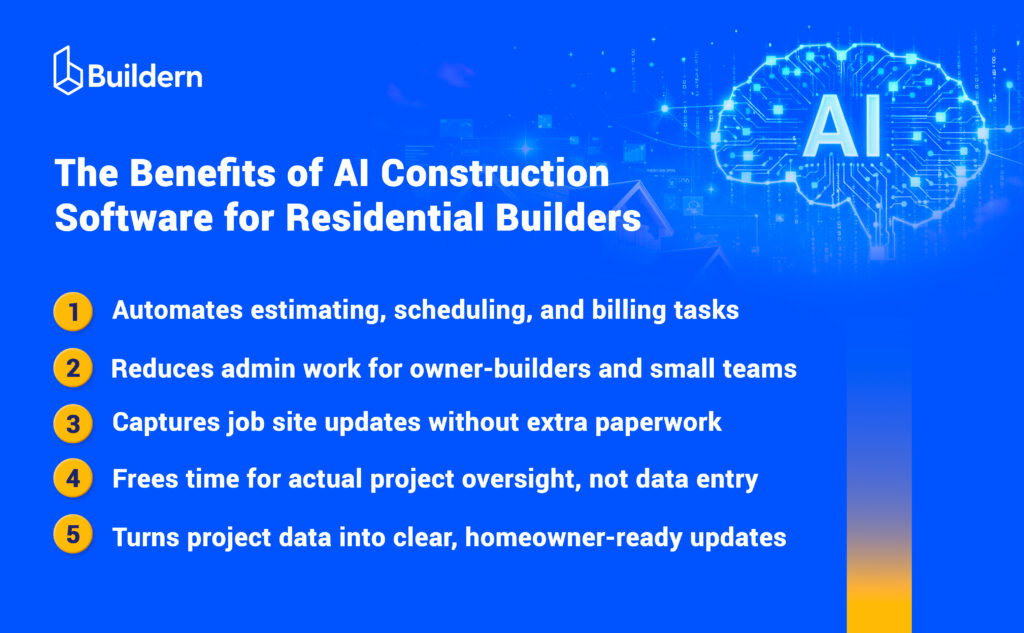
Most residential builders run lean by necessity. One person often wears multiple hats: estimating, scheduling, client communication, and cost tracking. There is rarely a dedicated analyst or admin layer to absorb inefficiencies.
That means small gaps compound quickly. A missed estimate detail, a delayed update, or an untracked change order lands on the same few people who are already stretched thin. One missed scope item can erase the margin on a smaller project. AI tools that reduce repetitive work or surface inconsistencies early can relieve pressure without adding headcount.
At the same time, residential teams do not have the bandwidth to babysit complex systems. Any AI-driven workflow has to fit into daily operations without demanding constant setup or oversight.
High Variability Across Projects
Residential projects repeat patterns, but no two jobs are identical. Custom homes, semi-custom builds, remodels, and additions all introduce different scopes, site conditions, and homeowner preferences.
This variability makes rigid systems hard to use.
- Static templates break quickly.
- Manual estimating relies heavily on memory and judgment, which becomes risky as volume increases.
AI performs best when it can recognize patterns across similar work while still allowing adjustments. In residential construction, that balance matters more than raw automation.
Client Communication as a Core Risk Area
Residential builders deal directly with end clients who are emotionally invested in the project. Homeowners want visibility into progress, costs, and changes, often in plain language rather than construction terms.
Miscommunication creates friction fast. Allowances, material selections, change orders, and draw timing are frequent pressure points where small misunderstandings escalate into disputes. Delayed updates turn into distrust, and unclear billing feels personal rather than procedural.
AI has a role here as support. When project data is structured correctly, AI can help turn raw information into clear updates, summaries, and explanations without builders rewriting the same messages every week.
Where AI Actually Fits in Residential Construction Workflows
AI earns its place in residential construction only when it supports the way projects already run. It does not redefine the builder’s role or replace judgment built through years of field experience. Its value comes from removing friction in estimating, scheduling, billing, and reporting, the areas where residential teams consistently lose time and focus as projects move from preconstruction into active work.
In practice, the strongest use cases appear where information already exists but is scattered across files, emails, spreadsheets, text messages, and people’s heads. Residential projects generate plenty of data, but it rarely lives in one place or moves cleanly from one phase to the next.
AI becomes useful when it connects that information into a single workflow and keeps it moving as the project evolves, without requiring builders to re-enter, reinterpret, or re-explain the same details at every stage.
This matters because residential work is fast, fragmented, and detail-heavy. Builders are constantly switching contexts, from estimating to client conversations to site coordination. When information breaks between systems, mistakes follow. AI fits best when it reduces those handoffs, keeps cost, schedule, and progress data aligned, and supports decisions instead of forcing extra administrative work.
1. AI-Assisted Estimating for Custom and Semi-Custom Homes
Residential estimating is rarely repeatable, even when homes share similar layouts or square footage. Revisions are part of the process, not the exception, as site conditions change and clients adjust scope after seeing the updated pricing.

AI supports estimating by organizing historical estimates, assemblies, and takeoff logic into a structured system that reflects how homes were actually built, not how they were originally planned. Instead of starting with a blank sheet, builders work from a baseline grounded in real project data. That baseline adjusts as inputs change, rather than forcing estimators to rebuild pricing manually with every revision.
This becomes especially valuable on projects where early estimates evolve through multiple design and selection rounds. Each change order, construction allowance adjustment, or material swap feeds back into the estimate instead of living in separate documents. The builder maintains control over pricing decisions while spending less time reconciling numbers. The result is fewer disconnects between what was estimated, what was sold, and what actually gets built.
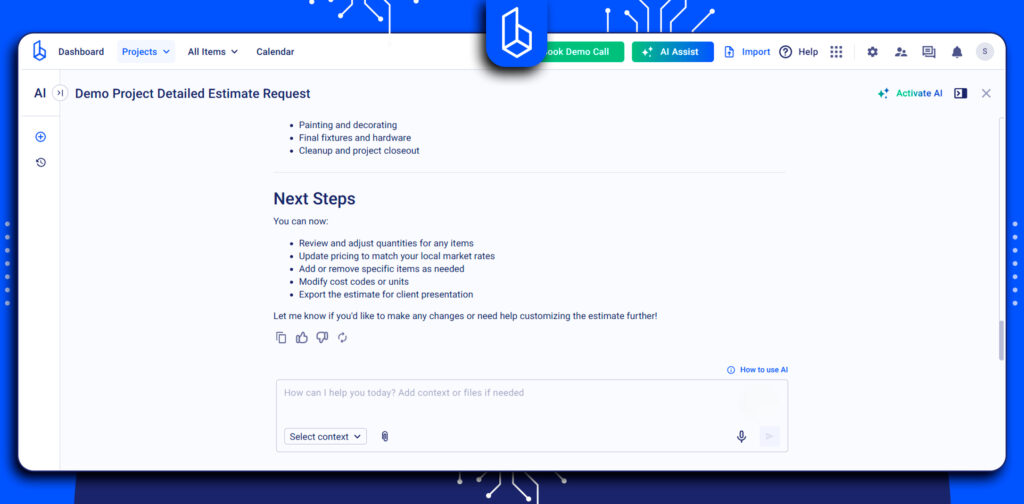
The value here is the speed and consistency when scope shifts late in preconstruction. Pricing stays aligned with reality, even when client decisions come in stages or change direction.
2. Location-Based Pricing for Residential Cost Volatility
Residential construction pricing reacts quickly to local conditions. Material availability, fuel costs, labor shortages, and regional supply issues can shift within weeks. Relying on static price lists or outdated construction cost catalogs increases exposure.
AI-driven pricing tools help by tying estimates to location-aware cost data and recent project history. When material or trade rates change, estimates reflect those movements across all affected line items. Builders are no longer dependent on memory or manual updates to catch cost drift.
This matters most in residential work, where construction margins are narrow and pricing errors compound quickly. Underpricing one home can erase profit from multiple completed jobs, especially when change orders arrive late or are only partially accounted for.
3. Turning Estimates Into Realistic Residential Schedules
Project planning often begins with optimistic timelines that assume perfect sequencing and uninterrupted trade availability. Once work starts, inspections shift, trades overlap, and client-driven changes disrupt flow.
AI helps by translating estimated data into task sequences based on how long similar work actually took on past projects. Instead of building schedules from generic templates, builders start with timelines informed by real performance. When scope changes, the schedule adjusts alongside budgets and quantities, reducing downstream conflicts.
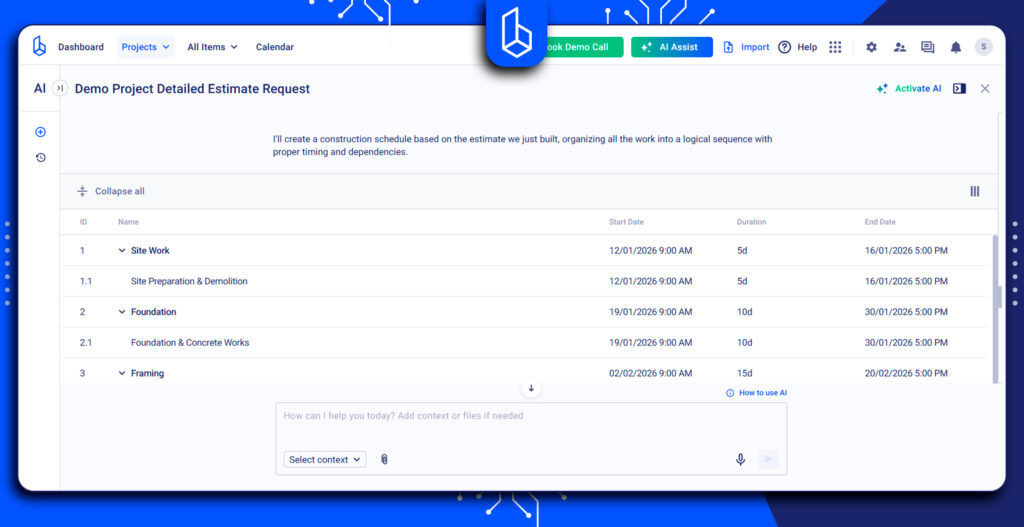
This results in fewer manual rebuilds, clearer task dependencies, and more predictable sequencing across trades. Builders spend less time adjusting timelines and more time managing progress on site.
4. AI-Powered Billing and Draw Management for Homeowners
Billing is one of the most sensitive points in residential construction. Homeowners expect transparency, while builders balance progress tracking, draw schedules, and cash flow.
AI-assisted billing connects completed work, approved changes, and budget line items into invoices that reflect actual site progress. Draw requests align with what has been completed rather than what someone reconstructs at the end of the month. When scope changes, billing updates follow automatically instead of being handled as exceptions.
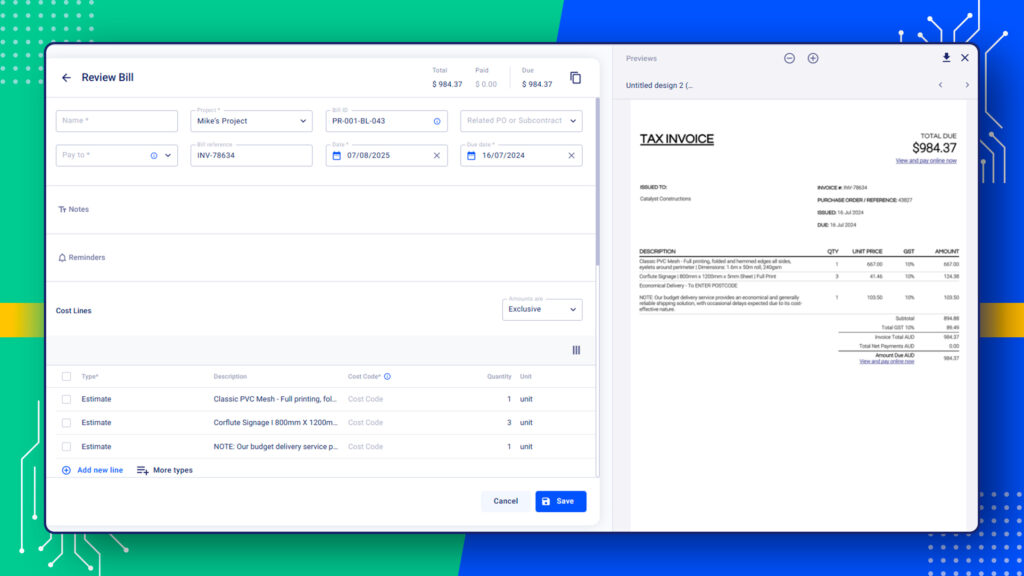
AI reduces disputes, speeds approvals, and stabilizes cash flow without adding administrative overhead, allowing you to maintain clearer financial control. At the same time, the homeowners receive documentation that accurately matches what they see on site.
5. Tracking Progress and Preparing Client Updates Automatically
Residential builders spend significant time explaining progress, often repeating the same information across emails, calls, and messages. That communication is necessary, but it pulls builders away from managing the work itself.
AI tools help convert site inputs such as photos, voice notes, and task updates into structured progress summaries. Instead of rewriting updates, builders review and send client-ready reports that reflect the current job status. Information flows from the site to the client without relying on end-of-day memory or manual formatting.
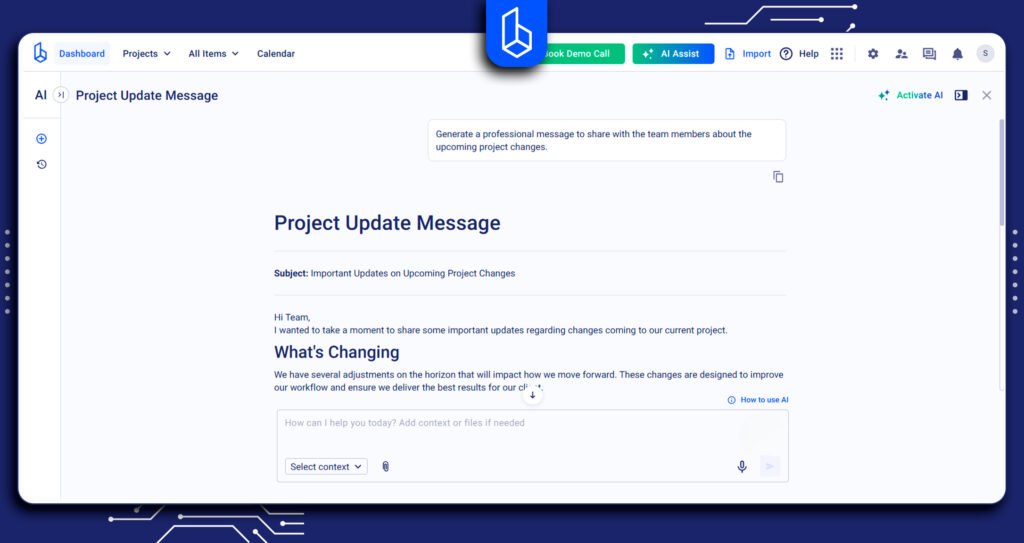
This keeps homeowners and construction teams informed, reduces misunderstandings, and preserves the builder’s time on site, where decisions and coordination matter most.
Across these workflows, AI fits best when it reinforces existing processes rather than replacing them. It works quietly in the background, keeping data connected and current, so residential builders can focus on execution instead of administration.
Cost vs Value: Is AI Construction Software Worth It for Residential Builders? | Evaluation Checklist
For residential builders, cost questions always come before feature questions. The budget is tighter than it looks on paper, and every new system has to justify itself quickly. The real comparison is not software price versus doing nothing. It is fragmented workflows versus a more connected way of running projects.
Before deciding whether AI construction software is worth the investment, it helps to pressure-test it against real residential workflows, not feature lists or demos.
Use the questions below as a practical filter.
- Does the estimate drive everything that follows? Can an estimate realistically flow into the schedule, budget tracking, change orders, and billing without rebuilding the same information multiple times?
- How quickly can it produce something usable? How long does it take to generate a first usable estimate and issue a first usable invoice using real project data, not sample files?
- Can it handle allowances and selections without workarounds? Are allowances, finish selections, and homeowner choices tracked clearly as they evolve, or do they require spreadsheets and manual notes outside the system?
- How does it manage change during construction? When scope changes mid-project, do the software update costs, timelines, and billing together, or does each piece have to be adjusted separately?
- Are homeowner-facing outputs actually client-ready? Do updates, invoices, and summaries make sense to homeowners without additional explanation or rewriting?
- What data does it rely on to stay accurate? Does the system improve as more projects are completed, and is it clear what information needs to be structured for the AI to remain reliable?
- Does it reduce admin work on active job sites? Can updates be captured quickly, including from the field, without pulling builders back into the office?
Why This Checklist Matters
Residential builders do not lose margin because software is expensive. They lose it when systems slow them down, duplicate work, or fail under real-world variability. A tool that answers these questions well usually earns its cost back quietly, through fewer errors, faster decisions, and cleaner communication.
Key Takeaways
After working through where AI fits, where it doesn’t, and how the cost-value balance actually plays out, a few points become clear.
AI construction software is not replacing builders, foremen, or project managers. Residential construction still depends on judgment, trade relationships, and experience on-site. No software changes that.
For residential construction, the real value of AI shows up in a narrower, more practical way:
- Speed: Estimates, schedules, billing, and updates move faster when they are connected instead of rebuilt from scratch on every project.
- Consistency: Similar homes and remodels stop being estimated and managed differently just because someone was tired, rushed, or working from memory.
- Reduced mental load: Fewer details live only in someone’s head. Fewer follow-ups depend on remembering to send an email or update a spreadsheet at the end of a long day.
When adopted thoughtfully, AI becomes another tool in the builder’s kit. It fits into the same category as digital estimating or project management software did years ago. At first, it feels unfamiliar. Over time, it becomes hard to imagine running jobs without it.
For residential builders under pressure from costs, timelines, and client expectations, the real question doesn’t refer to whether AI is impressive. Instead, ask yourself, “Does the work feel more controlled, predictable, and repeatable once the software is in place?”