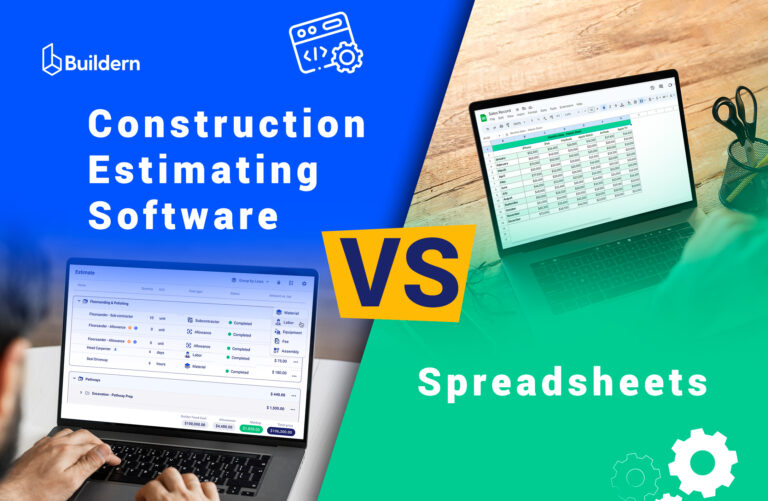
Residential Construction Estimating Software vs Spreadsheets: The Real Cost of Inaccuracy

I’ve yet to meet a residential builder who hasn’t lost money because of an estimate that looked solid during preconstruction but unraveled once work started. Cost estimation errors rarely show up as one big mistake. They appear as small misses that compound over time.
By the time the problem becomes visible, the margin is already gone. Therefore, I’ve decided to make sure you know how to make the most out of your financial planning with a dedicated residential construction estimating software solution.
Table of Contents
- The True Cost of Inaccurate Estimates in Residential Construction
- How Spreadsheets Became the Default Estimating Tool
- The Limits of Spreadsheets for Residential Estimating
- What Does Residential Construction Estimating Software Bring to The Table?
- Head-to-Head Comparison: Residential Construction Estimating Software vs Spreadsheets
- Cases When Spreadsheets Still Make Sense (And When They Don’t)

The True Cost of Inaccurate Estimates in Residential Construction
As a home builder, you know how estimating accuracy influences far more than the final budget. It significantly affects scheduling reliability, cash flow predictability, trade coordination, and client confidence. When estimates drift from reality, every downstream process absorbs the impact.
Direct Financial Losses
Underbidding is the most common and damaging outcome of inaccurate estimates. It usually begins with assumptions that feel reasonable in isolation.
- Labor hours are based on memory rather than data.
- Trade pricing reflects last season’s rates.
- Material allowances are rounded instead of calculated.
None of these decisions feels reckless when made, especially under time pressure.
The problem emerges when those assumptions collide with reality. Residential projects offer limited room to recover. There are no large construction contingencies or scope trade-offs. When framing costs exceed expectations or mechanical bids come in higher, the loss is absorbed directly by the builder.
Overbidding creates a quieter but equally harmful outcome. Projects are lost before construction even begins. A builder may assume the estimate was simply “too high,” without realizing it reflected inefficiencies or outdated pricing embedded in the spreadsheet.
Over time, missed bids shrink the pipeline and concentrate pressure on fewer active projects, which increases operational risk elsewhere.
Hidden and Long-Term Costs
The indirect costs of inaccurate estimates often outweigh the immediate losses. When estimates are wrong, schedules become unstable, while billing turns out to be more reactive instead of planned.
Administrative work increases, resulting in teams spending time explaining discrepancies to clients rather than managing work on-site. Every invoice turns into a discussion with a change order, feeling defensive instead of procedural.
Moreover, client trust begins to erode gradually. Homeowners may tolerate a few adjustments, but repeated changes undermine confidence. Once the trust is damaged, even accurate updates are questioned.
How Spreadsheets Became the Default Estimating Tool
Spreadsheets became the default for construction estimating because they were accessible, not because they were specifically designed for it. Excel was already installed, requiring no onboarding and allowing builders to shape it around their own thinking.
For small residential operations, spreadsheets felt efficient. Estimators often doubled as project managers. Much of the “system” lived in their heads. When something didn’t make sense, experience filled the gap.
As project volume increased, spreadsheets grew more complex with templates expanding and hidden formulas. Cost logic became layered and fragile. Eventually, only the person who built the spreadsheet fully understood how it worked.
At that point, estimating accuracy depended more on individual knowledge than on process. When that person was unavailable or rushed, the risk increased quietly.
The Limits of Spreadsheets for Residential Estimating
Spreadsheets don’t fail all at once. They fail incrementally, usually in ways that are hard to detect until costs surface on site.
What begins as a familiar, low-friction tool can slowly turn into a risk multiplier as project volume, scope detail, and client expectations increase.
1. Human Error and Manual Data Entry
Every spreadsheet-based estimate depends on manual input. Construction job costing with quantities, labor factors, waste allowances, and markups is created by hand. Each entry introduces a potential error point.
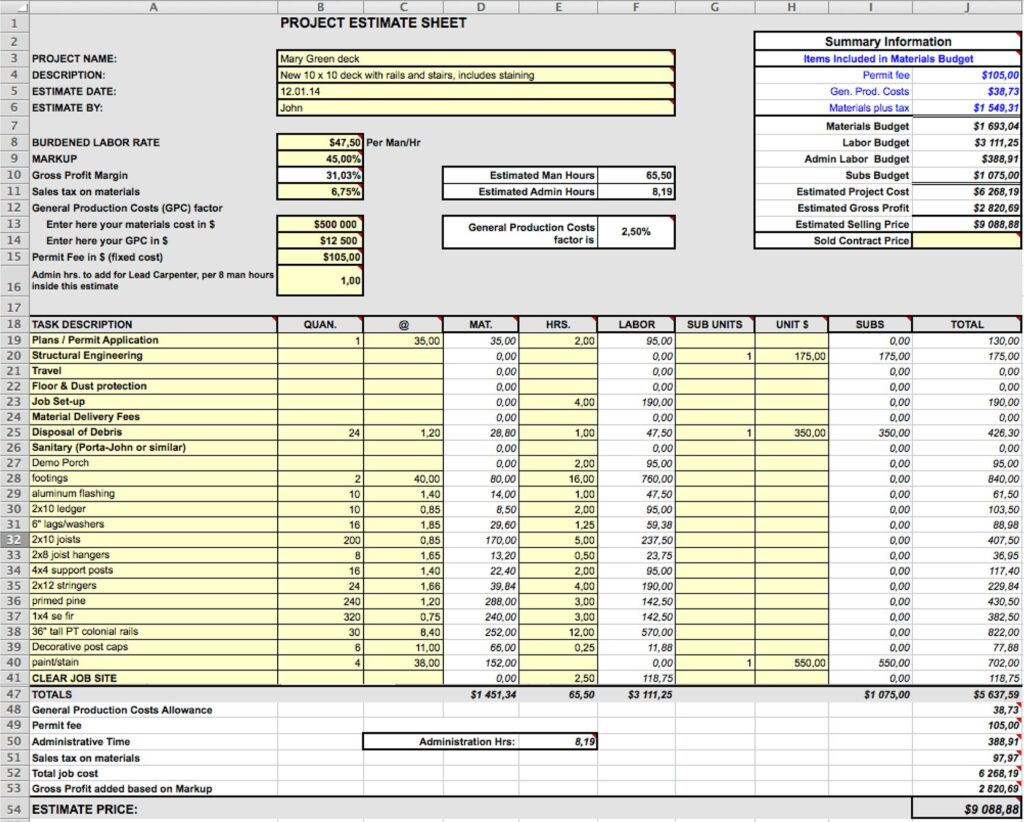
Revisions amplify that exposure. Scope changes often require updates across multiple tabs and linked formulas. One missed cell can skew totals without being obvious. Copying rows or sheets often breaks references silently. There is no system-level validation to flag inconsistencies or omissions.
Spreadsheets also lack construction context. They do not recognize missing scope, unrealistic production rates, or pricing that falls outside typical ranges. They assume every number is intentional and correct, even when it isn’t.
2. Lack of Real-Time Data
Residential pricing changes faster than most spreadsheets are updated.
Unlike residential construction estimating software, spreadsheets capture pricing at a single point in time. Unless construction cost catalogs are actively reviewed and updated for every estimate, numbers can easily drift away from current conditions. Many builders only see the gap after contracts are signed, or materials are ordered, when adjustments become difficult or impossible.
This disconnect creates a false sense of confidence during preconstruction, followed by margin pressure during execution.
3. Poor Scalability
As teams grow, spreadsheets become harder to manage. Multiple versions circulate through email or shared folders. Determining which file is current becomes a task in itself.
Standardization erodes. Each estimator has a different approach to the residential construction cost breakdown. Assumptions vary from project to project, while comparing estimates across jobs becomes time-consuming and unreliable. Forecasting future workload and profitability loses accuracy because the data is inconsistent.
4. No Built-In Validation or Risk Controls
Spreadsheets provide no warnings when something is off. They don’t flag missing scope, duplicated costs, unrealistic allowances, or conflicting assumptions. There is no audit trail to show what changed, when, or why.
Risk remains invisible until construction exposes it through change orders, delays, or budget overruns. By then, the opportunity to correct the estimate has passed, and the cost is absorbed in time, margin, or client trust.
These limitations don’t make spreadsheets unusable. They make them fragile, especially in residential construction, where small errors compound quickly across multiple projects.
What Does Residential Construction Estimating Software Bring to The Table?
Estimating software supports this by adding structure where spreadsheets rely on memory and manual discipline.
Benefit #1: Automation and Accuracy
Modern estimating tools integrate with construction takeoff software, automating and connecting them directly to cost assemblies that reflect how homes are actually built, not how they were originally sketched. Scope stays intact across revisions. When quantities change, dependent costs update automatically instead of being recalculated line by line.
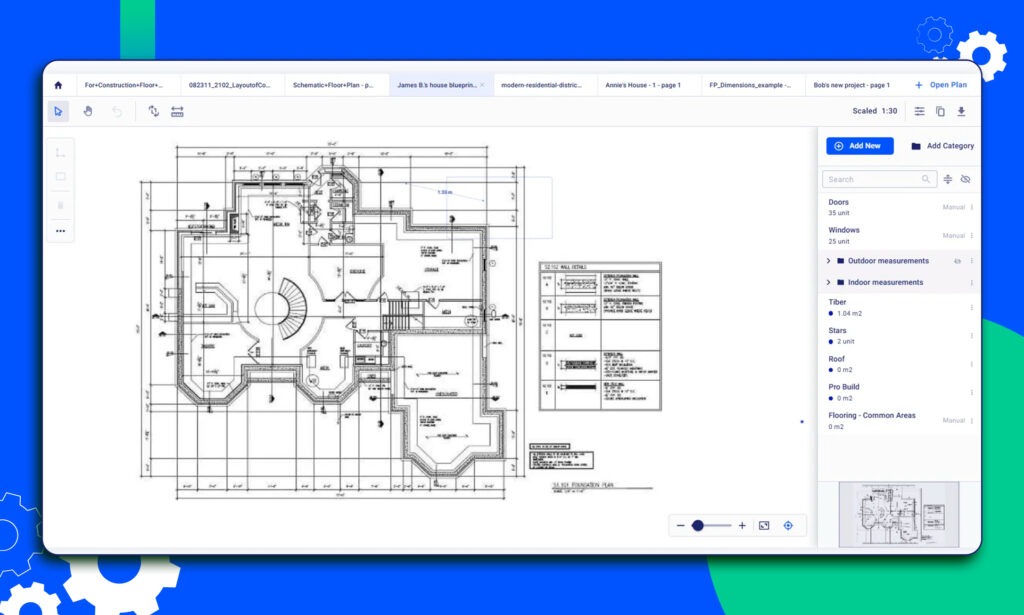
Formulas are protected, which prevents accidental overrides. Assemblies stay consistent from project to project, even when multiple estimators get involved. This allows teams to standardize assumptions around labor, waste, and overhead without forcing every estimate into the same rigid template.
As a result, estimators spend less time checking math and more time reviewing scope, assumptions, and constructability.
Benefit #2: Real-Time Pricing and Cost Control
Residential construction estimating software connects pricing to current inputs where available. You can apply labor rates, overhead allocations, and regional adjustments instead of re-entering data on every job.
AI-assisted estimating adds another layer by referencing historical project data and location-based pricing patterns. Instead of relying on last year’s numbers or memory, estimates reflect how similar residential projects were priced and executed recently.

This matters in markets where material and labor costs shift faster than contracts.
💡Check our extended guide to learn more about the benefits and other use cases of AI construction software below:
Benefit #3: Collaboration and Version Control
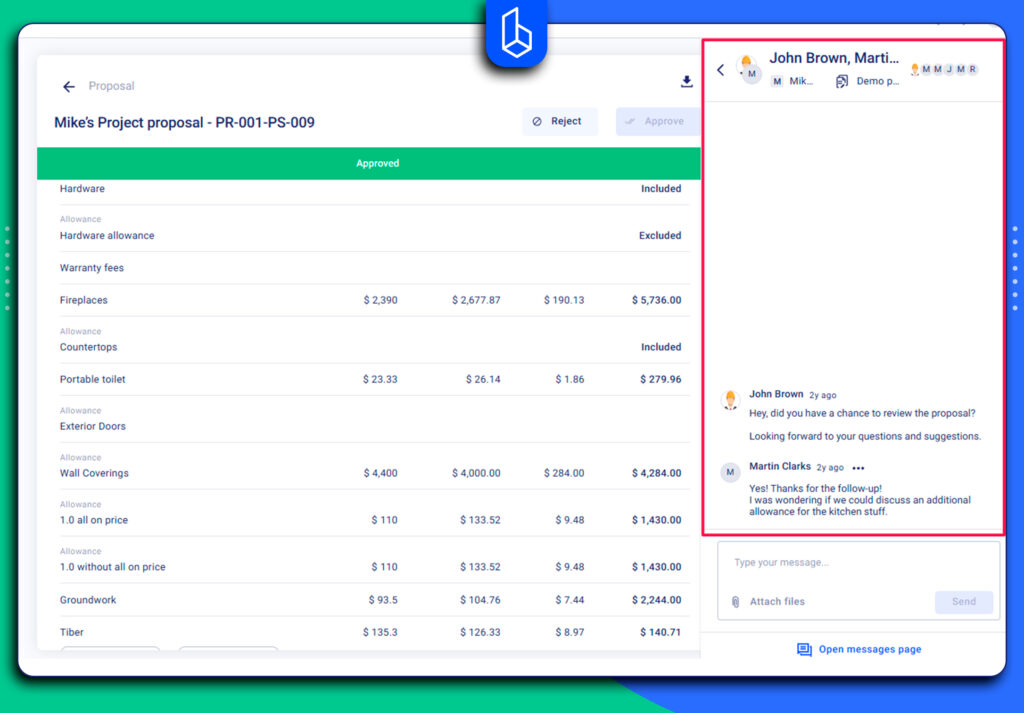
Cloud-based estimating systems keep teams aligned. Everyone works from the same version of the estimate. You can adjust permissions by limiting who can make changes.
When clients request adjustments through a dedicated construction client portal, your estimators revise instead of rebuilding the numbers from scratch. As a result, you get reduced turnaround time and preserve consistency across versions. Over multiple projects, this kind of efficiency compounds, especially for residential builders managing several jobs at once with lean teams.
Head-to-Head Comparison: Residential Construction Estimating Software vs Spreadsheets
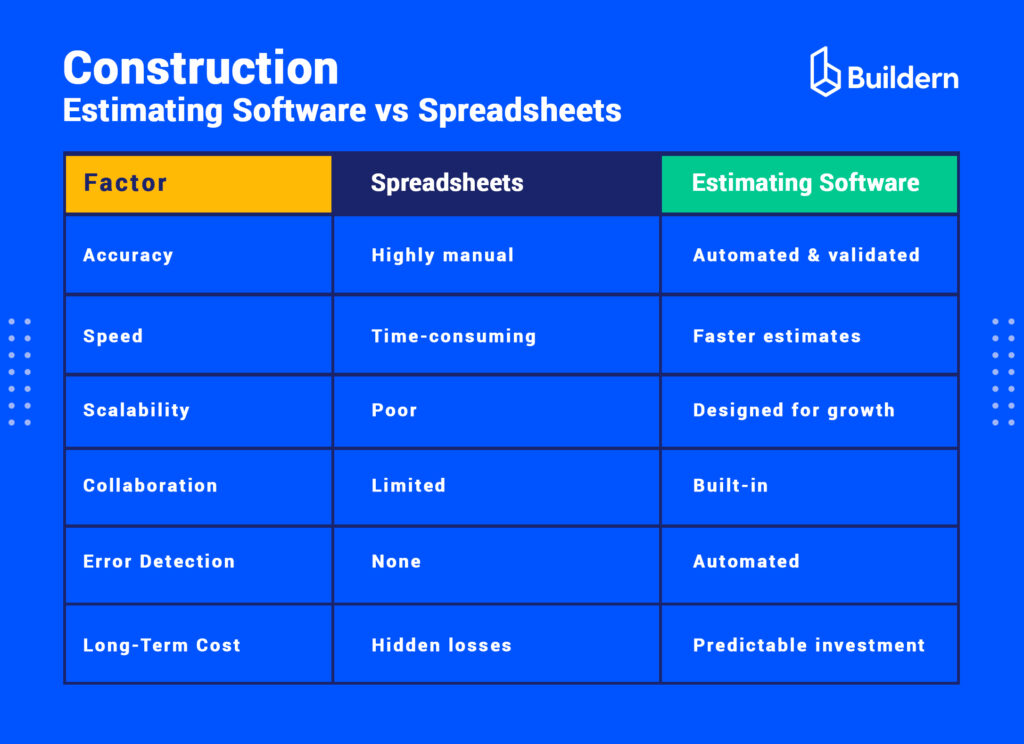
Spreadsheets continue to play a significant role in residential estimating, particularly for small jobs or early-stage planning. They appear to be familiar, flexible, and inexpensive on the surface. But they rely heavily on manual input, personal assumptions, and individual discipline. As projects scale, that manual nature shows its limits through slower turnaround, higher error risk, and difficulty maintaining consistency across estimates.
Residential construction estimating software is built to remove those pressure points. Automation, validation, and structured workflows reduce repetitive work and help teams produce faster, more reliable estimates. Collaboration is native rather than improvised, and growth does not require rebuilding the entire system from scratch.
The described differences show up in daily operations, not marketing claims.
Cases When Spreadsheets Still Make Sense (And When They Don’t)
Spreadsheets are not inherently wrong. They became the default estimating tool in residential construction for a reason.
In limited situations, they can still serve a purpose without creating unnecessary risk. The issue is not whether spreadsheets can be used, but whether they still fit the scale and complexity of the work being done.
Acceptable Use Cases
✅ Spreadsheets can work for very small, one-off projects where the scope is narrow and unlikely to change. Simple renovations, minor additions, or repeatable jobs with minimal variables can often be estimated adequately with a basic spreadsheet, especially when the same person handles estimating, purchasing, and project oversight.
✅ They are also commonly used for early feasibility checks. At this stage, the goal is not precision but direction. Rough cost ranges help determine whether a project is viable before plans are finalized or detailed takeoffs are prepared. In this context, spreadsheets function as a planning tool rather than a contractual document.
✅ Solo builders or very small teams managing a limited number of similar projects per year may also find spreadsheets sufficient. When volume is low, scope is familiar, and the same person controls every input, risk remains contained. Errors are easier to spot, and corrections can be made quickly without affecting multiple stakeholders.
In these scenarios, spreadsheets remain manageable because complexity is low and exposure is limited.
Red Flags It’s Time to Switch
Problems begin when you expect spreadsheets to support growth, variation, and collaboration.
🚩 Frequent revisions are often the first warning sign. When scope changes require manual updates across multiple tabs, formulas, or versions, the likelihood of missed items increases. Each revision adds friction and time, and accuracy starts to erode quietly.
🚩 Estimates taking longer to prepare are another signal. As projects become more detailed, spreadsheets demand more manual work. Builders spend increasing time checking formulas, reconciling numbers, and rebuilding estimates instead of refining scope or managing preconstruction.
🚩 Shrinking margins despite steady work are a critical red flag. When revenue holds but profit declines, the cause is often hidden in estimating gaps: missed line items, outdated pricing, or assumptions that no longer reflect reality.
🚩 Growing teams amplify these issues. Multiple people editing or referencing the same spreadsheet creates version control problems and inconsistent assumptions. What one person updates, another may overlook. Accountability becomes unclear.
These signs indicate that the estimating process is no longer supporting the business. At that point, the risk is no longer theoretical. It shows up in lost time, stressed relationships, and profit that disappears project by project.
Final Verdict
As a residential builder, I recommend you take a hard look at how your estimates are built and how often they hold up once construction begins. The most useful exercise is reviewing the last project that ran over budget and tracing the cause back to the estimate itself.
Was it labor that slipped, materials that moved faster than expected, scope that wasn’t fully captured, or revisions that slowly chipped away at the margin?
In most cases, the problem wasn’t a single bad decision, but a process that allowed small inaccuracies to accumulate without being flagged early.
Residential work still depends on knowing trades, sequencing, and how homes actually get built. What residential construction estimating software changes is the reliability of the process around that experience. It reduces preventable errors, keeps the scope intact through revisions, and maintains consistency when multiple people touch the same estimate.