



Reviewed in June 2026
In construction, projects may fail not because of bad materials or unskilled labor, but because of poor project management. That’s exactly what a construction project manager is hired to do: overcome the root causes of poor management.
So what is a construction project manager? At the most fundamental level, it’s the person who owns the outcome. They own the schedule, protect the budget, align the teams, and keep the client’s vision intact from groundbreaking to handover.
In this article, we will go through construction project managers, aiming to explore the typical qualifications, skills, and responsibilities of the role.
Table of Contents
- Who Is a Construction Project Manager and the Scope of Work
- Construction Project Managers’ Responsibilities
- Qualifications of Construction Project Managers
- Required Skills
- Project Managers vs Construction Managers
- What Challenges Do Construction Project Managers Face?
- How Construction Software Helps Project Managers
- Conclusion

Who Is a Construction Project Manager and the Scope of Work
Construction project managers are in charge of almost every aspect of construction processes, including planning, execution, and successfully wrapping up projects. They are responsible for identifying project goals, creating a project plan, managing resources, and monitoring progress throughout the project.
Generally, almost every company needs a manager to oversee one or more aspects of the project. But perhaps not all industries rely so heavily on managers as in construction. Project managers here serve as the bridge between the owners and the general contractors. They also collaborate with various stakeholders, making sure everything goes according to the plan.
Similarly, they need to communicate with the owners to keep all deliverables in line with their expectations.
Construction Project Managers’ Responsibilities
Construction project managers handle various segments of the projects, including:
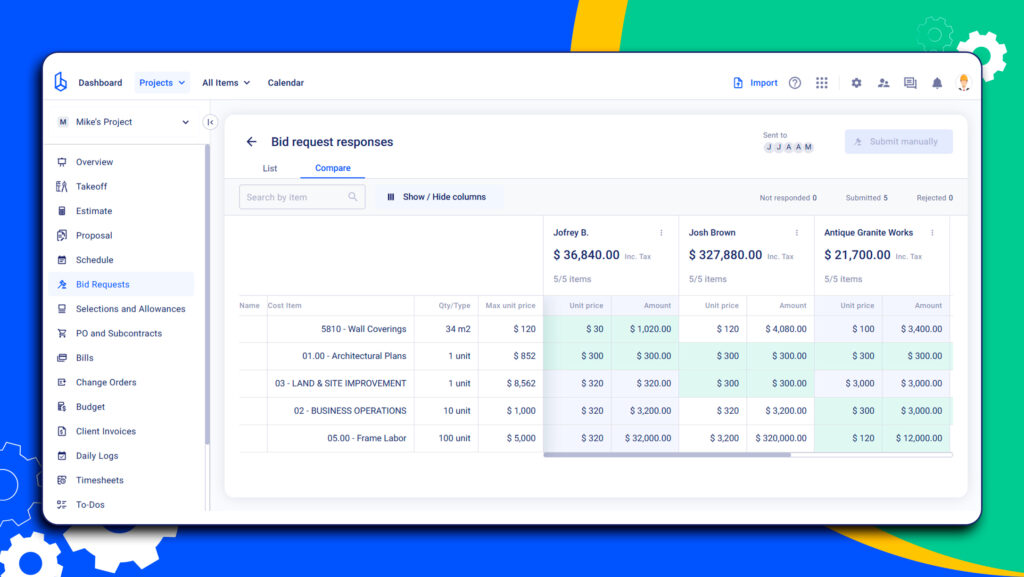
Creating and Managing Bid Requests
Construction PMs are involved in bidding, which implies creating and managing bid requests, doing bid leveling, and communicating with subcontractors and vendors. In most cases, they participate in the construction project planning from the very beginning, although their involvement may vary from one project to another.
Recommended reading:
Construction project managers may be involved in the process of assessing and reviewing bids as well as helping to prepare documentation for the bidding process.
This will help to maintain adherence to the project’s scope and timelines. Involving PMs from the beginning benefits the project since it allows them to understand and be informed about all the facets of the construction project.
Managing Project Schedule
After the bids are approved, they add the approved bids to the estimate and start planning. From that point on, construction project managers build a project schedule and guide the team to finish the work within designated time frames.
In the scope of scheduling, typical duties include ensuring that all the necessary materials and equipment arrive at the right time, as well as coordinating task dependencies.
Construction PMs are also responsible for updating the schedule from time to time, conducting schedule risk analysis, and implementing plans in case of unexpected delays.
Budgeting
One of the key responsibilities of a construction project manager is to estimate the budget precisely, which requires knowledge and strong problem-solving abilities. Construction project managers must manage the cash flow by scheduling all the necessary payments and ensuring projects stay within their budget.
Recommended reading:
They are also responsible for approving change orders, negotiating with vendors, and ensuring the financial stability of the projects.
Supervising the Jobsite
While construction project managers do not visit construction job sites daily, they do so regularly. They are constantly updated about everything through construction superintendents’ daily reports from the jobsite.
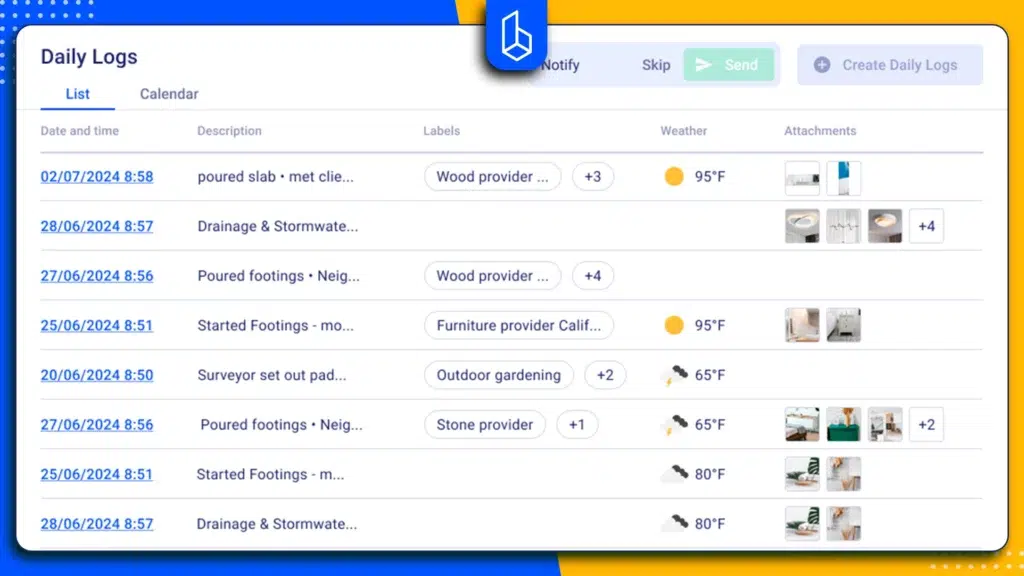
Visiting jobsites regularly is essential since it allows construction project managers to get the full picture of the process and progress.
This also allows them to identify if there are any issues or discrepancies, as well as if there is something the subcontractors or site staff need to work on to the best of their abilities.
Reporting and Communication Across Construction Teams
Communication is arguably the most underrated responsibility of a construction project manager. When it breaks down, it causes the most damage.
PMs are at the center of a web of stakeholders: owners, architects, engineers, superintendents, subcontractors, and vendors. Each of these parties has different priorities and different levels of involvement in the day-to-day build.
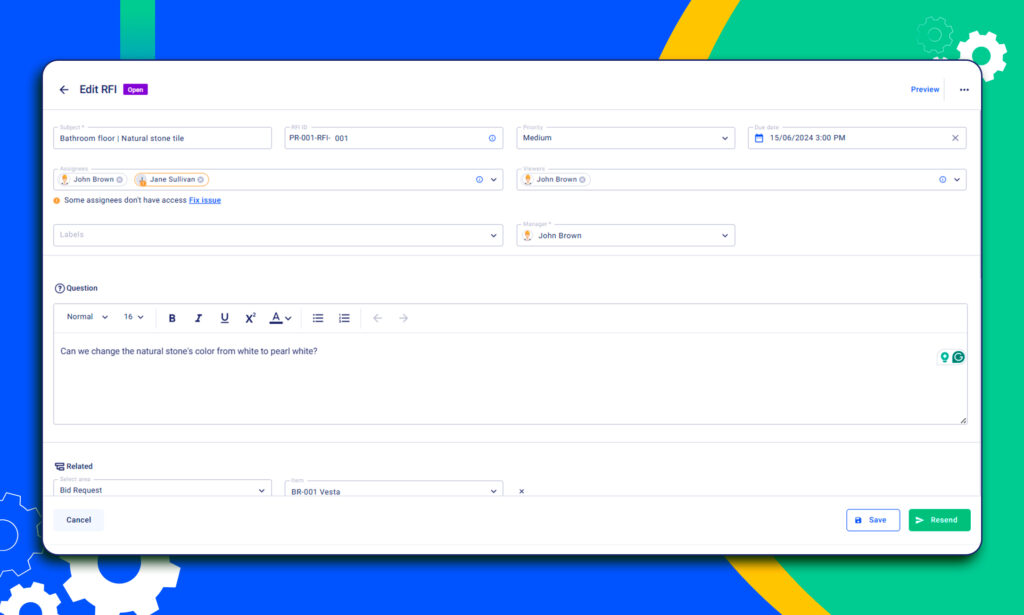
The PM’s job is to make sure the right information reaches the right people at the right time both in the office and on the jobsite.
Good communication means knowing how to communicate depending on the audience. For example, for the design and engineering team, there are detailed written RFIs and submittals. For general contractors, there is constant messaging and clear executive summaries for clients who want the bottom line without the technical detail.
Qualifications of Construction Project Managers
The construction industry continues to grow rapidly, and so does the demand for various professions within the industry, including the demand for project managers in construction.
Required qualifications for the position may vary from one company to another. However, generally, companies require an educational background and experience in the construction industry. Let’s explore a typical path one needs to take to become a construction project manager.
Education
Given the importance of the position in the construction industry, most companies require a bachelor’s degree in Construction Management, Building Construction, Construction Technology Architecture, Civil Engineering, or any other construction-related program.
While it is not mandatory, people pursue master’s degrees as well, which may increase their chances of success in the industry.
Certifications
Many candidates take certificate courses to stand out among many and boost their chances of landing the job. Several professional certifications are widely recognized in the industry. They include the Project Management Professional (PMP) or Certified Construction Manager (CCM), with each targeting a different experience level.
Training and Work Experience
One of the key things companies typically require is a strong background in construction management. Since hands-on experience is the key to managing large projects, many employers are looking to hire candidates who have at least 4-6 years of experience.
While a bachelor’s degree in a construction-related field is required and can be beneficial, practical skills and knowledge are often more important.

Required Skills
Construction PMs oversee the entire project, and there are several hard and soft skills they should possess.
Hard Skills
- Proficiency in construction software: The ability to work with construction project management software is a necessary hard skill PMs should possess, which will make things easier for them.
- Negotiations: PMs should have the ability to negotiate if required. One of the main responsibilities of construction project managers is to oversee the project while strongly adhering to the designated budgets.
- Document Management: Construction PMs should have the ability to manage all the documentation and facilitate correctly filled and safely stored documents.
- Risk Management: This is an essential hard skill allowing project managers in construction to identify, assess, and mitigate risks that may impact a project in its entirety. PMs should have the ability to anticipate challenges that may arise throughout the project. This includes but is not limited to safety issues, budget overruns, or legal issues.
Soft Skills
- Leadership: Skilled construction PMs must possess excellent leadership skills. Since they collaborate with diverse teams, they must be capable of leading and motivating those teams to work to the best of their abilities.
- Communication: PMs must acquire strong communication skills. They are the ones who generally pass on important information to various stakeholders. Having good communication skills will allow you to transmit important information in a way that is easy to comprehend.
- Team Management: There is a wide variety of teams working on construction projects. These include the upper management team, the middle management team, the hired staff, and the contractors. Project managers in construction stand out among many other professions since they are the ones who collaborate with almost every team and its members. Thus, a team management skill is a necessity for construction project managers.
- Problem-Solving: In construction projects, various sorts of issues may arise unexpectedly. Thus, managing and handling those issues or changes on time makes all the difference. PMs should have strong problem-solving abilities to be able to keep everything under control.
Project Managers vs Construction Managers
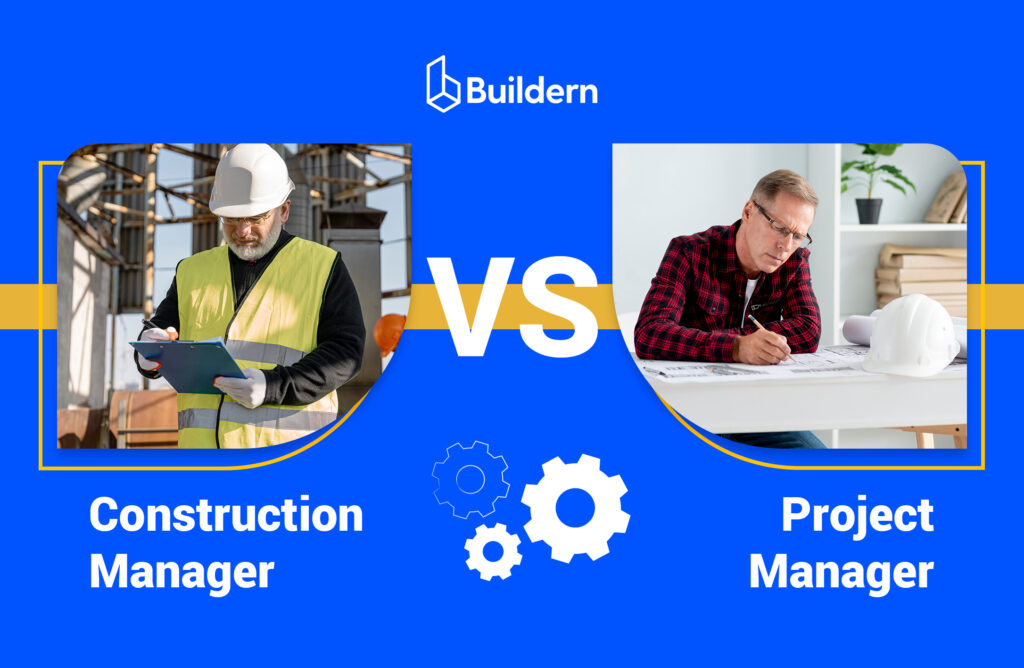
To understand “what is a construction project manager“, it helps to compare the role against construction managers, as these two titles are often confused. This is because when the projects are small and they have limited resources, employers tend to hire only one of those professionals.
However, these two professions do not always go hand in hand. While they share some similarities, they require different expertise and are responsible for overseeing different aspects of the project.
On one side, the project manager oversees the construction project in its entirety. They are responsible for various aspects of the project, from planning to execution, ensuring everything meets the requirements and expectations of the client.
On the other hand, construction managers are in charge of overseeing a specific aspect of the project, namely, the construction phase. Since they have expertise in building trades, their main responsibilities lie in subcontractor management, ensuring that on-site activities are handled properly and everything stays within budget.
💡Recommended reading:
What Challenges Do Construction Project Managers Face?
With big responsibilities come bigger challenges, and this, unfortunately, does not bypass construction PMs.
Working with a wide variety of teams and managing multiple things is not an easy task. Construction project managers often face both expected and unexpected challenges while trying to deliver a project successfully.
Let’s dive deep and explore the typical challenges construction PMs face throughout various stages of the project life cycle.
Managing Multiple Tasks Simultaneously
When there are multiple tasks ongoing, it becomes very difficult to handle them simultaneously. In such a situation, construction PMs need to prioritize certain tasks, which is important not only in terms of budget management but also for project scheduling.
Working with construction scheduling software can make all the difference. If there is a list view and a calendar view, you will have the chance to view your tasks in a clearly defined order, as well as the task’s start dates, finish dates, and task overlaps.
Unrealistic Managing Unrealistic Client Expectations
Managing clients’ expectations is a top priority for project managers. Since the construction industry is highly competitive and constantly changing, clients expect quicker turnarounds. It may affect the outcome.
In such cases, when clients don’t get updates about the processes, their expectations are not met. If there are tools for daily reports, you can keep your client in the loop by offering real-time updates from the construction site. You can attach files, create timesheets, or even update weather conditions, ensuring that they are informed about everything and that their expectations are fully met.
Handling Unexpected Changes and On-Site Issues
In construction projects, very often, changes are unavoidable. However, addressing those changes on time can make all the difference. While this may pose a challenge for construction PMs, addressing those issues and allocating additional resources or making minor changes in the schedule can help them resolve those issues easily.
To mitigate the risks of unexpected changes, many companies utilize construction software and its change order tool to have all changes documented and calculated.
Keeping Up with Industry Changes and New Technology
The construction industry is constantly evolving. New regulations or technologies are being implemented regularly. This poses a huge challenge for construction project managers as they constantly need to be informed about new changes to keep up with the trends.
In this environment, project managers have to integrate automated tools to avoid manual tasks and maintain accuracy.
Poorly Defined, Unclear Project Scope and Objectives
Very often, construction PMs struggle with their duties. This is because there are poorly defined objectives, which may result in additional rework or project delays.
While the requirements may be different from one project to another, each one may have its specificities that serve as the basis for the work to be completed. This can be easily avoided by using professional construction management software.
How Construction Software Helps Project Managers
If we look at a working day of a construction project manager, it’s clear that no two days look exactly the same.
The scope of the project and the number of active sites differ. Besides, on a large commercial project, a PM might be managing two or three active sites simultaneously. On a custom home build, site visits may be less frequent but client communication more intense.
What stays consistent is that the PM makes many decisions during the day, and construction management software helps the decisions happen proactively.
1. Starting a Day with a Dashboard
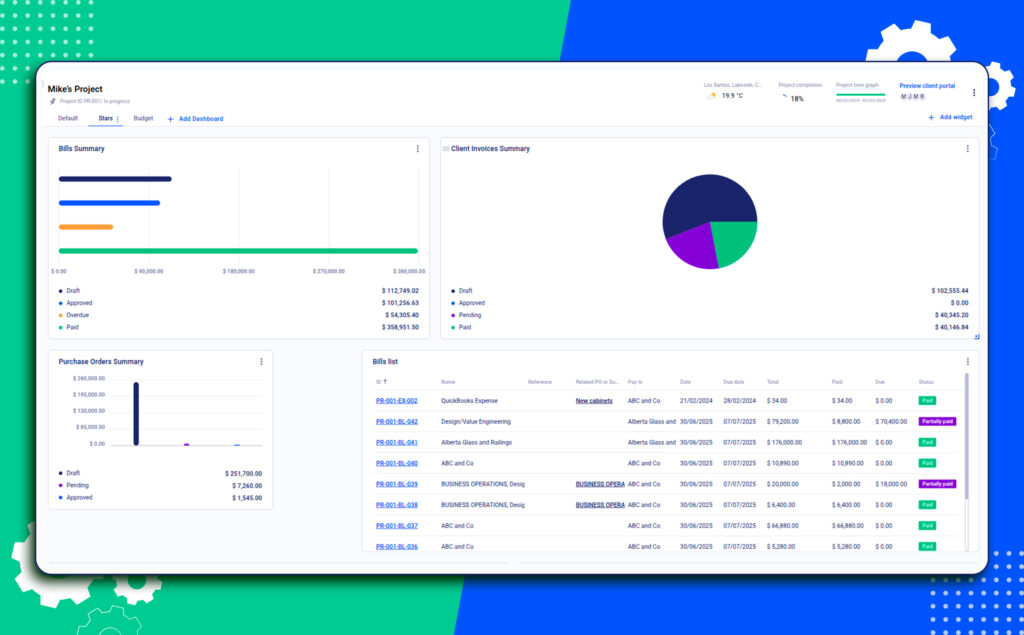
Before the first call comes in, the PM opens Buildern and gets the full project picture in one view. Budget burn, schedule status, open RFIs, pending submittals, unresolved change orders.
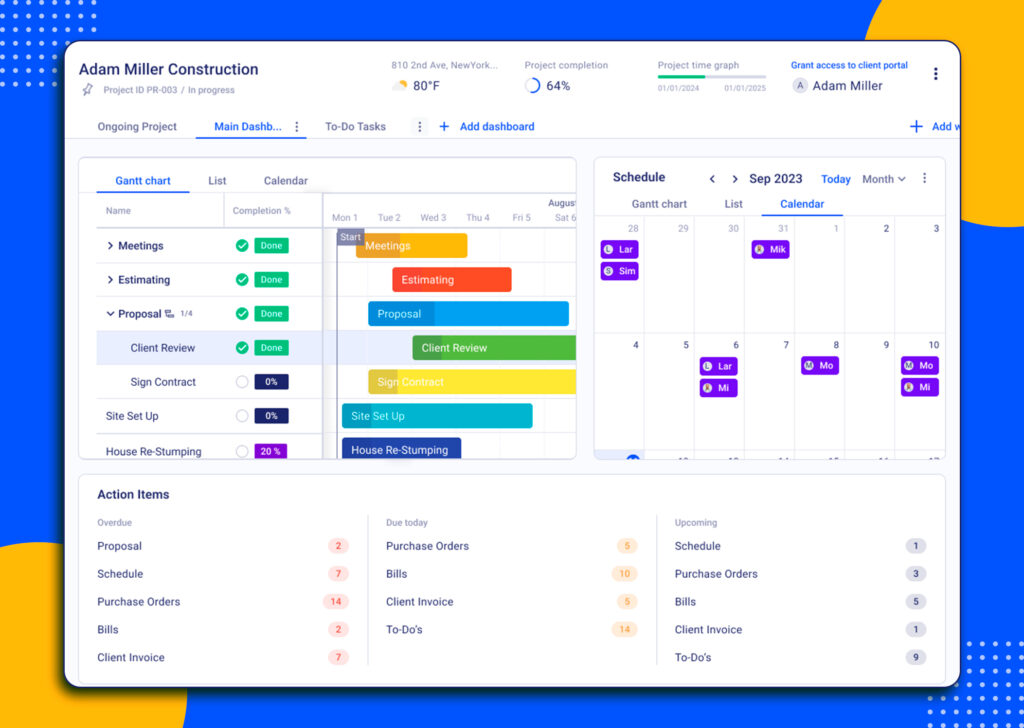
Everything that needs attention is immediately visible, even before a call to superintendent or digging through email threads. This sets the priority order for the day.
2. Working Through RFIs and Submittals
Next, the PM moves to open RFIs and submittals. Subcontractors need answers before they can move forward, and delays here can create schedule problems.
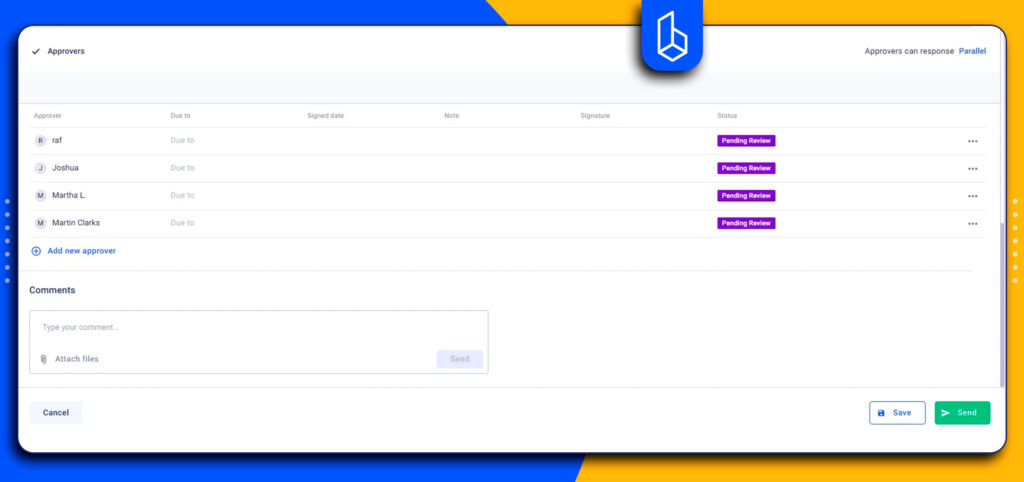
In Buildern, all RFIs and submittals are tracked in one placem, so the PM can review, respond, and approve them without switching tools.
3. Change Orders
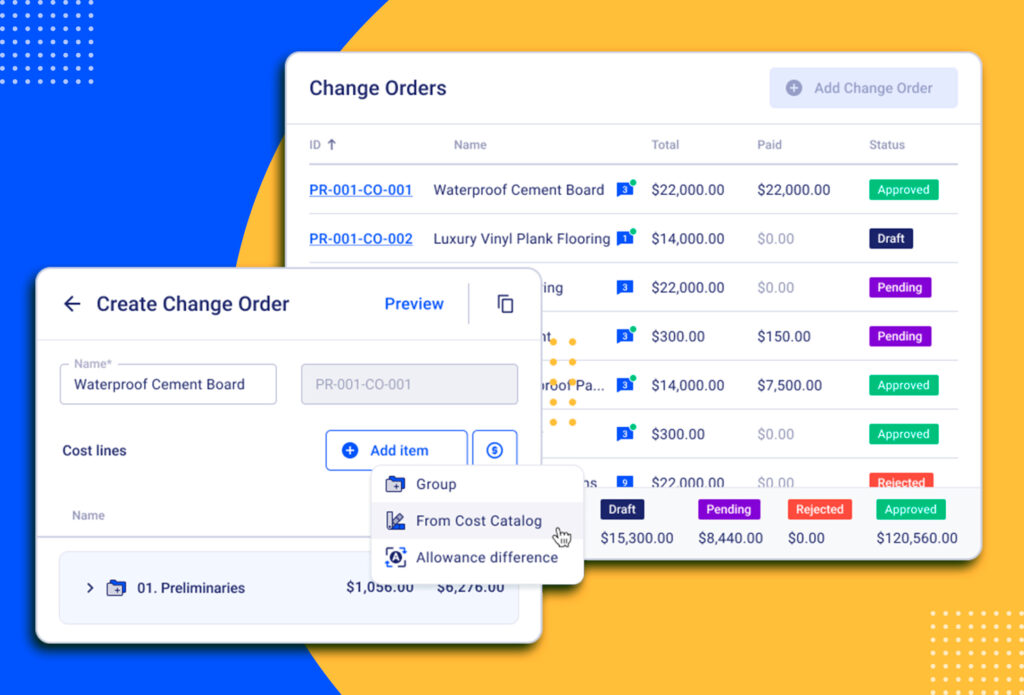
Change orders in particular require tight documentation: what changed, why, what it costs, who approved it. In the construction management software, change orders are logged, calculated, and tied directly to the project budget.
The financial impact is visible the moment it’s created, not discovered during final accounting.
Recommended reading:
4. Communication
Coordinating several teams and being in touch with them is one of the challenges that the software solves. In Buildern, commenting is built directly into each task, RFI, and change order, so there’s no need to switch to email or a separate messaging tool.
The conversation stays attached to the item it’s about, which means context is never lost.

5. Document Management
Across all of the above is a constant need for documentation. All project documents can be stored in one place and shared with project stakeholders.
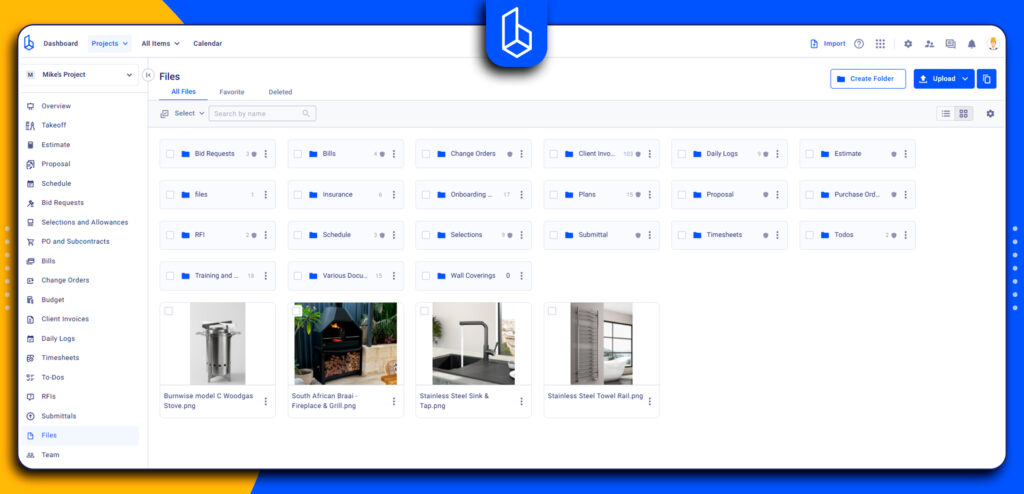
For example, when a subcontractor needs the latest drawing revision, the PM shares it directly from the platform. When a dispute arises regarding who had access to the file, the full document history is there.
Conclusion
Construction project managers are the force that drives every project forward at all stages, starting from the first bid request to the final walkthrough.
They navigate competing priorities, tight budgets, shifting timelines, and complex stakeholder relationships, often simultaneously. It’s one of the most demanding roles in the industry, and one of the most complex ones.
What separates good construction PMs from great ones isn’t merely technical knowledge. This position requires the ability to anticipate problems before they may cause budget overruns and disrupt schedules. At the same time, a skillful PM has to be good at communicating to make all stakeholders aligned.

What Does a Construction Project Manager Do?
A construction project manager oversees every phase of a construction project, from planning and budgeting to scheduling, subcontractor coordination, and client communication. They are responsible for keeping the project on time and within budget.
How to Become a Construction Project Manager?
Most construction PMs follow a path that combines a bachelor’s degree in construction management, civil engineering, or a related field with several years of hands-on industry experience. Earning a professional certification, such as the CCM or PMP, can significantly strengthen the candidacy, especially for large projects.
What Software Do Construction Project Managers Use?
The best option is to have end-to-end construction project management software. It’s a specialized software that includes project management, financial workflow, and communication in one tool. In this case, timelines, costs, and budgets are synced, and there is no need to juggle separate apps for each function.
Why Hire a Construction Project Manager?
A construction project manager is the single point of accountability for the entire project. They keep the build on schedule, protect your budget, and manage all subcontractors and stakeholders. For any project of meaningful size, the PM’s fee typically pays for itself.
How Much Does a Construction Project Manager Make?
Salaries vary by location and experience. In the US, the median starts from $106,980 per year, according to the Bureau of Labor Statistics. However, senior roles in major urban markets can push significantly higher across all regions.