Mastering Customer Communication Management in Construction: A Strategic Guide


Contractors often hear that “communication is key,” but they fully realize the importance when poor customer communication management costs money.
There’s nothing more damaging to client trust than saying “everything is fine” for weeks, only to admit later that the project is behind schedule or over budget.
In many projects, you can feel how frustration turns into disputes, not because of work, but the silence around it. Besides, communication is no longer a soft skill, and there are tools to manage it effectively.
In my blog article, I will show how customer communication management works in construction.
Table of Contents
- What Is Customer Communication Management in the Construction Industry?
- Poor Customer Communication Management Examples
- Why Traditional Communication Methods Fail
- How to Automate Customer Communication Management?
- How Communication Changes Through Project Phases
- Traditional vs. Automated: Why Automation Wins?
What Is Customer Communication Management in the Construction Industry?
It is a structured system for managing all interactions, updates, documents, and approvals between a contractor and a client throughout a project lifecycle.
Thus, it’s about creating a structured, transparent flow of information instead of sending occasional emails and exchanging calls. Just like in any other industry, building proactive communication from day one is a smart approach. Act from day one instead of putting out fires when it’s too late.
Overall, the surveys show construction customers cite poor communication as their top complaint. However, effective communication isn’t the same for all. Different clients have different priorities, expectations, and tolerances for updates.
Besides, not all customers are the same, and frequency and channels of communication during a remodeling project and a commercial build may vary.
Communication Needs Based on Construction Customer Types
To master customer communication management, you must first categorize who you are talking to. Each group has different needs, an approach to details, and a different preferred “frequency” of updates.
Let’s consider the examples of clients’ primary concerns based on the project type.
Remodeling Customers
Remodeling project clients are usually homeowners living on-site during renovations. Their pain point is that they live in a construction zone. Thus, they need frequent communication with a remodeler, and small touchpoints keep the relationship smooth while they live in the mess.
Custom Home Clients
For these clients, this project is likely their largest life investment, and they need emotional “buy-in.” They fear the project will end up costing much more than they expected. Weekly visual updates and real-time selection approvals are the best tactics for home builders.
Recommended reading:
Commercial Clients
Small business owners or franchise managers, for example, have strict deadlines. Every day is important for them as their business cannot open. Commercial clients need strict “look-ahead” schedules and status updates.
Poor Customer Communication Management Examples (Real Cases)
It’s clear that in real life, poor communication with a customer can lead to huge problems. Let’s consider several very common real-life scenarios and the problems they cause.
#1 Schedule Delays
A subcontractor falls behind on framing due to material delays. The project manager is aware but doesn’t notify the client right away.
Weeks later, the client asks about the timeline and discovers the completion date has shifted. The schedule slip itself is reasonable, but the lack of communication impacts all subsequent tasks and delays the project further.
Read more about project delays:
#2 Budget Overruns
During a remodeling project, a homeowner requests upgraded cabinetry. The contractor begins work without providing a clear cost estimate or getting the client’s formal approval. When the client receives the invoice at the end of the month, they are shocked by the higher cost.

#3 Rework Caused by Poorly Communicated Expectations
A commercial contractor identifies a way to adjust the layout of a retail space to improve customer flow. The contractor’s team implements the change without notifying the client, assuming it’s a minor improvement.
When the client visits the site, they insist on reverting to the original layout specified in the lease agreement. The result is costly rework that delays store opening.
#4 Legal Issues
A client verbally approves an additional feature during a phone call. The contractor begins work immediately without documenting the change in a signed change order. Later, the client disputes the cost, claiming it wasn’t authorized. The disagreement may escalate to a legal dispute.
Why Traditional Communication Methods Fail
Traditional communication methods weren’t designed to manage the speed, complexity, documentation, and accountability that modern construction projects require. In 2026, contractors cannot rely solely on answering calls, replying to emails, and sending texts.
When customer communication is informal and scattered, the following deeper structural problems begin to appear.
No Centralized Document Sharing
Poor document management, which is based on traditional methods, poses risks. Drawings, permits, specifications, and change orders must be stored in one place.
For example, clients may reference outdated plans, or approvals may happen without a full context, as it’s difficult to find and send a relevant document immediately.
Without centralized document access, both parties operate with incomplete information.
No Real-Time Visibility for Clients
Clients invest significant capital into a construction project. They begin to assume the worst when there is no consistency and no visibility into:
- Daily progress
- Schedule changes
- Budget status
- Pending approvals
Unstructured Approval Processes
Traditional communication often relies on verbal confirmations or informal written agreements. A client may say “that works” or email “ok”, but none of these answers creates a structure that can be considered a reliable approval workflow.
There may be multiple issues without formalized approval systems. When approvals are informal, cost data becomes fragmented.
As a result, budgets may appear stable internally, while actual exposure increases in the background. Clients don’t see the evolving financial picture, and contractors lose the ability to demonstrate cost control.
Learn more about the cost breakdown:
How to Automate Customer Communication Management?
Transitioning to new technologies and to a proactive communication strategy doesn’t mean spending more hours on your laptop. You should pick customer communication management software. In this case, you can let technology manage the heavy workload so you can focus on the build.
Why does it work? Automation replaces manual data entry and chats with a structured environment where information flows naturally. Instead of chasing approvals and worrying if a client saw a schedule update, you create a system that captures every data point in real-time.
Here is how to implement a “smart customer communication” workflow:
Create a Single Source of Truth for Customer
The first step is creating a single, centralized space where the client can follow the entire project. A dedicated client portal is not only for receiving occasional updates. Clients can log in and track the project financials whenever they need information.
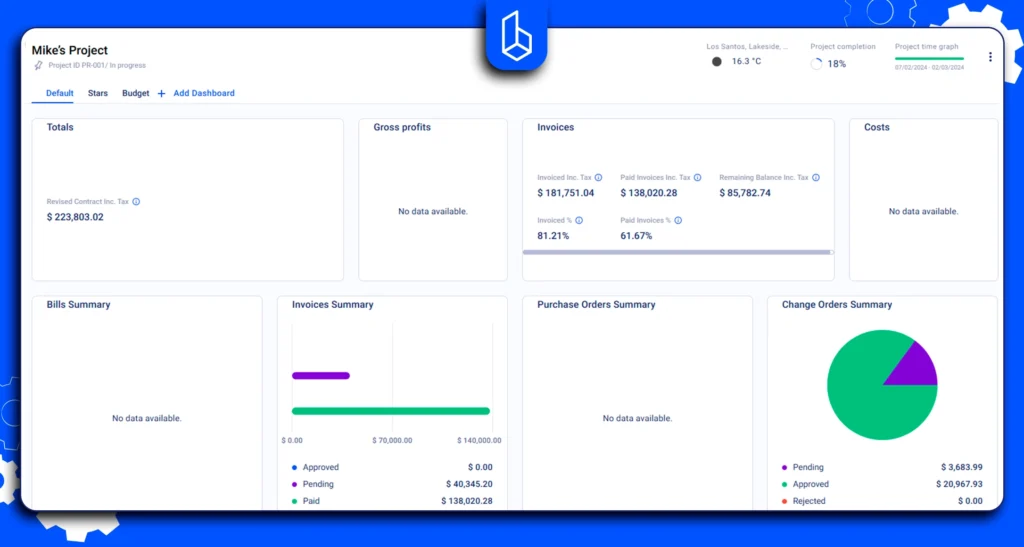
A well-structured portal allows clients to access:
- Schedules and milestone updates, providing visibility into progress
- Selections and allowances, including the latest versions and revisions
- Change orders, with clear approval records
- Invoices and payment history, so they always understand the financial status of the project
- RFIs and submittals, so clients can review questions, technical clarifications, and material approvals in one place
The most important outcome is transparency. Clients don’t have to ask the contractor for updates or search through the emails and messages to understand the current situation. They can simply open the portal and see the latest information in one place.
“Have you sent an invoice?” will no longer be a viable question.
Recommended reading:
Automated Cloud Storage for Document Access
Document management during the construction process includes not only financial papers but drawings, permits, and contracts.
Construction management software solves this problem by storing all project files in a single cloud-based environment. Every document, image, and update is automatically organized and accessible to the right stakeholders.
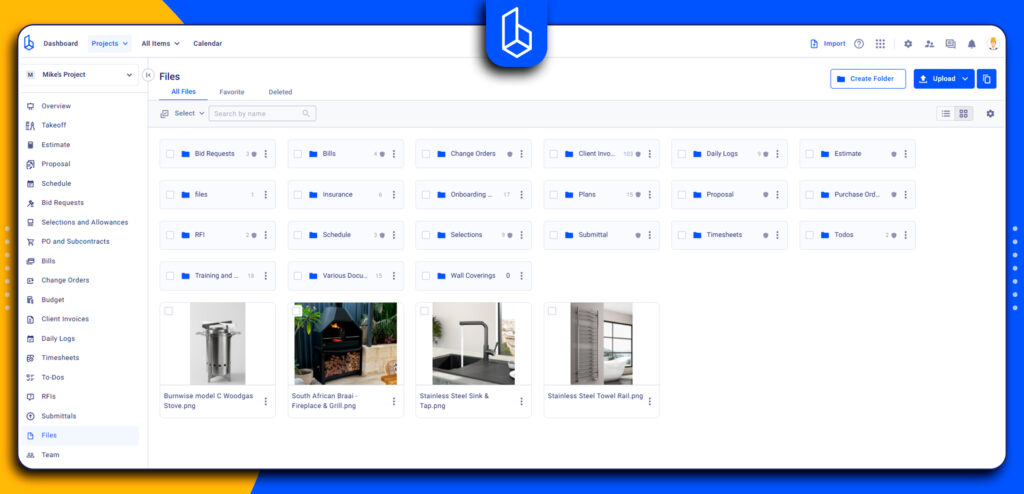
Files are linked to the relevant tasks, approvals, or financial records.
For example, imagine a client reviewing the progress of their commercial office renovation. They log into the client portal and want to confirm the materials used in the lobby flooring. They open the project’s document section and immediately see the approved flooring submittal, related specifications sheet, etc.
Streamline Messaging with Contextual Communication
Another issue that automation addresses is messages lacking context. A message, “The flooring change will add $1,500. Is it ok?” sent to the client willhardly add any clarity to the complex communication flow.
As a result, both sides lose time clarifying details, forwarding documents again, or searching through old conversations.
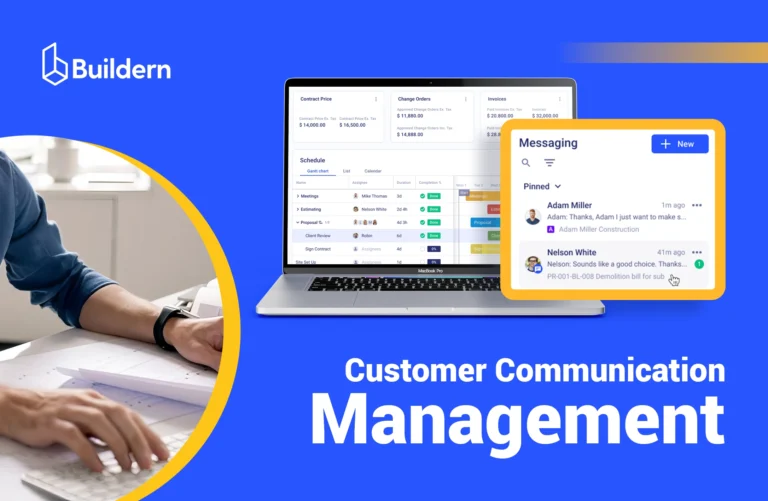
Construction management software allows teams to exchange messages directly within the relevant project element. Instead of having a general conversation in an inbox, communication happens exactly where the information is.
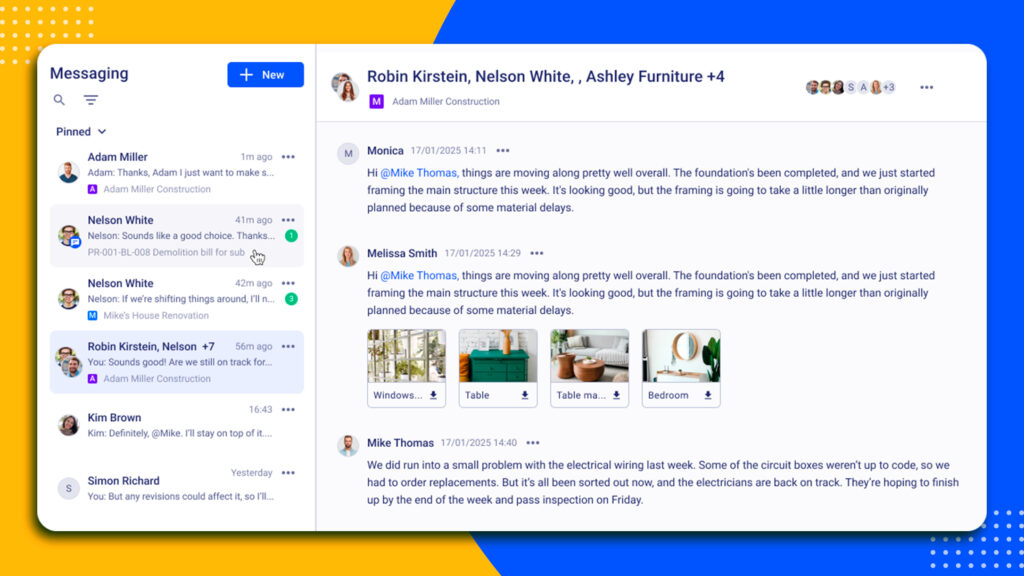
Some examples of discussions with the construction management software:
- If clients have questions about a particular change order, they can open this particular document and leave a comment.
- If customers want to comment on exterior door selection, they can add a message within that particular one so the entire discussion stays connected to the work being done.
This approach eliminates many common communication problems, like confusion about documents discussed or long conversations in email threads.
How Communication Changes Through Project Phases
Just as every construction project is unique, building communication with a client during each project phase also requires its own strategy and approach.
Preconstruction Stage
The goal of this phase is to set expectations, confirm project details, and prepare the client for the work ahead.
Communication focus in on presenting a proposal that would leave no room for doubt about the contractor’s transparency. At the same time, it’s useful to give a customer the possibility to comment on the proposal.
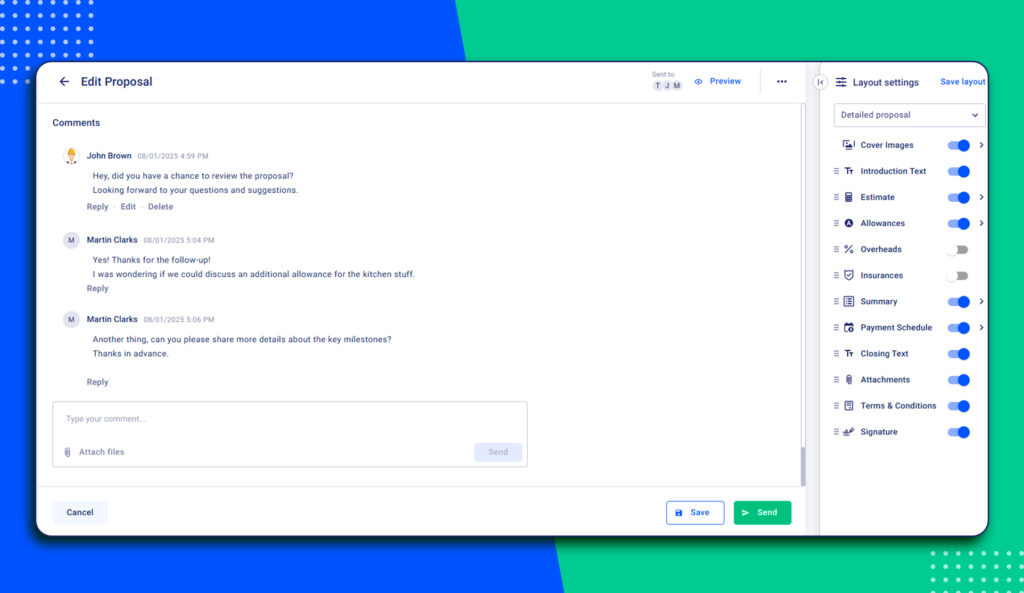
If the proposal is agreed, outline how the project will continue and what tools you will use:
- Introduce the project team and communication channels
- Confirm scope, budget, and schedule
- Explain the change order and approval processes
Construction Phase
The goal is to keep the client informed about progress, issues, and changes while maintaining transparency.
Communication focus is on task-based updates, statuses of RFIs or submittals, requests for approvals on decisions, and the impact on costs or schedules.
During this phase, communication frequency may vary depending on the project scope and client preferences. For example, during the remodeling project, the updates are likely to be more frequent.
Closeout Phase
The contractor has to ensure all project deliverables are completed, documented, and formally handed over.
The focus is on the completion report, inspection results, and the review of punch list items. It’s also the stage when a contractor lays the ground for further projects by collecting client feedback.
Traditional vs. Automated: Why Automation Wins?
Time is one of the most valuable assets in any construction project. Here is how a structured customer communication management system helps you save time.
| Project Tasks | Traditional Methods | Automated Solution | Why Automation Wins |
| Change Orders | Verbal agreements and text threads | Digital requests with digital signatures via the client portal | No work starts without an automated budget |
| Document Search | Digging through emails to find the final approved version of a permit. | The latest version is kept in files. | Risks are minimized as everyone works from the same plan. |
| Updates | Clients wait for updates. | Clients get access to selections, invoices, and to-dos. | Builds trust, reduces repeated check-ins, and clients feel in control |
| Administrative load | High load with emails, follow-ups, forwarding attachments, and manual tracking | Automated notifications | Saves time for contractors and PMs, reduces delays |
Thus, automated workflow in customer communication management ensures that every update, approval, and document is captured, organized, and shared.

How to Improve Customer Communication Management?
To improve customer communication management, use a centralized client portal, automate updates and approvals, link messages to tasks and documents, and maintain real-time visibility.
How Often Should a Contractor Update Their Client?
Frequency depends on project type and client preferences. The contractor should also consider the phase of a construction project. It can be a daily/weekly update or a task-based update.
What Is a Construction Client Portal?
It is a dedicated online platform for clients where they can access project information, including drawings, schedules, change orders, invoices, RFIs, and other data.