AI Construction Software in Australia: A Builder’s Guide to Practical Automation


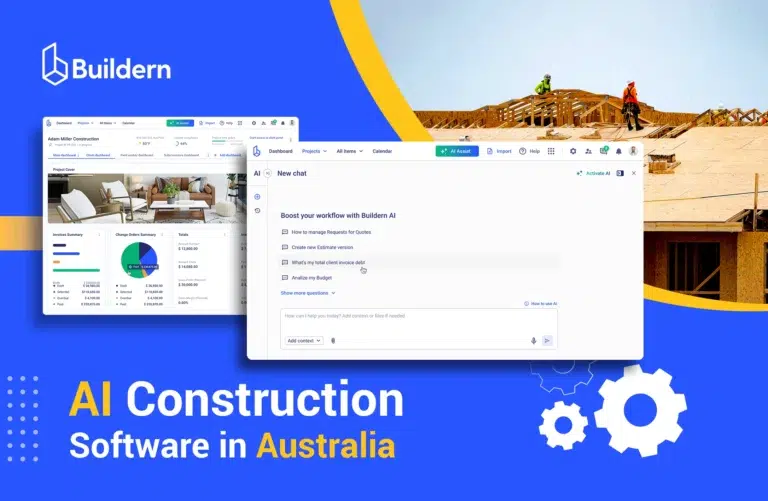
AI in construction is no longer experimental, but it is also not a silver bullet.
AI construction software in Australia is already embedded in estimating, cost tracking, scheduling logic, and administrative workflows. At the same time, it does not replace experience, trade relationships, or on-site decision-making. Builders who expect AI to “run the job” are usually disappointed, while those who use it to remove friction tend to see results.
Therefore, to help you join the second group of Australian builders, I’ll try to focus on where AI fits into real workflows and where expectations need to stay grounded.
Table of Contents
- What AI Construction Software in Australia Really Means
- Why Australian Builders Are Turning to AI Now
- Core AI Use Cases Across the Construction Lifecycle
- Where AI Adds the Most Value for Small and Mid-Sized Builders in Australia
- Common Misconceptions About AI in Construction
What AI Construction Software in Australia Really Means
In practice, AI construction software is not a separate tool that builders “switch on.” It sits inside existing workflows and operates quietly in the background. The strongest systems use AI to automate routine tasks, recognise patterns across project data, and support decisions that builders already make every day.
For Australian builders, this usually shows up in four areas:
- Automation of repetitive admin and data entry
- Pattern recognition across estimates, budgets, and schedules
- Consistency across similar projects
- Early signals when costs, time, or scope begin to drift
AI is most effective when it reduces friction rather than adding another layer of complexity. That means fewer spreadsheets, fewer manual handovers, and less rework when information changes.
It’s Embedded, Not Standalone
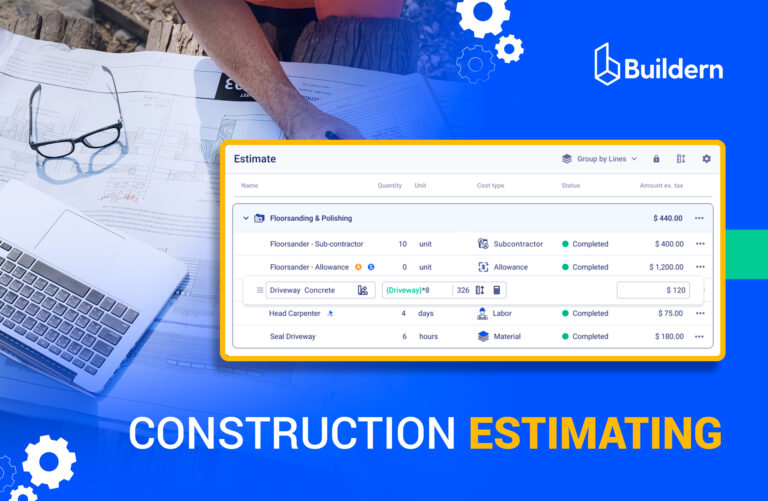
For example, AI-assisted estimating does not replace the estimator. It helps organise historical project data, cost assemblies, and takeoff logic so that new estimates start from a realistic baseline. When scope changes, the system adjusts connected data rather than forcing manual recalculation across multiple files.
The same principle applies to variations, scheduling updates, and reporting. AI works when it connects data that already exists and keeps it aligned as projects evolve.
Practical AI vs Marketing Labels
The construction software market is saturated with “AI-powered” claims. Many of these labels are vague and offer little insight into how the technology actually helps builders on-site or in the office.
Practical AI focuses on:
- Reducing manual input rather than generating abstract predictions
- Supporting decisions rather than replacing them
- Highlighting risk early rather than documenting problems after they occur
Generic AI labels often focus on dashboards, forecasts, or automation without clear linkage to daily workflows. When AI is bolted onto a system without strong process foundations, it tends to create noise instead of value.
Why Australian Builders Are Turning to AI Now
AI adoption in Australian construction is a realistic response to pressure that has been building across the industry for several years.
Labour constraints, cost volatility, and rising compliance demands are forcing builders to look for ways to protect construction margins without adding more administrative load.
Skilled Labour Shortages Are Structural, Not Temporary
Australia’s construction sector continues to face a persistent skills shortage, particularly in residential building and specialised trades. According to the Jobs and Skills Australia (former National Skills Commission), construction has remained on the Priority Skills List for multiple consecutive years, with roles such as carpenters, project administrators, estimators, and site supervisors consistently flagged as hard to fill.
Recent data shows that vacancy fill times in construction are significantly longer than the national average. In practical terms, this means:
- Builders are operating with leaner teams
- Experienced staff are stretched across more projects
- Administrative and coordination tasks are increasingly handled by people whose primary role is not admin
AI construction software becomes attractive in this environment because it absorbs repeatable work without requiring additional headcount. Updates, variation tracking, progress reporting, and document handling can be supported by automation when labour is scarce and expensive.
Rising Material Costs and Margin Compression.
Data from ABS Producer Price Indexes and industry reporting from Master Builders Australia show that construction input costs increased at a much faster pace than output prices over recent years. For builders on fixed-price or partially fixed residential contracts, this has resulted in margin compression rather than revenue growth.
In this environment, small estimating errors compound quickly. Underpricing one job can erase the profit from several successful projects. AI-assisted estimating and cost tracking help builders respond by:
- Anchoring new estimates to recent project data
- Flagging cost movement earlier in the project lifecycle
- Keeping budgets, schedules, and variations aligned as inputs change
Core AI Use Cases Across the Construction Lifecycle
For Australian builders, AI only earns its place when it fits naturally into existing workflows. The most effective use cases are not experimental or abstract. They sit inside everyday processes where time is already being lost, margins are already under pressure, and errors are already costly.
#1 AI-Assisted Estimating and Takeoffs
Estimating is one of the earliest points where risk enters a project, and in residential construction, that risk is rarely obvious at the start. Plans may look similar, but site conditions, client selections, local labour availability, and supplier pricing introduce variation on every job.
AI-assisted estimating helps by grounding new estimates in real historical data rather than assumptions or memory. Instead of starting from a blank worksheet, builders work from structured estimate templates that reflect how similar projects were actually delivered.

In practice, this means:
- Faster estimate creation using past project patterns
- More consistent cost breakdowns across similar homes
- Reduced reliance on manual copy-paste between spreadsheets.
The benefit is not perfect accuracy. There are fewer preventable errors and more predictable margins.
#2 Variation Management
Variations are unavoidable in Australian residential construction. Client-driven changes, regulatory adjustments, and site-specific issues all introduce scope movement after contracts are signed.
The problem is rarely the variation itself. It is how inconsistently variations are tracked, priced, approved, and reflected across budgets, schedules, and progress claims.
AI-supported variation management improves control by keeping financial and scheduling impacts aligned automatically. When a variation is raised:
- Budget changes flow through to cost tracking
- Schedule impacts are reflected without manual recalculation
- Documentation remains consistent across approvals and claims
Clear variation records also reduce disputes. When scope, price, and approval history are documented as part of the workflow, conversations with clients stay factual rather than reactive.
#3 Admin and Reporting Automation
Administrative load is one of the least visible pressures on Australian builders, yet it consumes a disproportionate amount of experienced staff time. Progress reports, cost summaries, compliance documentation, and client updates are often compiled manually from multiple sources.
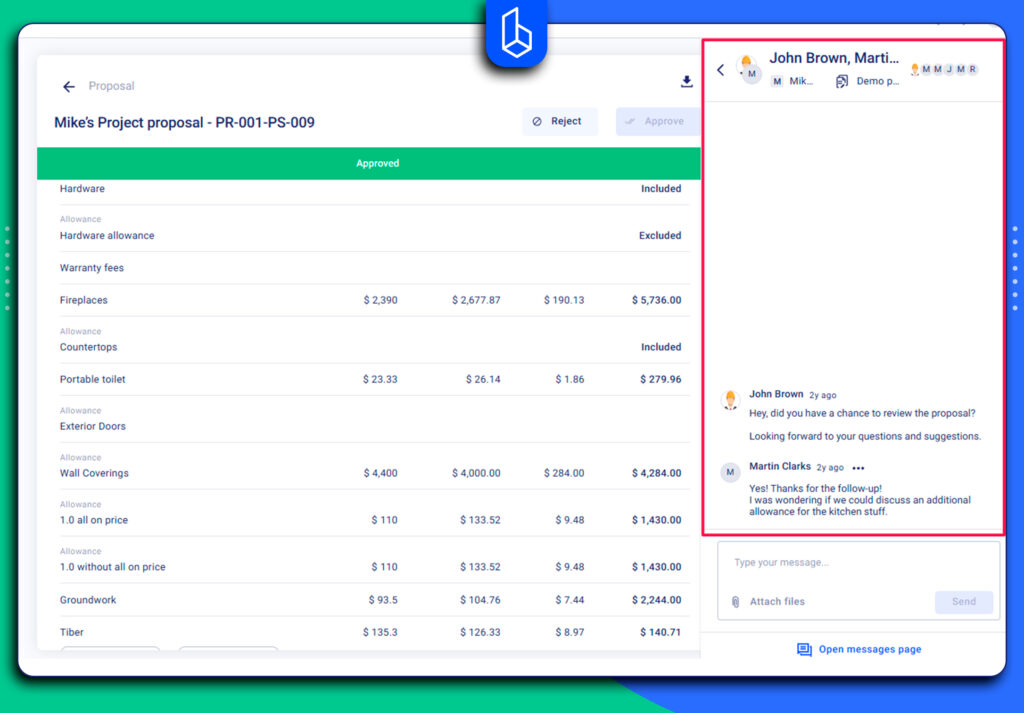
Common gains include:
- Less repetitive data entry across systems
- Cleaner project records without after-hours admin
- Faster reporting without manual compilation
When connected to construction document management and construction client portal tools, this automation improves transparency without increasing workload. Builders spend less time explaining what has happened and more time managing what happens next.
Importantly, this is where AI delivers immediate, measurable relief. Admin tasks do not disappear, but they stop growing faster than the business.
Where AI Adds the Most Value for Small and Mid-Sized Builders in Australia
AI tends to be discussed as a tool for large firms with dedicated systems teams and complex data environments. In practice, many of the clearest gains appear at the small and mid-sized end of the market, where time pressure is highest and process gaps are most exposed.
One of the strongest advantages comes from repetition. Home builders deal with recurring patterns: similar scopes, similar trades, similar approval cycles. When AI is embedded into estimating, budgeting, and scheduling workflows, each completed project improves the next one. As a result, decisions rely less on memory and more on recent data.
This is especially relevant for builders who:
- Deliver variations of the same home design
- Work with a stable group of subcontractors
- Operate in defined geographic regions
Admin-heavy roles also see immediate relief. In many small teams, senior staff handle both site coordination and paperwork. AI-driven automation reduces manual reporting, document handling, and data re-entry. That frees experienced builders to stay focused on supervision, sequencing, and client communication rather than chasing updates across systems.
Common Misconceptions About AI in Construction
As AI construction software becomes more visible across the industry, expectations are often shaped by marketing language rather than on-site reality. For Australian builders, separating practical capability from assumption is essential before adopting any AI-enabled system.
A few misconceptions appear repeatedly when builders first assess AI tools:
- AI replaces builder judgment: It does not. Decisions around sequencing, trade coordination, client communication, and risk management remain human responsibilities. AI supports those decisions by organising information, identifying patterns, and reducing administrative drag, but accountability stays with the builder.
- AI fixes broken processes automatically: Automation reflects the structure it is given. If estimating workflows are inconsistent, variation records are incomplete, or documentation is fragmented, AI will surface the same issues faster, not resolve them.
- AI only works for large companies with huge datasets: In residential construction, value often comes from relatively small but consistent datasets. AI learns from how work is actually delivered, not from abstract benchmarks.
- AI adoption requires disruptive change: Practical tools integrate into existing workflows rather than forcing teams to rebuild operations overnight. Gradual adoption allows builders to test reliability, build confidence, and retain control over decisions while benefits accumulate.
- AI decisions are opaque and uncontrollable: In construction contexts, effective AI focuses on transparency. Builders can trace inputs, understand adjustments, and override outputs when needed. The system assists rather than dictates.
Conclusion
AI construction software in Australia shows up in narrow, practical ways, not in sweeping transformation claims. When applied correctly, it reduces friction in estimating, variation control, scheduling coordination, and reporting.
In practice, my recommendation is to judge AI construction software in the same way any other tool is judged on-site:
- Does it reduce rework?
- Does it improve visibility before problems escalate?
- Does it support decisions instead of slowing them down?
When the answer is yes, the next step is simple: test it where friction already exists. Apply AI to one workflow, estimating, variations, or reporting, and judge it by results. If it reduces rework and improves visibility without adding complexity, it earns its place as a practical tool for protecting margins, reducing admin load, and maintaining control.

Does AI Construction Software Require Clean Data From Day One?
AI doesn’t need perfect historical data to be useful, but it does require structured workflows. Consistency matters more than volume. Your system will improve as estimates, budgets, and variations get handled in a repeatable way. Waiting for “clean data” before starting often delays benefits unnecessarily.
Is AI Construction Software Suitable for Fixed-Price Residential Contracts?
Yes! Moreover, this is the area where many builders see the strongest impact. Fixed-price contracts leave little room for error, so early visibility into cost drift, variation impact, and scheduling pressure becomes critical. AI does not remove risk, but it helps surface it sooner, when corrective action is still possible.
How Should Builders Evaluate Whether AI Features Are Practical or Just Marketing?
The easiest way to evaluate AI construction software is by testing the workflow impact. Ask whether the AI features reduce manual steps, cut duplicate data entry, or improve visibility without adding complexity. If the extra features require separate dashboards, extra setup, or constant interpretation, those are likely decorative rather than practical. Useful AI disappears into the workflow and saves time quietly.
![Construction Estimating Software for Small Businesses: 7 Tools Compared [2026 Update]](https://buildern.com/resources/wp-content/uploads/2025/12/BLOG_COVER_Best-Construction-Estimating-Software-for-Small-Businesses-2026-768x501.jpg)