Typical Contractor Overhead and Profit: What to Expect in 2026



How much should I charge my client? A million-dollar question every general contractor faces when starting a construction project.
It’s also one of the easiest places to get things wrong. When pricing too low, you risk being stuck covering hidden costs out of your own pocket. The price is too high, and you risk losing the job altogether.
Balancing between two realities is harder than ever because of ongoing labor shortages and tighter margins. In such circumstances, accurate estimating becomes more important than ever.
In this guide, I will discuss what typical contractor overhead and profit look like today, what the industry benchmarks and best practices are to maintain a construction project’s financial health.
Table of Contents
- Why Overhead and Profit Are Important?
- Profit vs. Markup
- Typical Contractor Overhead and Profit in 2026
- How to Calculate Overhead in Construction?
- How to Calculate Profit?
- Mistakes To Avoid When Calculating Overhead and Profit
- What Healthy Overhead and Profit Look Like
Why Overhead and Profit Are Important?
Typical contractor overhead and profit are two core components that are behind every bid.
Overhead refers to all the ongoing indirect costs required to run a construction business. Unlike direct costs of material and labor, the overhead is not linked to a specific project but is essential for keeping operations running.
Let me list some examples of overhead:
- Office expenses (rent, utilities, supplies)
- Salaries of the office workers
- Insurance (general liability, workers’ compensation)
- Licenses, permits, and regulatory fees
- Marketing budget
- Software and digital tools used for estimating, scheduling, or project management
Contractors may underestimate overhead because some costs are less visible or fluctuate throughout the year. However, equipment maintenance, training of the staff, or vehicle costs can reduce margins on every project unless they are calculated properly.
Profit margin is the amount that a contractor earns after all project and overall business expenses have been covered. However, a common misconception in construction is treating profit as optional or “extra money.” In reality, it also includes business sustainability, reinvestment, and maintaining stability.
Recommended reading:
Profit vs. Markup
The terms may sound too alike, but there is a difference between profit margin and markup. Not to mix them and be confused, let me put it this way: profit is calculated on revenue, while markup is calculated on cost.
- Profit: The actual dollar amount left over after all costs (direct and indirect) have been paid. It’s the real final number your business keeps. Profit margin is the percentage of your selling price (revenue) that remains as profit after costs are covered.
- Markup: The percentage added to your direct costs when setting a price. It should be done at the estimating stage when all costs are calculated before the project even starts.
Recommended reading:
There are three core profit margin types, with each telling a contractor something different about where money is going.
Gross Profit Margin: This measures the revenue after the direct project costs (materials, labor, and subcontractor payments) are deducted.
Operating Profit Margin: In addition to direct project costs, this profit margin also includes indirect overhead costs. It gives a much clearer picture of how efficiently your operation is actually functioning.
Net Profit Margin: This margin is the amount you keep after all expenses. It’s the most important number, the one that shows if your company is actually growing.
Recommended reading:
Typical Contractor Overhead and Profit in 2026
Overhead and profit ranges depend on how a construction business operates. The companies with different sizes, types of projects, and degrees of complexity may have different costs.
Typical Overhead
In general, overhead is not a fixed number. It is one of the benchmarks where only some ranges can be named. For example, in the case of small contractors, the range can be between 15% and 25%, while for large firms, around 10%-14%.
Recommended reading:
Besides, the type of company also matters. Specialty trades like HVAC, for instance, may have an overhead of 20%-25% as they use specialized tools, fleets, and skilled technicians.
A company’s internal structure and cost mix (the share of indirect vs. direct costs) also directly influence how much overhead needs to be recovered per project.
Technology has become another major driver. The construction project management software improves how overhead is tracked and allocated. Such tools provide real-time visibility into costs, labor, and resource usage. In this case, allocations are more accurate and easier to adjust as projects evolve.
Typical Contractor Profit
After some price swings during recent years, contractors seem now to focus on protecting their bottom line through precise job costing and technology.
Although the data from different organizations, such as the Construction Financial Management Association, may vary, the experts point to the average net profit margin ranging between 5% and 11%.
It’s important to consider that not all contractors operate at the same margin. Profitability shifts significantly depending on the type of work and level of specialization.
Here, the word typical is not that accurate and varies depending on the construction segment.
| Construction Segment | Typical Net Profit % | What Is Behind It? |
| Residential | 6%-9% | Custom builders are hitting the 9% mark, while volume builders are closer to 6% due to high borrowing costs. |
| Commercial | 5%-8% | Competitive bidding compresses profit |
| Speciality Trades | 10%-14% | Higher margins due to specialization and demand |
| Industrial | 5%-8% | High material costs and project scale increase risk |
In general, residential work requires higher gross margins because the “overhead-to-revenue” ratio is much higher, while commercial projects rely on scale. Speciality trades, in turn, compete on technical expertise rather than just on the lowest bid.
How to Calculate Overhead in Construction?
Calculating overhead means you need to look at your total overhead costs over a period of time and compare them to your revenue.
The main formula is:

Let me bring the following example with a company that has:
- Total overhead costs: $150,000
- Total revenue: $1,000,000
Overhead % = $150,000 ÷ $1,000,000 = 15%
This means for every $1 you earn, $0.15 goes to overhead, and the remaining amount must cover direct costs and profit.
💡Tip: The key is tracking it consistently. Many contractors underestimate overhead because they miss small recurring costs like subscriptions or equipment depreciation. Over time, it turns into a large amount.
How to Calculate Profit Margin?

Calculating profit margin in construction is easy when you break it down. In fact, profit is simply what’s left after you subtract all your costs from your revenue. It tells you the actual percentage of every dollar that stays in the business.
In a real construction project, this would look like the following:
Step 1: Start with your revenue, which is the total contract value
For instance, project revenue is $100,000
Step 2: Subtract direct costs, which include materials, labor, equipment, and subcontractors. For example, direct costs are $60,000.
$100,000 – $60,000 = $40,000 gross profit
Step 3: Subtract overhead, which may include office expenses, construction project management software, insurance, and office workers’ salaries.
Overhead: $25,000
$40,000 – $25,000 = $15,000 net profit
Step 4: Calculate profit margin.
Profit margin = $15,000 ÷ $100,000 = 15%
You made a $15,000 profit on a $100,000 project with a profit margin standing at 15%.
💡Tip: Even if your gross profit looks high, overhead can quickly reduce your final margin. This is one of the most important points the contractors have to consider when estimating jobs.
Mistakes To Avoid When Calculating Overhead and Profit
Even contractors with dozens of years of experience may get their numbers wrong. The math is hard, but it gets harder when details are overlooked. There are simple ways to avoid the following mistakes, which I will consider below.
Mixing Up Markup and Margin
Applying a markup doesn’t guarantee the profit you think it does. A 20% markup doesn’t mean 20% profit. If you have a wrong calculation, you may be underpricing every project without realizing it.
Mistake: Adding 20% to a $100 cost gives you a $120 price. However, your profit ($20) is only 16.6% of the $120 total. If your overhead is 18%, you just lost money.
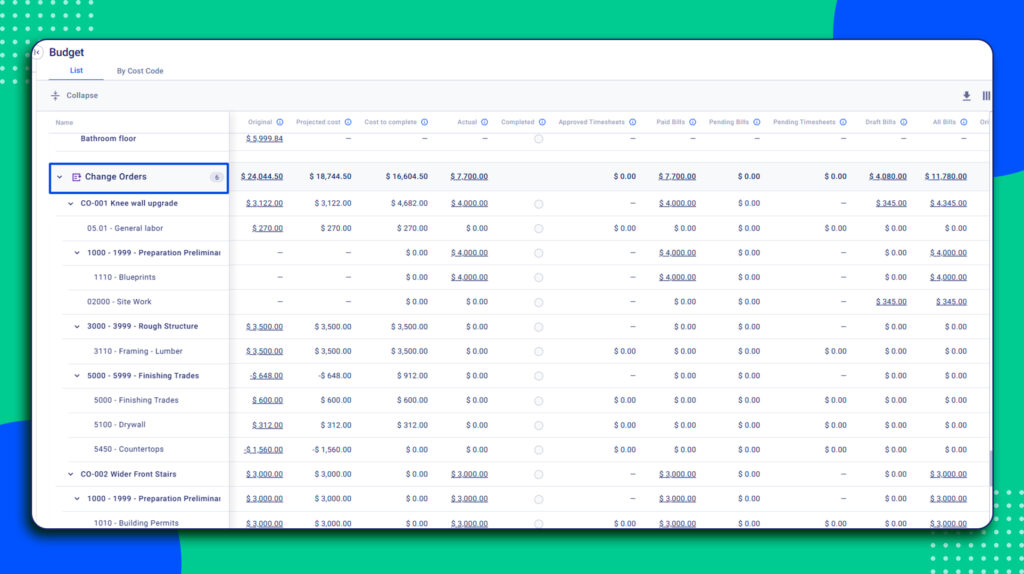
When using construction project management, you can add markup automatically to avoid similar mistakes. For instance, you can set a default markup percentage and apply it automatically to all cost items. Besides, you are free to apply or update markup across multiple items and ensure it is reflected in estimates, later on in proposals, and the budget.
Not Updating Numbers Regularly
Using outdated numbers is one of the fastest ways to lose profit without noticing. In the construction industry, costs change constantly, labor rates go up, material prices fluctuate, and insurance premiums increase.
If your overhead and markup are based on old data, your estimates won’t reflect reality, and you risk having budgeting problems or not even starting a project.
Mistake: You priced a project using material costs from a few months ago. Materials were estimated at $50,000, but due to price increases, the actual cost is now $55,000. On a $100,000 project, that $5,000 difference directly reduces your profit.
The key is to regularly review and adjust your overhead and markup so they match current conditions. Keeping these numbers up to date ensures your estimates remain accurate.
Relying on Manual Calculations
Manual calculations and copy-pasting from one spreadsheet to another cannot work nowadays, even for small construction projects, as they can become a source of errors. It’s clear that a single wrong cell or missed update can affect the entire project.
Mistake: A contractor manually updates costs in a spreadsheet but forgets to adjust a formula linked to overhead allocation. As a result, the final bid is underpriced. If there is a structured approach, all-in-one construction management tools make a difference. Instead of relying on different spreadsheets, costs, overhead, and markup are all calculated automatically.
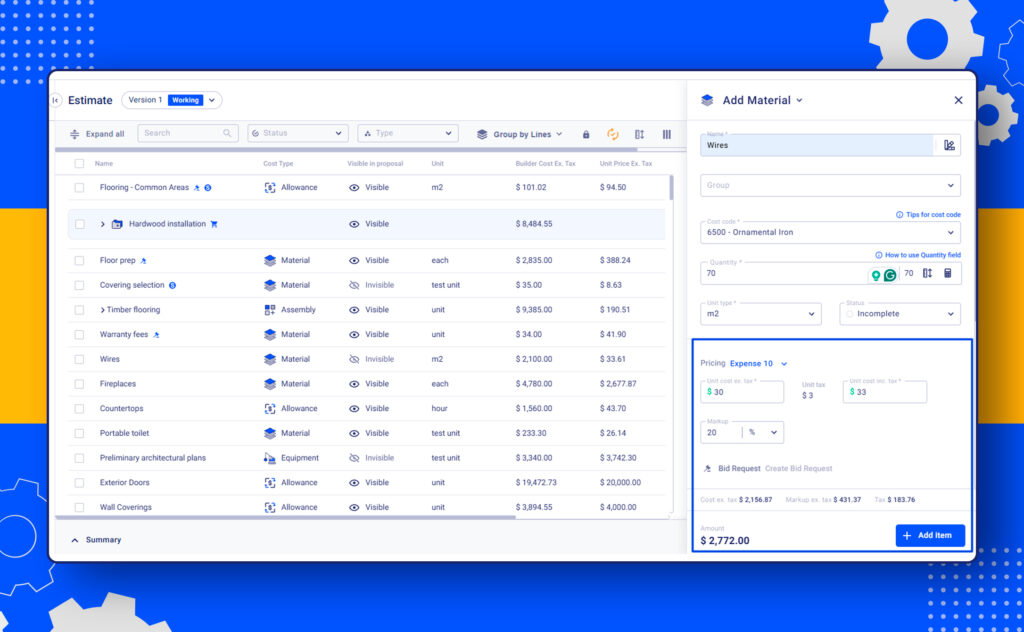
Updates to one value change across estimates, budgets, and proposals. This helps contractors maintain accurate pricing and protect profit margins without constant manual recalculations.
What Healthy Overhead and Profit Look Like
Healthy profitability means not chasing high margins but staying within realistic, sustainable benchmarks.
Net profit margins and overheads depend on company size, the region it operates in, and specialization. Residential and specialty trades tend to have a higher profit margin, while commercial and industrial work often runs tighter because of competitive bidding and higher risk exposure.
Contractors who understand their overhead structure, keep costs updated, and apply consistent markup strategies are likely to stay within healthy margins.
Ultimately, a healthy profit in construction is not defined by one number, but by consistent actions in terms of updating and tracking all figures smartly.