AI for Construction: What Works Today and What’s Coming in the Future



AI is changing the way we work and live. It’s already not a technology of the future but the reality.
I bet you have heard about “AI transforming the industries” numerous times, but you wonder what that really means for construction. If you are sceptical about its real effect on construction and day-to-day construction project management, you are not alone.
When something new appears, it’s always difficult to accept it. However, new technologies, such as AI estimate and AI billing, are already here, quietly improving the way contractors plan and deliver projects.
In this guide, we’ll explore real use cases of AI for construction, including estimating, scheduling, automated billing, and what’s coming next as new tools enter the industry.
Table of Contents
- What is AI for Construction?
- How AI Works for Construction
- AI in Construction Project Management
- AI in the Field Works
- Benefits and Challenges of Using AI in Construction
- Will AI Completely Replace Construction Employees?
- Future of AI in Construction Project Management

What Is AI for Construction?
AI for construction refers to digital tools that analyze data, automate tasks, and assist project teams with faster decision-making. In simple terms, it’s software that learns from your project history, documents, schedules, and workflows.
The construction industry has always been known as one of the most traditional sectors, not rushing to have a strong digital presence. Change was slow, and I was among those who could not always welcome innovations with open arms.
But times are different now, and AI is not only a construction technology trend. Modern construction companies cannot survive without digital marketing tools, mobile apps, and project management software.
Meanwhile, construction AI tools are a big step that is rapidly developing before our eyes.
The figures show that the global AI in construction market is growing. According to a recent report, it is valued at $11.1 billion in 2025 and is expected to grow to $24.30 billion by 2030.
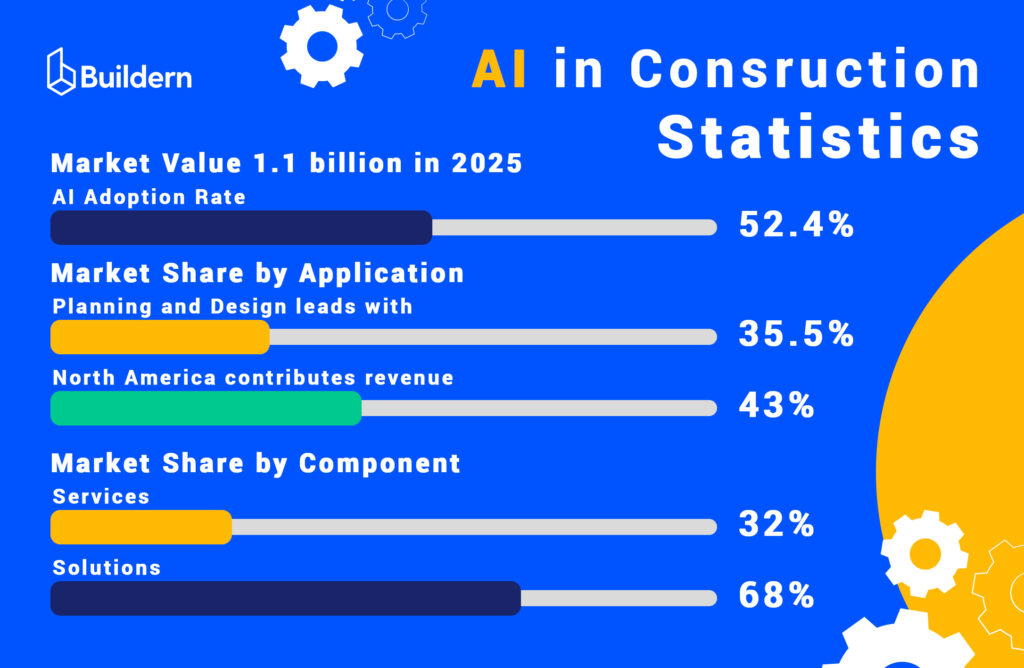
This is the best proof of how the construction industry is adapting to new tools. Now let me show some typical AI applications in two main areas: in the field, where the work is happening, and in project management, where decisions are made.
How AI Works for Construction?
AI works by collecting information from different sources across a construction project, including schedules, estimates, bills, and invoices, and analyzing it to produce insights or recommendations.
In practice, this means AI can:
- Save time for contractors and project managers
- Point to risks and concerns
- Detect patterns and predict delays
- Generate schedules, checklists, and estimates based on your data
- Classify documents or extract details from contracts and invoices
- Interpret job site images to track progress or flag safety concerns
Most importantly, it gives recommendations and suggestions on what to do next. Think of it as a smart assistant built into your construction software. AI helps project managers, estimators, and field teams make decisions with fewer mistakes and less manual effort.
AI in Construction Project Management
In general, project management in construction takes much time and effort. AI can help automate some repetitive tasks. Scheduling, budgeting, and managing dozens of client invoices can be automated to save time for building and problem-solving.
Preconstruction Planning
It all starts with planning a house or a building. At this important stage, the risk of miscalculation is huge, while AI can become a powerful assistance, for example, with generative design tools.
AI can create many building design options based on specific goals and a budget.
One of the examples I have recently found is AI use in generating estimates and analyzing financial indicators of your project.
Besides, instead of manually making calculations and analyzing the budget, AI can do it and provide recommendations on what to do next. Let me show some examples.
How AI Improves Construction Estimating
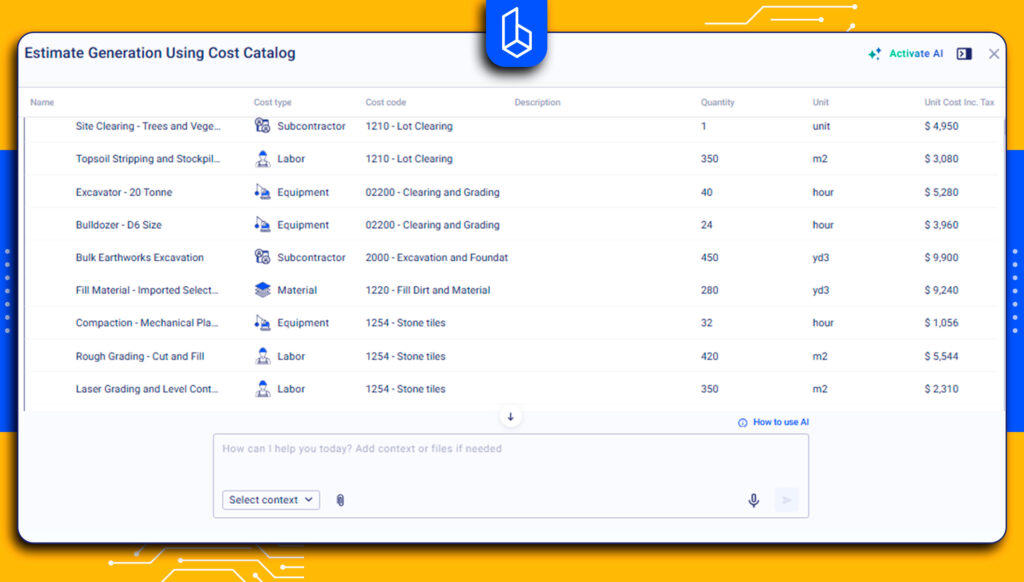
When I start a new project, generating an estimate is always a headache, as it’s a complicated and long process. AI for estimating makes this a task that takes several seconds to complete.
Estimates can be generated from a takeoff, an Excel file, a cost catalog, or previous project data. By the way, AI uses some information about projects, such as project type, location, and area.
AI for Scheduling
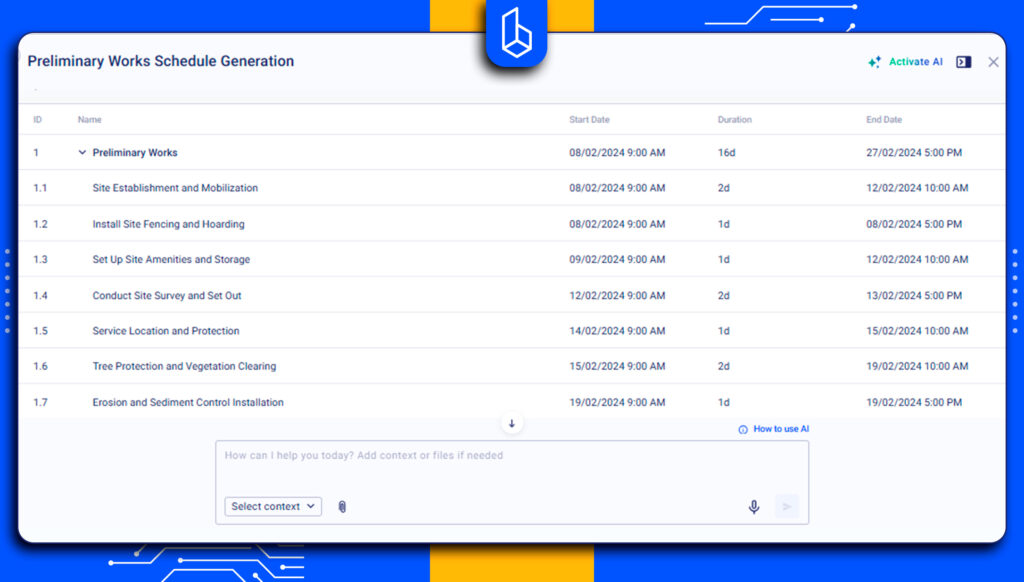
AI can also help contractors create project schedules faster instead of guessing durations or manually sequencing tasks.
Here, I asked AI to generate a schedule for preliminary works on one of my projects. The AI breaks the work into logical steps and assigns realistic durations.
AI for Construction Financial Management
Invoices are one of the most time-consuming but critical parts of construction project management. When I first started receiving invoices, it seemed like one of the routines that I would like to speed up.
When you try to copy and paste data from an invoice (in a worst-case scenario, it can be a paper invoice), it’s difficult to make everything fast and correct.
How could I feel the difference? The answer is when I managed to automate the entire process by pulling financial data directly from ongoing projects.
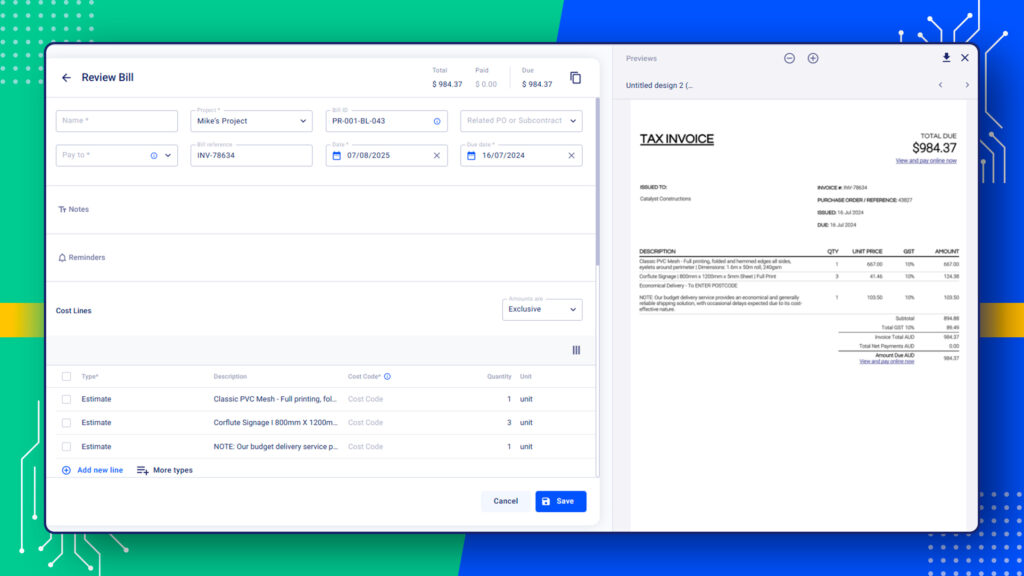
In addition to figures, the AI helps extract key information as dates, taxes, vendor, or subcontractor information.
For me, scanning and automation of billing means fewer disputes with clients and subcontractors and faster approval. A part of your financial records that requires consistent effort is handled in a few clicks.
Beyond automating invoice entry, AI can also analyze your project budget in real time. Instead of manually reviewing dozens of spreadsheets or cross-checking each cost code, it gives results like this:
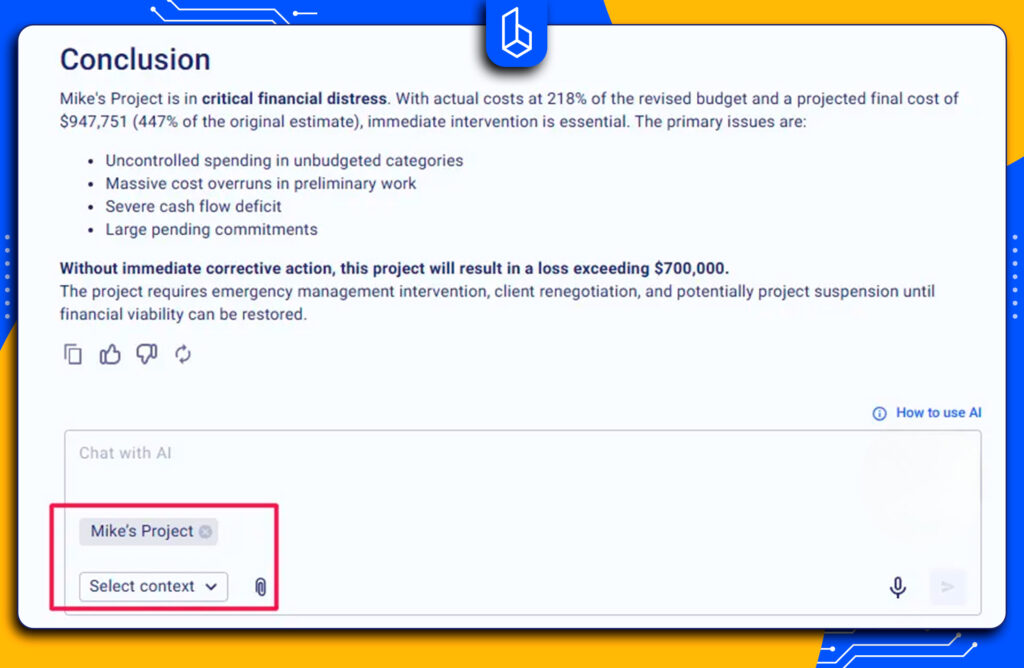
If you manage multiple projects at once, the AI first asks which one you want to analyze, then instantly presents a clean, easy-to-read summary.
AI for Client Communication
In my experience, one of the biggest challenges in construction is communication. The point is that even a small project involves many stakeholders, and having a client portal and unified communication platform is essential.
In other industries, AI is also widely used in communication. Many of the tools we use in everyday life, like messaging apps, already integrate AI. I am sure many of us see chatbots in the messengers that answer the questions automatically.
Construction is no exception. For example, AI can summarize long message threads or meeting transcripts, pulling out only the key points and action items. In the future, it may track approvals across different teams and send reminders when something is waiting for a response.
It does not mean AI comes to replace human conversations; it only helps make them easier to manage.
AI in the Field Works
When saying AI, I do not mean that it’s related only to AI assistants, chatbots, or software. Its application in the field work makes a huge difference. Let’s see some examples.
Autonomous Construction Equipment
This is one of the most visible ways AI is changing the fieldwork. There are bulldozers, excavators, or haul trucks that can operate with minimal human intervention.
Heavy machines use AI-powered sensors, cameras, and GPS to understand their surroundings and perform repetitive tasks. For example, AI systems can detect obstacles and automatically adjust a machine’s path.
As a result, there are fewer risks of accidents at the site. Some companies are even experimenting with fleets of self-driving vehicles that communicate with each other to coordinate tasks.
Drones
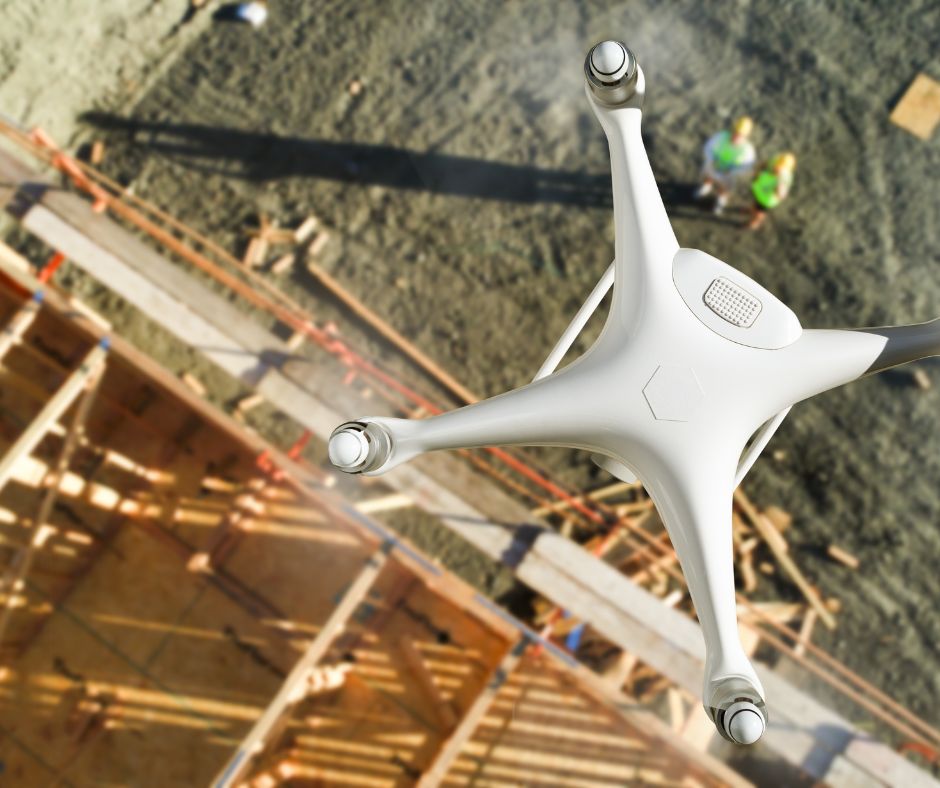
Drones are no longer just a cool gadget on construction sites. With AI, they have become a powerful tool for monitoring and managing projects. They fly over sites, capturing high-resolution images and videos.
For instance, drones can automatically detect progress, monitor materials, and spot potential issues. They can identify deviations from design plans or track inventory. Beyond inspections, drones are used for surveying large areas much faster than traditional methods.
It’s clear that they are more commonly used during big projects like industrial facilities and skyscrapers, where surveying areas are more important. AI analysis helps track thousands of details, which is difficult to do manually.
IoT Sensors + AI
The combination of IoT (Internet of Things) sensors with AI brings a new level of intelligence to construction sites.
Sensors embedded in machinery, tools, or even building materials collect real-time data. On their own, these sensors can track things like temperature, vibration, equipment usage, or structural stability.
AI gives more value as algorithms can analyze sensor readings to detect patterns and predict issues. For instance, vibration data from heavy machinery can signal early signs of wear and tear. Most importantly, in this way, raw data turns into a smarter and safer construction practice. Contractors can focus on building while AI keeps machinery running smoothly.
AI as a Safety Tool
Site safety is always a top priority for construction projects. AI tools can help people find the risks more efficiently. It’s not only about pointing to unsafe behaviors but also about predicting accident hotspots.

Benefits and Challenges of Using AI in Construction
Like any new technology, the rise of automation and AI in any industry raises many questions. Will it really make projects more efficient? What happens to people when machines take over repetitive tasks? Can smaller companies afford these tools?
Of course, there are both benefits and challenges, and I will try to list some issues that concern me when I think about AI.
Benefits
- Increased efficiency: For me, the biggest advantage is that automation saves time as it decreases the time spent on repetitive tasks.
- Reduced errors: Automated billing and data analysis in general, no matter whether it’s about construction management or fieldwork, minimizes human mistakes that often lead to costly rework.
- Improved safety: Robotics, drones, and other AI-powered systems lower risks by keeping workers out of dangerous situations.
- Cost savings: Automation saves money as handling 10 tasks with AI is several times faster than doing it manually. Moreover, improved safety and reduced errors cut down unnecessary expenses.
- Better data insights: AI transforms raw project data into insights that really help managers make smarter decisions.
- Labor shortage solution – Automation can help fill the gap amid a shortage in skilled labor, especially for repetitive tasks.
Challenges
- Data dependency: AI can act and handle tasks with clear and detailed data; if the data is poor and incomplete, it will give wrong and inaccurate responses.
- Cybersecurity risks: Sensitive data related to the project, for example, financial records and client information, is stored in the system and is an attractive target for cyberattacks. Weak security or poor data management can expose companies to breaches.
- Integration challenges: Many construction companies still rely on traditional methods. Without careful planning and training, AI integration can actually slow down projects.
- Possible job displacement: Most serious concern companies in the construction industry and outside have is that AI may reduce demand for certain roles.
Will AI Completely Replace Construction Employees?
This is probably the question I personally also hear most often. Naturally, new technologies always spark a bit of fear. Robots on job sites, AI billing, or drones surveying projects sound like they could leave little room for people. But let’s be honest, construction is still impossible without people, and it is the industry that involves many people and a lot of communication.
The only thing I am sure about with AI is that we have “a new normal,” and it is changing the way we work just before our eyes. Some repetitive and manual tasks are already shifting toward automation, and that trend will continue.
However, instead of completely replacing workers, AI, in my mind, simply transforms the roles. For example, rather than laying bricks, someone might oversee an autonomous machine doing the heavy lifting. Or instead of spending hours on spreadsheets, a project manager can focus on other important things, like communication with a customer, while AI takes care of billing.
Of course, there are ethical concerns. People worry about fairness in AI-driven decisions and whether machines will ever replace human judgment. These are valid questions, and the construction industry needs to address them openly.
However, machines didn’t eliminate carpenters, and AI won’t eliminate construction workers. I think it will create new roles and demand new skills. In the future of construction, AI won’t just be helpful but a core part of how projects are planned.
Future of AI in Construction Project Management
If AI is already used in many areas today, it means it will continue playing a bigger role. Right now, we’re already seeing tools that work on different tasks. But this is just the beginning.
As technology advances, more functions, especially in project management, will likely rely on AI. It’s important not to miss the moment and choose the construction management software that will not lag behind the “AI revolution”.
What excites me most is how AI can help project managers shift to proactive work. AI offers something new:
- Identifies risks earlier than humans can
- Suggests faster or more efficient ways to plan work
- Processes massive amounts of project data instantly
Thus, it changes how we used to deal with daily tasks. However, people will always be at the center of project management as AI won’t take away the need for negotiation and problem-solving skills.
How is AI Used in Construction?
AI is used both at the job site and in the office. In the field, AI powers autonomous equipment, site robots, drones, and IoT sensors that monitor progress and ensure safety. Meanwhile, in project management, AI helps with preconstruction planning and billing automation. Of course, it can be used in more areas, but I believe we can see other applications of AI soon.
What Are the Main Benefits of Using AI?
I use AI to speed up the process and reduce the risk of errors when performing some repetitive tasks. When it comes to large construction companies, they use AI to monitor large areas, which saves time and resources. It also improves safety by spotting hazards and monitoring worker health. The main benefit is that construction teams are free to focus more on decision-making.
What Challenges Come with Adopting AI in Construction?
Adopting new technologies comes with certain challenges. There are cybersecurity risks as sensitive project data is stored, as well as ethical concerns and fears of job displacement. Anyway, AI adoption requires careful planning and responsible implementation.