



Reviewed in June 2026
With so many moving parts and multiple stakeholders involved in the construction projects, how does everything stay on track and within budget?
The answer may be that the secret is “good project management”. The reality is that a successful project is one where specific things that are a part of the construction management process are done early. For example, estimating is done with consistent cost codes from day one, or the right documents are linked to each other.
Without a smooth and well-organized workflow, even the most experienced industry experts will struggle to deliver satisfying results.
Let’s take a deeper look at construction management to see how it actually works on a job and some real problems that may go wrong at each stage.
Table of Contents
- What is Construction Project Management?
- Key Stages of Construction Project Management
- Types of Construction Projects
- Construction Roles
- Types of Construction Contracts
- Essential Documents Used in Construction Project Management
- Construction Project Management Software Toolkit
- Conclusion

What is Construction Project Management?
If we were to define construction project management (CPM), we could say it’s about organizing every stage of the build.
Every construction project goes through a series of stages, starting from the feasibility conversation to the final walkthrough. The role of CPM is to ensure that costs, schedule, quality and communication all move in sync.
In practice, construction project management is mostly about keeping the numbers reconciled. Reconciliation is not just financial; it also refers to the accuracy of the schedule dates.
The “wrongs” in project management are visible when the invoice does not match the contract or the budget is negative. This usually means the documents that should have been linked to each other were not.
Key Stages of Construction Project Management
For anyone outside of the industry, constructing an entirely new building almost feels like magic. But in fact, it is far from it. In reality, all projects demand hard work, effort, and very organized management strategies.
This goes through the following stages:

1. Initiation
Every great project starts with an idea.
Sometimes, the construction company itself will come up with a great concept. Still, more often than not, clients already have the idea prepared, and the construction company simply needs to develop them further.
There are a couple of factors the construction company should consider in these cases. First, it should understand the client’s desirable scope and then conduct a feasibility study to estimate whether the project can be completed successfully or not. During this study, the construction company should try to answer the following questions:
- Are there enough resources and a sufficient project budget to bring the project to life?
- Will the project satisfy the local safety requirements?
- Can the project be completed within the deadline?
If the initial concept passes this feasibility test, both sides can move to the next steps, which include:
- Proposal preparation for the client to approve
- Preparing a plan for the initial project execution
At this stage, acquiring permits is also important. A feasibility study can clear every other probem. However, when it comes to a permit, it may still stall for weeks, for example, because nobody checked the permit time for that specific jurisdiction.
2. Preconstruction Planning
Once the project has been approved, construction project managers start the initial project planning by going through:
- Detailed design development and takeoff
- Estimation and preliminary budgeting
- Identification of potential project risks and creation of a risk management plan
- Sending out bid requests to their subcontractors and vendors
- Selection of subcontractor and vendor bids
Preconstruction sets the foundation of the project. It helps to identify and mitigate any challenges, sets a realistic budget, and ensures that all parties involved are on the same page before any actual construction work begins. Planning at this stage should involve multiple parties and advanced tools to automate and streamline the process.
Here are a couple of tools from our construction project management software to help you improve your preconstruction planning:
Integrated Takeoff and Estimation Tools
Buildern allows its users to estimate accurately the quantity of construction materials and labor required for a project. By leveraging digital blueprints and design plans, users can perform detailed takeoffs and transfer the gathered data into our estimation software, which uses advanced algorithms to generate precise calculations for costs, timelines, and resource allocation.

This integration not only reduces manual entry errors but also saves valuable time and ensures consistency throughout the planning process, ultimately enabling better decision-making and budget management.
3. Procurement
Construction is all about communication and working with different teams to achieve a common goal. Once the initial plans are ready, the next thing is to begin the process of acquiring the materials, equipment, and all the other resources needed. This process is known as procurement, and it involves finding the right vendors and negotiating contracts.
Collaboration is the core of the procurement process that suggests sending out bid requests and selecting vendors and subcontractors for the project.
However, managing bid requests and responses from non-Buildern partners can be time-consuming and chaotic. To streamline this process, Buildern offers the option to send bid requests through our software, allowing for easy tracking of multiple bids and their corresponding deadlines. Then, it’s up to the construction project manager to go through the subcontractors’ bids and choose the best one.

Bid Leveling Methods
Of course, the selection methods differ from company to company, but usually, it will be one of the three methods listed below.
- Low-Bid Method: Here, the PO selects the contractor who offers the lowest bid.
- Best-Value Method: In this method, the project owner does not look solely at the price bid. Instead, he analyzes the price-quality ratio. The project owner makes the decision only after examining the RFP (request for proposal) submitted by the contractors in detail.
- Qualifications-Based Method: Finally, with this method, the project owner focused on the contractor’s qualifications, analyzing each contractor’s RFQ (request for qualifications) and deciding who was the most qualified for the project.
Once the project owner finally chooses the contractor, both sides must sign a payment agreement contract to start working.
This helps with accurate cost-estimating and developing proposals that are more likely to turn into ongoing contracts. Sub/vendors can easily submit their bids online, and the data is automatically transferred into our system for further analysis.
4. Construction (Execution)
When all the planning is done, it’s time to start the work!
This is when the project management team comes together for a meeting, where all team members get to know their tasks and deadlines. During this stage, the team will:
- Identify all the required activities to complete the project
- Produce project deliverables, which then will be tested and approved by the client
Ongoing Monitoring and Controlling
Even if you’ve done your best to pre-plan everything and outline the entire project from the start till the end, you can’t lay back and forget about it. Monitoring and controlling the work is one of the essential stages of any construction project management.
This is because you might confront some unforeseen issues that need an impromptu solution. But even if nothing goes wrong, you still need to make sure that the construction crew follows the plan and meets all the deadlines.
You should also provide a project report to your client regularly. It should show precisely at which stage the project is and whether it is staying within the allocated budget and schedule or not.
Working with Daily Logs (aka Site Diaries)
Speaking of updates, it’s important to keep track of daily progress and activities on the construction site. Daily logs are great for this purpose, allowing on-site workers to document their daily activities, tasks, and any issues that may arise.
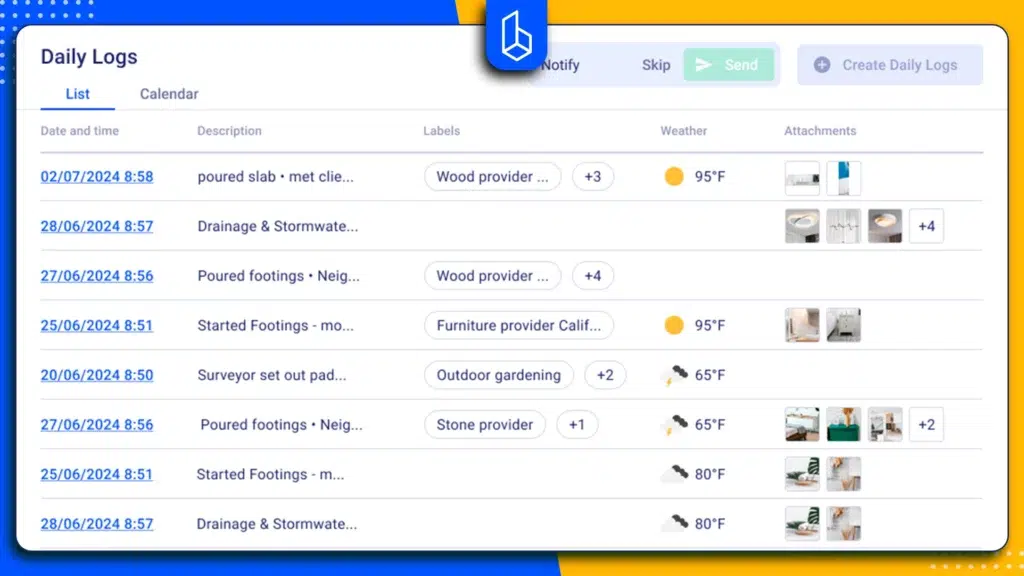
It is also important for project managers to review these logs regularly and address any concerns or delays that may affect the project timeline. This helps to maintain transparency and ensure that the project stays on track.
Financial Management
Construction projects involve a lot of money, from purchasing materials to paying workers. It’s crucial to keep track of the finances throughout all stages of construction project management. Generally, managers handle multiple financial components, including:
- Bills & Purchase Orders – Keeping track of material costs and supplier invoices
- Client Invoices – Ensuring accurate and timely billing for completed work
- Budget Control – Monitoring expenses to prevent cost overruns
Construction project management tools allow construction managers to centralize financial data and prevent miscalculations.
5. Project Closeout (Post-Construction)
Last but not least, the final stage of construction project management is project closeout. This involves completing all remaining tasks, finishing up documentation, and handing over the finished work.
It’s a rather stressful and no less responsible period when all stakeholders involved in the project must ensure that everything is completed successfully and to the client’s satisfaction.
Project closeout typically includes:
- Final inspections and obtaining necessary documentation from all the subcontractors, like warranties or lien waivers.
- Tracking all the change orders to ensure the project stayed within budget, and the reasons for all changes are documented.
- Handing over all necessary project documents to the client, including manuals, warranties, as-built drawings, final reports, and other relevant information.
- Conducting a final walkthrough with the client to ensure their satisfaction with the project and address any remaining concerns.
- Finalizing all financial aspects, including submitting final invoices and reconciling any outstanding costs.
Types of Construction Projects
Although there are many different kinds of construction projects, the main types of construction projects include:
- Residential Projects
- Commercial Projects
- Mixed Use Projects
- Industrial Construction Projects
- Civil and Infrastructure Projects
Let’s quickly skim through all of them:
1. Residential Building (Construction and Renovation/Modeling)
Residential construction aims to build, repair, and remodel structures to house people.
Apartments, townhomes, condos, nursing homes, and dormitories are all examples of residential buildings. Even the installation and repair of garages or utility outbuildings for water and electricity supply are considered residential constructors.
What specialists are usually involved in this type of construction?
Well, in the execution phase, there are architects who are professionals in building design, as well as engineers who are skilled professionals who invent, analyze, and test various complex systems and structures, from buildings to software.
Most construction companies usually hire subcontractors to do the project’s mechanical, structural, and electrical work. However, some companies prefer to handle all house design and construction phases themselves.
2. Commercial Projects
Commercial construction involves the construction, renovation, and expansion of buildings used for commercial purposes. This includes stores, shopping malls, restaurants, office buildings, hotels, and other venues.
Unlike residential projects, commercial construction typically involves larger budgets, longer timelines, and more stakeholders. These projects must often comply with detailed building codes and accessibility standards. They need fire safety regulations and industry-specific requirements.
One of the challenges of a commercial project is collaboration between different stakeholders. In addition to more complex budgets, schedules, and procurement, project managers have to oversee communication among the parties involved.
3. Mixed Use Projects
Such projects combine two or more property types and are designed to create spaces where people can live, work, shop, and access services.
For example, it can be an apartment building with a ground-floor retail space or a restaurant, or an office building inside residential towers. They usually have unique design requirements and operating needs.
Close collaboration among architects, engineers, contractors, and project managers is needed to consolidate the requirements for all occupancy types into a single set.
One of the specific features of such projects is that they usually attract consultants who are involved through the planning and construction stages to ensure compliance with standards.
4. Industrial Construction Projects
These projects focus on building facilities used for manufacturing, processing, production, storage, and distribution. The projects that support industrial operations often require specialized equipment, utility systems, and strict safety standards.
One of the features of industrial construction is its focus on technical performance and regulatory compliance. Contractors must carefully coordinate infrastructure, specialized installations, and environmental controls to ensure the facility is ready for efficient and safe operation.
Examples of industrial construction projects include factories, manufacturing plants, warehouses, power plants, processing facilities, and distribution centers.
5. Civil and Infrastructure Projects
Such projects focus on the construction and maintenance of the infrastructure that enables transportation, utilities, and public services.
Highways, bridges, tunnels, and airports are just a few examples of such projects that are typically large in scale requires long planning.
These projects are complex and need careful coordination of schedules and traffic management.
Construction Roles
The management of the construction needs a great team of experts. For those wondering how to get into construction project management, let’s take a look at the most popular construction roles.

The management of the construction needs a big team of experts. For those wondering how to get into construction project management, let’s take a look at the most popular construction roles.
- C-level executives oversee strategy and financials across the company, not individual project execution.
- Architects and engineers own design integrity and code compliance.
- Contractors handle the construction management process
- Construction project managers own the project lifecycle end to end, including budget, schedule, client and vendor communication.
- Superintendents run daily on-site operations against the plan.
- Field workers execute the physical work.
- Subcontractors and vendors deliver specific scopes of work or materials.
Check our extensive guide to learn more about the construction project team structure:
Types of Construction Contracts
For every construction project, it’s essential to ensure smooth work and payment processes in the project initiation phase. That’s why there are different types of construction contracts that meet the requirements of all project participants.
As with any other contract, the construction contract is just an agreement between project parties to provide services in compensation for payment. It is one of the most important project documents.
As mentioned, construction companies usually have a clearly defined hierarchy, so each party involved in the construction process will have a contract with the other: for example, the owner with the general contractor, the general contractor with a subcontractor, etc.
The construction contract should include:
- The general conditions of the involved parties
- The detailed scope of work
- The project timeline
- The payment terms
Additionally, the contract should clarify the rights and responsibilities of all parties. It may also include many other documents that explain the conditions.
Though the contract parties are free to choose any terms they want in their agreement, there are mainly three types of contracts in the construction industry.
- Fixed-price contracts
- Time and material contracts
- Cost-reimbursement contracts
Fixed-Price Contract
This type of contract is the most popular. It is also known as a lump sum contract because the whole work is charted under one fixed price. It has both benefits and disadvantages.
Advantages of a Lump Sum Contract
The owner and the general contractor start a bidding process to begin any construction project. So, it’s easier to negotiate one total price instead of submitting different bids.
This type of contract also allows you to save your project budget. When you complete the construction in time and under a precisely estimated budget, you don’t have additional expenses, which means what is left is the profit.
Disadvantages of Lump Sum Contracts
Accurate calculation and cost control are the keys to success. Any failure and miscalculation will be reflected in the budget. And the bigger the construction, the more specialists will be involved in the process, so the chances of money loss will increase.
To avoid that, at the beginning of the project, one should account for unexpected costs or delays.
Overall, considering the benefits and disadvantages, we can conclude that lump sum contracts are usually suitable for small projects with a predictable project scope.
Time and Material Contracts
Time and material contracts are implemented if the project scope is not accurately defined and there is no exact payment rate for the materials’ cost.
Advantages of Time and Material Contracts
These types of contracts are really agile, as the customer reimburses the contractor the cost of the materials and pays an hourly wage. This means all the unexpected delays, roadblocks, and changes will be covered.
Also, Time and Material Contracts set easy rules for negotiations between both sides. For example, you can easily decide on the hourly wage and which materials will be covered.
Disadvantages of Time and Material Contracts
To calculate each material cost correctly, one needs a lot of time. So this is one of the main drawbacks of the contract: if you spend so much time counting the material cost, in the end, the result may not be justified.
Another disadvantage is that even if you finish the project early and get ahead of schedule, your company will not get any bonuses, salary raises, or awards. Pretty sad, isn’t it?
Moving to the:
Cost-Reimbursement Contract
This type of contract is also called the Cost Plus contract. It is usually used for projects that require a lot of creativity. And as with any creative process during these projects, many ideas arise, which bring unforeseen expenses.
This contract mainly has two parts: the fixed fee which the sides have agreed upon and the additional costs that arise during the project’s progress.
Cost Plus contracts cover all the human and material resources: both direct costs like labor and materials and indirect costs like renting an office, traveling, and other administrative expenses.
Advantages of Cost Plus contracts
The Cost Plus contracts are really flexible as they allow the owners to change the initial design along the way, knowing that they will still be paid for the extra materials and time.
An advantage of these contracts is that miscalculations are not as devastating as in other cases. There can be minor inaccuracies in the initial bid; it won’t become a big problem anyway.
Disadvantages of Cost Plus contracts
The main disadvantage of these contracts is that sometimes, the contractors might force the construction company to justify certain costs and expenses. And alas, some costs might be hard to account for.
Other than these three main contract types, there are also Unit Price contracts and GMP contracts, both of which are pretty popular.
- Unit Price contracts: These contracts are used when the costs cannot be determined ahead of time, so the materials are set with unit prices.
- GMP contracts: GMP stands for the guaranteed maximum price contract. It works with the same principle as the Cost Plus contract; only the contractors define the maximum price here.
Essential Documents Used in Construction Project Management
Every construction project management phase is tied to documents which has to be synced to avoid delays and budget overruns. Here’s a closer look at the documents that actually carry a project from preconstruction to closeout.
Budget
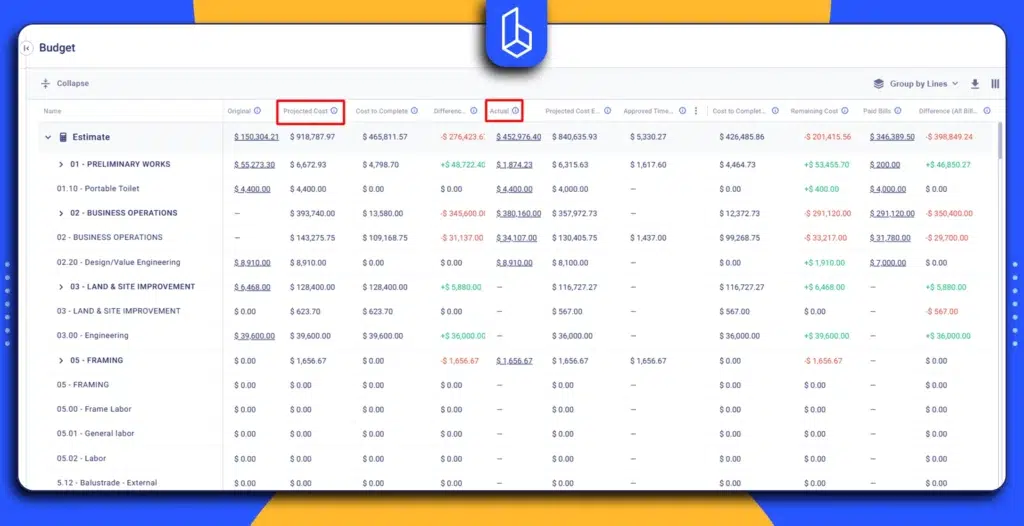
The budget is the first that comes to mind; it’s not a document but rather a live reconciliation of all financial components: estimate items, purchase orders, timesheets, and approved change orders. It answers how much has actually been spent against how much was planned.
Bid Requests
A bid request is the formal inquiry sent to vendors and subcontractors to price work or materials. It has to be ideally generated directly from the estimate. In this case, the items, quantities, and cost codes can’t differ from what was actually planned.
Purchase Orders (POs)
It is a document that authorizes the purchase of materials, equipment, or services from a supplier. A bid request defines the agreed quantities, pricing, and delivery terms before the purchase is made.
Change Orders
A change order documents changes once the contract is signed. It can refer to a small material change or a complete redesign. It has no impact on the budget until the client approves it. However, after approval, it changes the baseline. This is the reason change order management is one of the biggest challenges for the contractor.

RFIs (Requests for Information)
An RFI is a formal question that requires a documented answer. The document is typically submitted by contractors, subs, or vendors to architects, engineers, owners, or other accountable project stakeholders to confirm project requirements.
Submittals
A submittal is the document that a contractor provides for the review and approval of the architect or an engineer. It can be product data, shop drawings, or material samples. Submittals are used to confirm that what’s about to get built actually matches what was specified.

Daily Reports (Daily Logs)
A daily report shows what happened at the jobsite each day. It usually includes completed work, labor hours, weather conditions, delays, incidents, and photos. Daily reports create a documented history of the project.
Punch Lists
It’s a checklist of an incomplete work or a minor repair and missing elements identified before final handover. The project is fully finished when each item is completed and verified.
Choosing the Right Construction Project Management Software
The best tool for project management is software designed specifically for the construction industry.
Today, so many things need to be tracked and taken care of in large projects that it’s impossible to imagine that all of that can be done manually. Tracking cost codes, bid comparisons, and budget reconciliation within several projects quickly becomes overwhelming, especially when the company scales. It is the actual reason construction-specific software has become close to mandatory rather than optional.
What to look for in the construction project management software:
- All-in-One Workflow: First, you should make sure that it offers a centralized system where all documents are synced. Software that creates links, for instance, by generating a PO straight from a bid, a bill straight from a PO, removes the most common source of errors, which usually happens in the case of using spreadsheets.
- Real-Time Budget Visibility: The budget should not be a periodic reporting but a dynamic, changing document that is updated the moment a bill gets approved or a change order is signed off.
- Accounting Integration: In the case of two-way sync with accounting apps like QuickBooks or Xero, there is no need for duplicate data entry or manual reconciliation. Bills, invoices, payments, and costs are synced between project management and accounting tools.
- Solid Customer Support and Onboarding: If you are trying the software for the first time, its dashboard may seem to be complicated. It’s important to have an onboarding team that will help you overcome this stage.
Buildern offers all of it and is the perfect choice for all types of construction companies. Every document is designed in a way for the data to flow from one to another rather than being re-entered from scratch.
Conclusion
Construction project management is pretty complicated, but the results are absolutely worth it if you do it right. In the end, don’t overthink it. Get yourself the right tools, pick a good team, and start working. Overall, keep in mind that you have to constantly keep your eye on the project and communicate with team members and stakeholders. Everything else will move with its own flow.
And while on it, don’t forget to check out what’s going to be trendy this year to make your construction project even more outstanding. From AI technologies to 3D printing, there is so much that can help you to take your project to the next level, but as a first step, we advise you to get yourself cloud-based software and get all of it organized.
Don’t worry, it won’t cost you a fortune. In fact, you can start using it right now, with our free plan at Buildern.


