AI Construction Software Explained: How It Works in Project Management


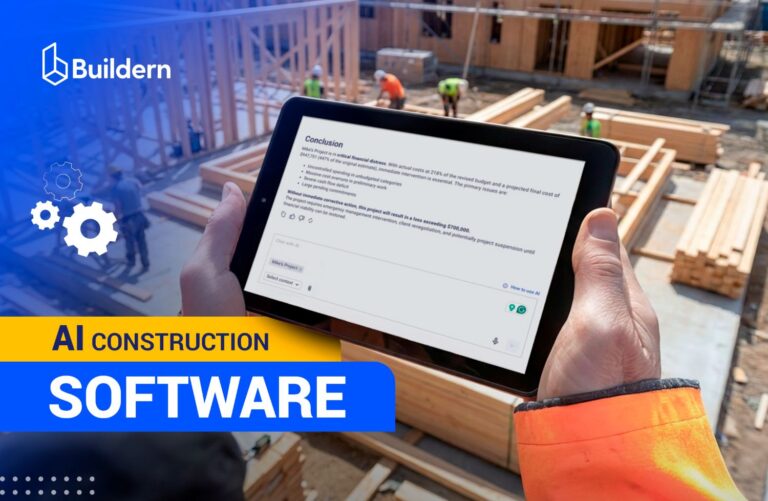
The role of artificial intelligence is no longer experimental among construction software solutions. It is already embedded in the way projects are estimated, scheduled, reviewed, and financially controlled. Over the past few years, construction project management software has automated individual tasks. What has changed recently is the scope.
AI construction software is no longer limited to speeding up isolated actions. It now works across connected workflows, where decisions depend on context, history, and live project data. For general contractors and project managers, this raises practical questions rather than abstract ones.
- Can AI help build estimates without rework?
- Can it surface budget risks before they turn into overruns?
- Can it reduce the time spent navigating software, checking invoices, or assembling schedules?
So, let’s look at how AI is being used inside construction project management software today, focusing on real workflows and concrete use cases.
Table of Contents
- What AI Construction Software Really Means
- AI Construction Software in Action (Real Cases)
- Generating Estimates Automatically
- Location-Based Pricing and Cost Data
- Creating Schedules From Estimates and Project Files
- AI-Powered Billing
- Voice-Based Data Capture From the Job Site
- Turning Project Data Into Bid Requests, Purchase Orders, and Selections
- Analyzing Project Progress and Preparing Client Updates
- Text Summarization and Professional Content Generation
- Generating Project-Specific Checklists
- Benefits of AI for General Contractors in 2026
- Using AI to Work Smarter in Construction
What AI Construction Software Really Means
Construction stands out due to the overwhelming amount of information teams deal with every day. Every day, GCs deal with multiple drawings, RFIs, schedules, daily logs, invoices, and budget updates. Project management software was built to organize this information and reduce manual work, while AI changes how that organization happens.
AI in construction software does not operate as a standalone feature. Instead, we are witnessing how it works across existing workflows, using project data, historical records, and live inputs to support decisions as they happen. Instead of only storing information, the software can interpret it, connect related data points, and surface insights that would otherwise require manual review.
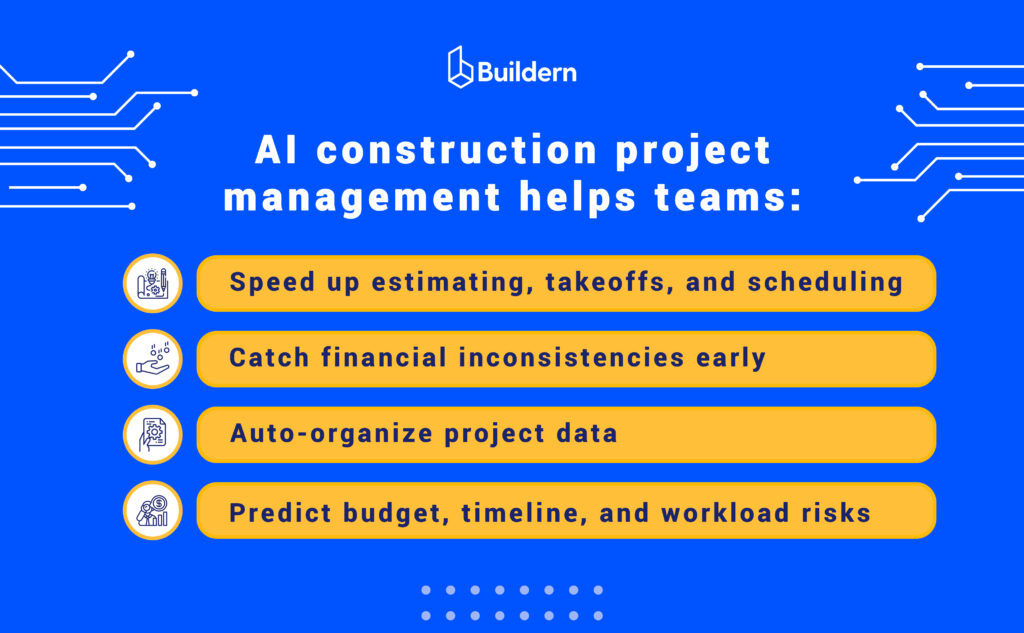
In practice, AI construction project management software helps teams:
- Move faster through estimating, takeoffs, and scheduling without starting from scratch
- Identify inconsistencies and potential issues in financial documents before they escalate
- Organize project information automatically, reducing manual sorting and duplication
- Forecast risks related to budgets, timelines, and workload based on current project data
The goal is not automation for its own sake. It is reducing friction in the parts of the job where time is lost, and mistakes tend to compound.
What makes AI useful in construction is context. It works with the same information teams already rely on. Your software can now understand which cost codes are involved, which changes have been approved, and how to guide you through the process to reach the end goals.
Ultimately, it allows contractors and project managers to interact with their software in plain language and receive responses that reflect the actual state of the job.
AI Construction Software in Action (Real Cases)
Instead of acting as a generic assistant, AI inside construction project management software works with live project data, established workflows, and historical job information. This allows it to support core construction processes in ways that standalone AI tools cannot.
For those using Buildern as their construction project management software, AI has become an integral part of how their teams handle the daily tasks.
AI construction software works through simple, natural interactions. Teams can ask questions, generate estimates or schedules, review financial data, or create project documentation using plain language. The system responds based on the specific project, its structure, and the data already stored in the platform.
Example #1: Generating Estimates Automatically
Estimating is one of the most time-sensitive and risk-prone parts of construction. AI improves this process by building estimates using the same structure, cost logic, and historical data your construction company already relies on.
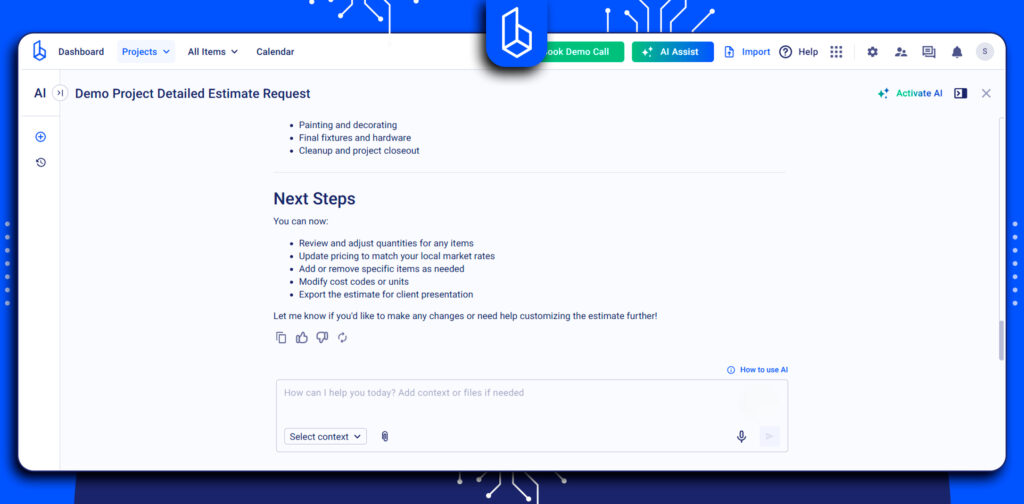
When generating an estimate, AI considers factors such as project type, scope, size, and location, along with cost catalogs, templates, and previous estimates. It allows teams to start from a structured, realistic baseline instead of a blank page.
For builders, this means:
- Faster turnaround times on bids without sacrificing accuracy
- More consistent pricing across projects and teams
- Reduced dependency on manual copy-pasting from past jobs
Artificial intelligence doesn’t replace an estimator’s experience. On the contrary, it reduces repetitive setup work so estimators can focus on reviewing numbers, adjusting assumptions, and making informed decisions.
Example #2: Location-Based Pricing and Cost Data
Construction costs are highly dependent on location, with labor rates, material prices, and availability varying significantly by region. AI supports more accurate estimating and cost control by applying location-specific data when projects are created or reviewed.
When a project is tied to a specific area, AI can:
- Apply relevant labor and material pricing
- Reflect local market conditions more accurately
- Reduce the risk of underpricing or cost overruns
If your company operates across multiple states, this capability improves consistency while still accounting for local differences. It also supports better forecasting and margin control early in the project lifecycle.
Example #3: Creating Schedules From Estimates and Project Files
One of the most common disconnects in construction happens between estimating and scheduling. When schedules are built independently from estimates, timelines are often based on assumptions instead of the real scope, which creates coordination issues once the project moves into execution.
AI construction software helps close this gap by generating schedules directly from estimates and project files.
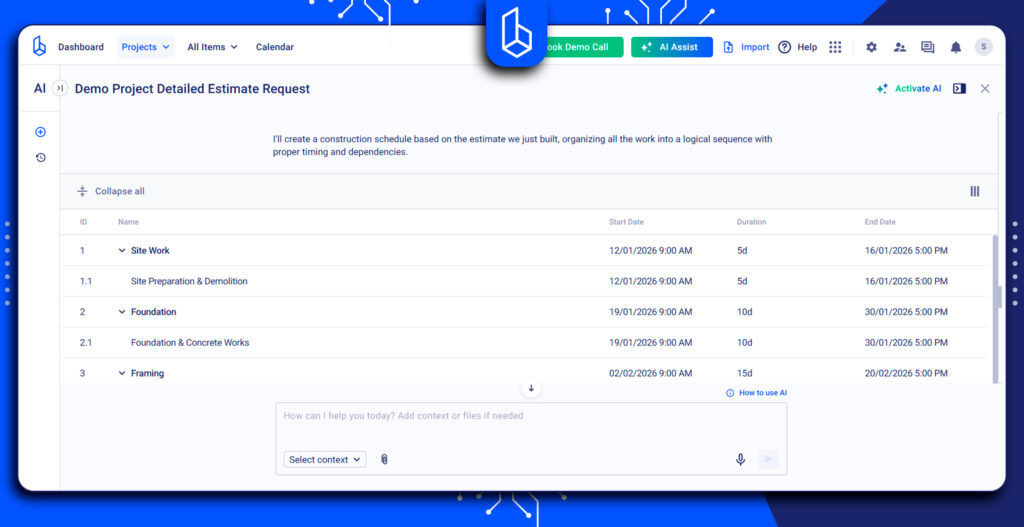
Instead of manually rebuilding timelines, AI translates estimated work groups, quantities, and scopes into structured schedules. Activities are sequenced logically, durations are assigned based on the scope, and dependencies reflect how the work will actually be executed.
This approach helps teams:
- Align schedules with what was actually priced
- Reduce omissions and unrealistic timelines
- Improve coordination between planning and execution
As projects progress, having schedules rooted in estimated data makes it easier to track performance and understand the impact of changes.
Example #4: AI-Powered Billing
Billing is another area where AI removes manual effort. AI-powered billing tools can extract data from invoices and other documents in PDF or similar formats and enter that information directly into the system.
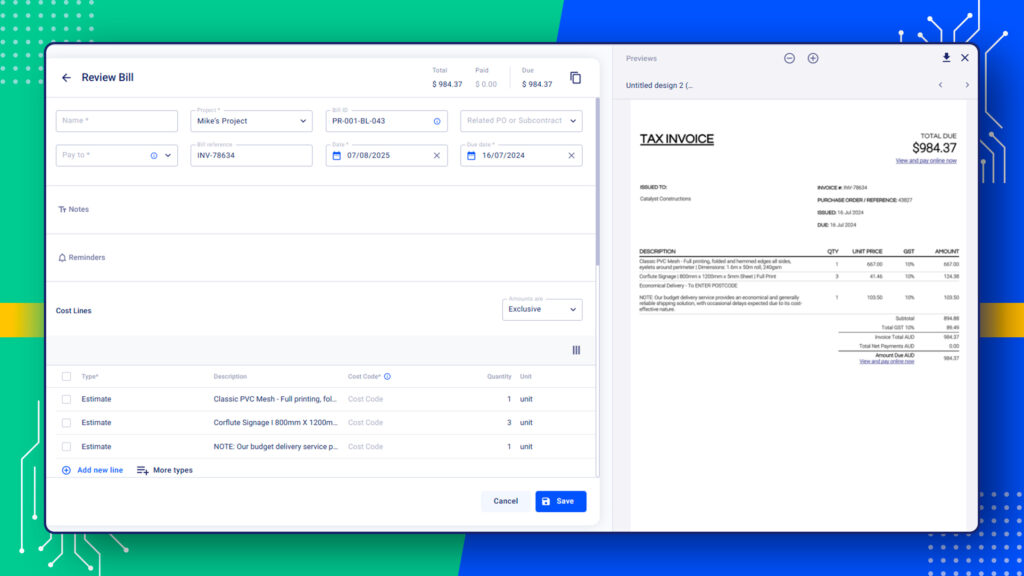
With this functionality integrated into construction project management software, invoice processing becomes part of the same workflow used for budgeting and cost control. AI reads the document, captures vendor details, amounts, cost codes, and references, and files everything under the correct project automatically.
This helps teams:
- Process invoices faster
- Reduce data entry errors
- Keep all financial information organized in one place
For construction businesses handling a high volume of bills, this reduces processing time significantly and minimizes the risk of errors caused by manual entry. It also improves visibility, since all billing data is stored in one place and can be reviewed alongside budgets, purchase orders, and payment statuses without switching tools.
Example #5: Voice-Based Data Capture From the Job Site
Builders and site managers are constantly moving, reviewing work, checking details, and coordinating with crews. Stopping to take notes or enter data into a system when the work is at its peak is not only challenging but also almost impossible to handle.
AI within construction software helps close this gap by enabling voice-based data capture directly from the job site. You simply record observations verbally by mentioning quantities, counts, or specific details such as installed items or site conditions during a walkthrough. The software then analyzes the recording and converts the information into relevant data for project management.
Such an approach allows teams to:
- Capture information at the moment it is observed
- Reduce reliance on handwritten notes or follow-up data entry
- Improve the accuracy of quantities and field observations
Processing and structuring data this way allows linking it to estimates, schedules, or progress tracking without additional manual steps. This, in its turn, significantly reduces delays between site activity and system updates and helps ensure that project records reflect what is actually happening in the field.
Example #6: Turning Project Data Into Bid Requests, Purchase Orders, and Selections
Construction workflows rely on the same core data appearing in many different forms. An estimate turns into bid requests, approved scopes turn into purchase orders, and design decisions turn into selections. Traditionally, such conversions require repeated manual work, re-entering the same information across multiple documents.
AI helps eliminate this duplication. Based on the data already available in the system, AI can generate bid requests, purchase orders, selections, and other essential documents automatically. Instead of copying information from one place to another, teams can convert structured project data into the required document format in seconds.
This creates several practical advantages:
- Faster turnaround for procurement and approvals
- Fewer inconsistencies between documents
- Reduced risk of missed or mismatched information
By allowing one type of data to flow cleanly into another, AI helps keep estimating, procurement, and execution aligned throughout the project lifecycle.
Example #7: Analyzing Project Progress and Preparing Client Updates
AI can analyze project activity over a defined period, identifying what tasks have been completed, what is currently in progress, and where work may be lagging. While understanding what has actually been completed on a project is not always straightforward, AI brings data spread across schedules, daily logs, photos, and task lists together into a single clear picture.
Based on this analysis, you can quickly generate structured updates for weekly reports and milestone summaries. From there, AI can also assist you in formatting the report into professional and neat presentations suitable for sharing with clients and stakeholders.
For construction businesses, this improves transparency, strengthens client communication, and reduces the administrative effort required to keep everyone informed.
Example #8: Text Summarization and Professional Content Generation
Construction teams send a large volume of written communication to clients, subcontractors, and vendors, so summarizing project information or drafting clear explanations often takes more time than expected.
Artificial intelligence for construction supports this process by summarizing existing information and generating professional, structured text based on project data. You are free to apply this to project updates, descriptions, explanations of changes, or internal notes that need to be shared externally.
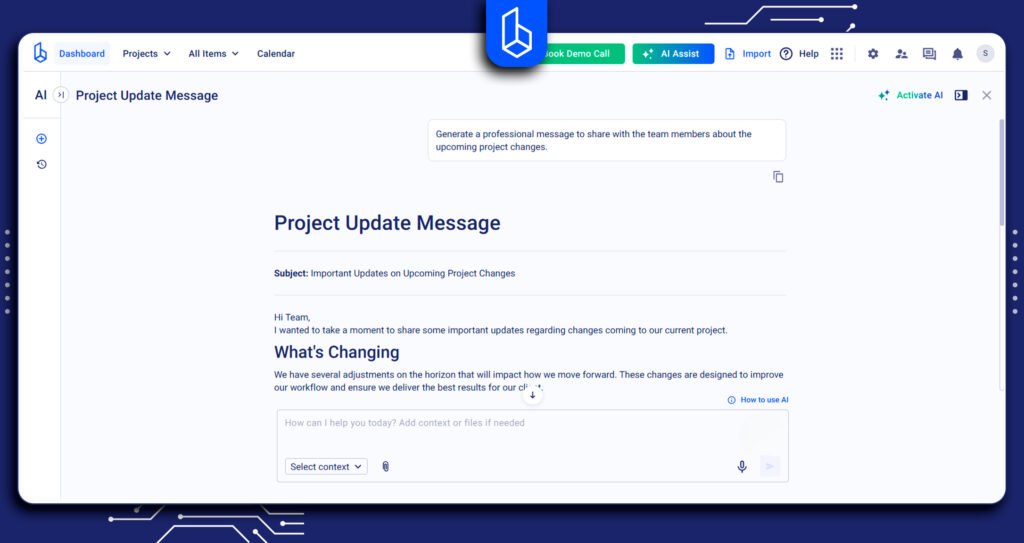
The benefit is not just speed. By standardizing tone and structure, AI helps ensure that outgoing communication is clear, consistent, and professional. It will reduce misunderstandings and help maintain a higher level of communication quality across all projects.
Example #9: Generating Project-Specific Checklists
Another powerful way AI supports contractors is by generating detailed checklists, instantly and with project-specific context. While most teams either reuse generic templates that do not fully match the project or spend time rebuilding task lists from past jobs, AI scales the process with a few simple clicks.
Instead of spending time drafting steps, organising tasks, or searching through old documents for templates, you can simply describe what you need in plain language.
The assistant analyses your request, determines the type of project, and generates a clear, organised list of tasks. Every item appears in the correct order, and it also mentions the priority of each task.
Each checklist is organized in a logical sequence and reflects how the work is typically executed. Tasks are grouped clearly, ordered correctly, and assigned priorities where needed. This helps ensure that critical steps are not overlooked and that teams follow a consistent process from one project to the next.
You can also request a checklist not for a project but, let’s say, for a submittal. AI produces a checklist for generating a submittal similar to what you see in the screenshot below:
Because the AI operates inside the construction management platform, it draws from existing estimates, schedules, and historical job data. This results in far more detailed and relevant task lists than those produced by generic AI tools that lack project awareness.
Benefits of AI for General Contractors in 2026
AI becomes valuable to general contractors when it supports decisions, not just tasks. When embedded inside construction project management software, AI operates with full awareness of active projects, financial structures, schedules, and historical performance. This allows it to assist in ways that directly affect control, predictability, and scale.
Rather than replacing human judgment, AI reduces friction in areas where time, attention, and consistency are often stretched thin.
Faster Execution Without Rushing Decisions
Many construction workflows are slow, not because they are complex, but because they require repetitive setup and cross-checking. AI helps remove this friction by automating preparation work while keeping decision-making in the hands of the contractor.
Estimators can start with structured estimates instead of blank files. Schedules can be generated and adjusted based on real scope data. Financial reviews that once required manual compilation can be surfaced instantly.
The result is not just speed, but more time to review, validate, and act with confidence.
Fewer Errors in High-Risk Areas
Small mistakes in construction tend to compound. A missed cost code, an incorrect invoice entry, or a misaligned schedule can ripple through the project and affect margins, timelines, and relationships.
AI helps reduce these risks by continuously reviewing data for inconsistencies and anomalies. Financial documents, change impacts, and schedule progress can be checked automatically against project data and historical patterns.
This does not eliminate the need for oversight, but it significantly reduces the likelihood that critical issues go unnoticed.
Better Decision Support Under Real Conditions
Construction decisions are rarely made with complete information or unlimited time. AI supports contractors by analyzing available data and providing immediate, contextual insight.
For example, when reviewing a change order, AI can show how it affects the project budget, schedule, and forecast based on current progress and past performance. Instead of pulling reports manually, contractors can access the information they need in the moment decisions are being made.
This helps shift decision-making from reactive to informed, even under pressure.
Improved Oversight Across Multiple Projects
As companies grow, managing multiple projects becomes less about individual tasks and more about visibility. AI helps contractors maintain oversight by summarizing activity, highlighting risks, and surfacing patterns across jobs.
Instead of checking each project separately, contractors can quickly see where attention is needed, whether related to budget pressure, schedule slippage, or workload balance. This allows leaders to focus on problem areas without losing sight of the broader portfolio.
More Consistent Processes Across Teams
One of the ongoing challenges in construction is consistency. Different teams, project managers, and sites often develop their own ways of working, which makes outcomes harder to predict.
By generating estimates, schedules, checklists, and documents based on shared data and workflows, AI helps standardize processes without forcing rigid templates. This improves repeatability while still allowing flexibility where it matters.
Using AI to Work Smarter in Construction
AI construction software has moved beyond experimentation. It is already supporting daily workflows across estimating, scheduling, financial control, documentation, and communication. When used inside a project management platform, AI helps teams reduce manual effort, improve accuracy, and make decisions with better context.
The real value comes from adopting AI deliberately. This means working with structured data, integrating AI into existing workflows, and giving teams time to understand how it supports their work. When approached this way, AI does not disrupt how construction businesses operate. It strengthens the systems already in place.
In practice, working smarter with AI is not about replacing experience. It’s what we call “using better tools” to support it.