Construction Contingency vs. Allowance: The 2026 Guide to Profit Protection



Construction budgets rarely go exactly as planned. There are too many uncertainties and cost shifts, selection changes, and risks.
For the right financial management given these conditions, it’s crucial for contractors and project owners to understand contingency vs. allowance in construction.
While the two terms are often used interchangeably, they serve very different purposes. In reality, contingency and allowance serve different purposes in the construction process and have distinct implications for the timeline and budgeting.
A construction contingency protects your budget from unexpected risks, while allowance covers items that are expected but not yet finalized. In this guide, I’ll break down contingency vs allowance in construction and explain how each impacts contractors and budgets.
Table of Contents
- Key Differences at a Glance: Contingency vs. Allowance
- What Is Construction Contingency?
- What Is Construction Allowance?
- How to Calculate Contingency?
- How to Add Allowance?
- Contingency vs. Allowance: Real Project Scenarios
- Bottom Line
Key Differences at a Glance: Contingency vs. Allowance
Contingencies and allowances in construction cover different risks and serve distinct purposes within a project budget.
| Feature | Construction Contingency | Construction Allowance |
| Covers | Unknown risks | Known but not finalized items |
| Type of Risk | Unpredictable | Expected but variable |
| Controlled by | General Contractor/Owner | Owner (selection-driven) |
| Adjusted when | Risk occurs | Item is selected |
What Is Construction Contingency?
Contingency is a predetermined sum of money allocated to cover potential risks or changes in the project scope that are not known in advance.
Added during estimating for contingency reasons, the funds are intended to pay for unanticipated costs that may arise during the project lifecycle
Projects with allocated contingency funds are securely protected against overruns, scheduling delays, and any other risks that may arise during construction.
While preparing for every project contingency in advance is almost impossible, a well-defined plan will guarantee a smooth operational workflow. Depending on project scopes and specific circumstances, reasons, and the preplanning preparations differ.
Recommended reading:
Why Include Contingency in a Construction Budget?
Contingency is included in a construction budget to manage financial risk. Construction projects involve variables that cannot be fully defined during preconstruction.
Market volatility, incomplete information, and evolving site conditions can all introduce additional costs. Without contingency, these risks directly impact profit margins or require emergency funding.
Including contingency in the budget:
- Protects contractors from unexpected cost overruns
- Reduces the likelihood of disputes
- Maintains cash flow stability
- Helps absorb schedule-related costs
- Supports smoother decision-making when changes arise
In short, contingency safeguards the financial health of the project while allowing flexibility in uncertain conditions.
Learn more about construction risk management:
Typical Contingency Percentage
The percentage of contingency depends on the project type, possible risks, complexity, location, and other factors. The higher is a chance of uncertainty during the construction project, the higher the contingency percentage.
- Residential projects with standard materials and predictable site conditions: 5–10%
- Complex Commercial Projects: 7–10%
- Renovations/Remodelers: up to 20%
- Infrastructure Projects: 10%-15%
What is Construction Allowance?
Construction allowance is a budget set at the beginning of a project, determining the funds set aside for items with variable costs.
The so-called known unknowns refer to project components with an uncertain cost. The allowance addresses these items and secures the budget from unexpected cost overruns.
Some of the most common items that heavily rely on allowances include lighting fixtures, plumbing appliances, cabinetry, etc.
Contractors are free to determine and set allowances in different units: per item, per sq. ft, per acre, room, etc.
Learn more about allowances:
Types of Allowances
Construction allowances are typically divided into two main categories: material allowances and installation (labor) allowances. Both play an important role in financial management and budget accuracy.
Material allowances cover items that have not yet been selected at the time of estimating. These often include finishes such as flooring, cabinetry, lighting fixtures, plumbing appliances, or countertops.
As the exact product is undecided, a reasonable budget amount is allocated to prevent underestimating costs while maintaining flexibility for client selections.
Installation allowances apply when the scope of labor cannot be precisely defined in advance. This may occur when site conditions are uncertain or when final design decisions could impact labor requirements.
Setting installation allowances helps contractors manage potential labor cost variations.
Why Include Allowance in a Construction Budget?
Including allowances in a construction budget is essential for accurate financial planning.
Here are some convincing reasons to include allowances:
Prevents start delays: Construction projects often start before every finishing detail is selected. If you wait for a client to choose, for instance, the exact Italian marble for a bathroom before signing the contract, the project might never start. An allowance allows you to give the client time to shop for finishes.
Streamlines the bidding: Allowances provide a predefined budget for items that are not fully specified, and ensure all contractors use the same baseline costs, making bids easier to compare and reducing confusion over unknown selections.
Protects margins: If a contractor guesses the cost of flooring and the client later picks a premium hardwood that costs triple the estimate, the contractor would lose money. By using an allowance, the contractor protects margins.
Recommended reading:
How to Calculate Contingency?
Handling unexpected costs requires a contingency budget proportional to the project size and complexity. Building contingency funds should be derived from historical data. You have to take into account the potential risks and costs related to the project and the industry standards.
Here, I will show two methods builders frequently use to allocate backup funds for their projects.
Deterministic Method
The deterministic method is the most common approach for residential and mid-sized commercial builds. It applies a fixed percentage (usually 5–10%) to the base estimate.
Contingency = Contingency Percentage × Project Base Cost Estimate
For example, if a contractor applies a 10% job contingency to a $120,000 project, the contingency reserve would be $12,000.
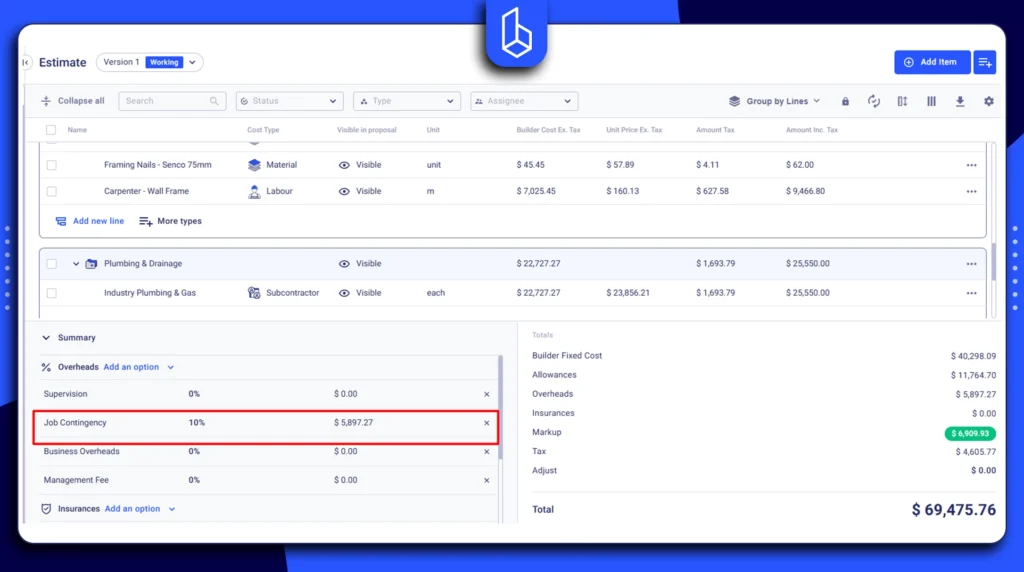
How do companies define the proper percentage for the projects? Expert judgment and accepted guidelines from authoritative bodies, such as AACE International Guidelines, help determine the correct contingency percentage.
Probabilistic Method
The probabilistic method uses risk analysis to calculate contingency based on potential events and their financial impact.
For complex, high-budget projects (typically $10M+), builders use probabilistic modeling. This method doesn’t just “guess” a percentage, but calculates the Expected Monetary Value (EMV) of specific risks.
Expected Monetary Value (EMV) = Probability of Risk × Impact Cost
For instance, if there is a 20% chance of a $50,000 site condition issue, the expected contingency for that risk would be $10,000.
How to Add Allowance?
There are some practical steps to take when deciding allowances for a particular project.
1. Clearly Define the Scope: Start by identifying which items will remain flexible. Common examples include cabinetry, tiles, appliances, lighting, or landscaping. Be specific about what the allowance covers (supply only or supply and install).
2. Base It on Market Research: Allowances should reflect realistic current market prices. Review bids, past project data, and regional cost trends in your location.
3. Add a Markup: Professional builders often add a percentage (e.g., 10-30%) on top of the allowance to cover the administrative work of ordering, receiving, and inspecting the items the client selects.
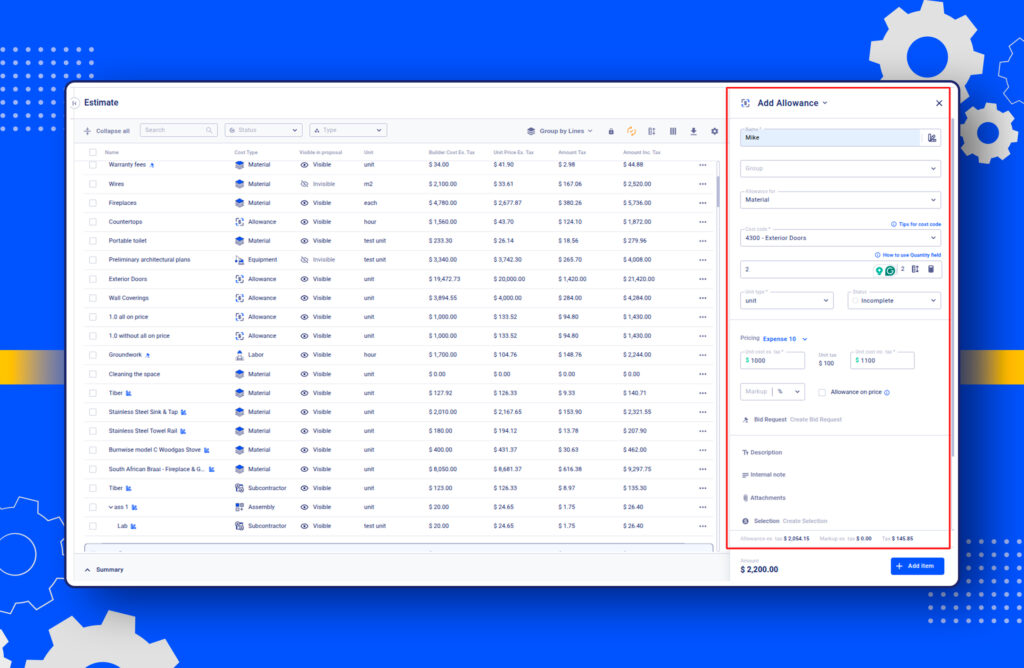
4. Use Construction Software: When applying allowance in a construction software, it appears as a separate budget line item within the estimate and is carried through to the project budget. This approach keeps the budget transparent and structured. As actual selections are made and real costs are entered, the allowance line updates accordingly.
Contingency vs. Allowance: Real Project Scenarios
The difference between allowance and contingency is visible when you see how each works in real life.
Contingency Use Cases
Case 1: Site Condition Surprise
During the excavation phase for a new home foundation, the team hits a massive, undocumented vein of solid granite three feet underground. The overall cost is $8,500 for specialized rock-blasting equipment and an extra three days of labor.
Since this was an unpredictable site condition, the builder pulled $8,500 from the contingency. The client’s original design remains the same, but the funds cover the extra effort to reach the starting line.
Case 2: Hidden Structural Damage
During a renovation, a remodeler discovers rotted framing behind drywall. The contractor included a 5% contingency in the budget, which covers the unexpected repair cost without affecting profit.
Allowance Use Cases
Case 1: Kitchen Cabinet Selection
A remodeler includes a $15,000 cabinetry allowance in the estimate because the homeowner hasn’t chosen the final style yet. Once the client selects expensive custom cabinets totaling $18,500. The builder is protected from the price hike, and the client gets exactly what they want by paying the difference.
Case 2: Bathroom Finishes
A builder sets a tile allowance of $8 per sq. ft. The client later selects premium tile at $11 per sq. ft. The difference is tracked against the allowance line in the budget and adjusted accordingly in the construction project management software.
The Bottom Line
For construction projects to stay on track, contractors need both flexibility and financial control. Contingency and allowance serve complementary roles.
In a contingency vs. allowance comparison, contingencies help contractors keep unexpected risks under control. In contrast, allowances cover the scope of work costs yet to be finalized through the builder-client communication.
By tracking contingencies and allowances within the same platform, contractors can maintain financial visibility, reduce surprises, and provide more accurate estimates to clients.
Understanding and applying both strategies is key to profitable, well-managed projects.

What is the Difference Between Contingency and Allowance?
Contingency covers unexpected costs and unknown risks, while allowance covers known items with variable costs, such as client-selected finishes or appliances.
Are Allowances Important in Construction Budgeting?
Allowances protect a contractor’s profit by ensuring that the financial responsibility, for example, for premium selections, rests with the client, preventing cost overruns and delays.
Can I Use Both Contingency and Allowance in the Same Project?
Yes. Using both provides protection and ensures smoother project management.
![Construction Estimating Software for Small Businesses: 7 Tools Compared [2026 Update]](https://buildern.com/resources/wp-content/uploads/2025/12/BLOG_COVER_Best-Construction-Estimating-Software-for-Small-Businesses-2026-768x501.jpg)