Construction Timesheet: Meeting Deadlines and Budget with Buildern


Ever found yourself scratching your head at the end of the week, wondering where all the time went on your construction project?
Construction sites bustle with an array of subcontractors and various crews. Each is focused on their tasks, ranging from laying foundations to installing electrical systems, all converging to complete the final build. The builder oversees these moving parts, including the crucial task of tracking work hours.
Yet, keeping track of every minute might seem impossible. But what if we told you that a well-kept construction timesheet could be the secret to smashing your deadlines and keeping your budget in the green? Let’s dive in and discover how you can turn time tracking into your new best mate on the site.
Table of Contents
- What Is a Construction Timesheet?
- How Does a Digital Construction Timesheet Work?
- 3 Reasons Timesheets for Construction Workers Are Crucial
- How to Create a Construction Timesheet
- Get the Most With Professional Construction Project Management

What Is a Construction Timesheet?
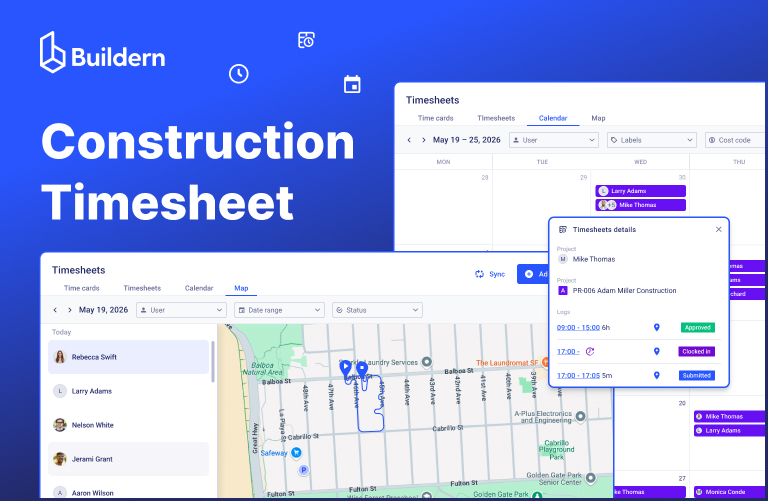
In simple terms, a construction timesheet is a record kept by managers to track the hours spent by workers on a particular project. Timesheets capture vital information such as employee names, job tasks, and break times, among others.

The purpose of a timesheet is to provide an accurate account of labour costs against the budgeted amount for the project. With this data, builders can effectively monitor their expenses and make necessary adjustments to stay on track.
Timesheets also help managers create work schedules, allocate resources, and identify any potential scheduling conflicts or delays.
How Does a Digital Construction Timesheet Work?
The case with manual timesheets is that they are often prone to human error, leading to inaccurate data and confusion. Builders using paper-based timesheets often face the frustrations of deciphering illegible handwriting or missing entries.
However, with software, the way managers track time on-site has been simplified.
A digital construction timesheet streamlines the traditional process, using software to ease the tracking of hours and resources. This innovation means manual timesheets, although effective, are fast becoming a method of the past.
If the construction project management software is equipped with built-in features designed to enhance project tracking and management. If it is tailored specifically for the construction industry, the contractor gets other features in addition to recording, monitoring, and analyzing labour in real time.
In this case, instead of functioning as a standalone activity, digital time tracking is often integrated into a broader project management workflow. When connected with other project data, recorded hours can automatically feed into labor cost tracking.
In more advanced setups, time tracking data also contributes to reporting and forecasting. Real-time insights into workforce activity allow teams to detect delays early, maintain accurate job costing, and support more informed decision-making throughout the project lifecycle.
Recommended reading:
3 Reasons Timesheets for Construction Workers Are Crucial
Logging the daily efforts of the workforce can feel like a tedious and time-consuming task, but the benefits far outweigh the effort.
Reasons may vary depending on your needs and expectations. Some builders may find it essential for budget monitoring, while others prioritize project scheduling and resource allocation.
Regardless of specific requirements, here are the main reasons why timesheets are crucial in construction management:
Provides Better Insights into Cost Control
Cost control is paramount in construction projects, where even minor deviations from the budget can have significant repercussions. Using a time tracking system allows builders to get a better idea of the actual job costs.
By accurately logging hours worked and tracking labour expenses in real time, project managers can identify cost overruns early on and take proactive measures to mitigate them.
Software time-tracking functionality can provide builders with detailed insights into labour costs, including regular hours, breaks, hourly rates, etc. With such a granular level of visibility, managers can pinpoint areas of inefficiency or excessive labour expenditure and implement corrective actions promptly.

Recommended reading:
Improve Billing and Payroll Management
While using the traditional tracking methods can be error-prone, it can also lead to delays in billing and inaccuracies in payroll processing.
Digital tracking systems have been designed with this in mind, aiming to bring clarity, accuracy, and efficiency to these critical aspects of construction project management.
The advantage of using software for timesheets is it creates a clear record of hours worked, tasks completed, and project milestones. This data is captured consistently and stored in a centralized system.
Performance Evaluation Is Now Easier
Digital timesheets can also serve as a basis for evaluating employee performance and productivity. Comparing the planned versus actual working hours, construction managers can identify any possible discrepancies and address potential problems like underutilization and overwork.
The construction management software enables managers to track their construction team’s productivity over time, allowing them to identify patterns and make informed decisions about resource allocation and workflow optimization. By leveraging this data, construction companies can maximise efficiency, minimise waste, and drive productivity across their projects.
Everything recorded with a digital time clock guarantees employees receiving constructive feedback. This in its turn will contribute to improving the overall work performance.
So, what’s the takeaway?
There are many more reasons why builders choose to use construction timesheets. The most crucial part is to assess your needs and requirements. By carefully evaluating the specific demands of each project, builders can determine the most effective ways to benefit from the timesheet technology.
How to Create a Construction Timesheet
To be effective, a timesheet should be structured, consistent, and aligned with the overall project workflow.

1. Define Your Workforce and Roles
Each timesheet entry should be tied to a specific team member. Establishing a clear list of workers, along with their roles and responsibilities, ensures that time entries are properly attributed and easy to review later.
In many workflows, labor rates and default cost codes are also assigned at this stage to simplify tracking and reporting.

2. Establish a Centralized Time Tracking System
A centralized system whether manual or digital helps maintain consistency in how time is recorded. This system should allow teams to log hours against specific tasks, either retrospectively or in real time.
Real-time tracking, often used in field environments, provides greater visibility into daily operations.
3. Use Cost Codes to Structure Work
Cost codes are essential for organizing labor data. By assigning time entries to specific cost codes, projects can be broken down into smaller components. Thus, it is easier to track where time and resources are being allocated.
This level of detail supports more accurate job costing and helps identify which parts of a project require more attention or resources.
4. Review and Validate Entries Regularly
Timesheets should not be treated as static records. Regular review helps ensure accuracy and prevent issues from compounding over time.
Consistent validation also improves accountability across teams and provides more reliable data for reporting and billing.
5. Connect Timesheet Data to Project and Financial Workflows
The value of timesheets increases significantly when they are connected to other project processes.
When integrated with scheduling, job costing, or invoicing workflows, time data can support:
- More accurate labor cost tracking
- Faster and more consistent billing
- Better visibility into project performance
This approach reduces duplication of work and helps maintain alignment between field activity and financial reporting.
Get the Most With Professional Construction Project Management
Of course, keeping track of all your construction timesheets is a great way to ensure that every aspect of your project remains well-organised and transparent.
Beyond time tracking, effective project management relies on how well different workflows are connected. Scheduling, estimating, billing, and cost control are all interdependent. When managed within a unified system, they provide a clearer picture of overall project performance.
On the financial side, integrating time data with invoicing and expense tracking improves accuracy and consistency. When labor hours are directly linked to billing and cost records, it becomes easier to monitor budgets.
Ultimately, the value of construction project management lies in bringing these elements together. It creates a workflow where information flows seamlessly from the field to the office, supporting better decisions at every stage of the project lifecycle.