Ever wrapped up a project only to realize your labor costs ate into your profit more than expected?
Builders often find labor as one of the most unpredictable expenses in construction. While managing a small residential remodel or a large-scale commercial build, knowing how to calculate labor cost in construction the right way can mean the difference between hitting your margins and losing money.
Labor costs go far beyond hourly wages.
Including direct and indirect expenses, they can snowball into budget overruns when overlooked. The full picture of labor costs is the first step toward building realistic and profit-conscious construction estimates.
So, let’s break down some of the key components of construction labor costs and walk you through the most effective calculation methods.
Construction labor costs represent the total financial outlay required to employ workers to complete a project. They typically fall into two main categories: direct and indirect labor costs. Understanding both and how they correlate helps builders create accurate estimates and keep projects on budget.
Direct Labor Costs
Direct labor costs are the wages paid to workers who are physically involved in constructing the project. This includes:
Carpenters, electricians, plumbers, and general laborers
Foremen directly supervising construction crews
Payroll taxes, Social Security, Medicare
Overtime pay
Paid time off (PTO) if applicable
Direct labor costs are directly tied to specific tasks on the job site. They are measurable, time-bound, and relatively straightforward to calculate.
🧠According to the U.S. Bureau of Labor Statistics (BLS), the median hourly wage for construction laborers was $20.31 as of May 2023, but this can vary widely depending on state, trade, and experience level.
Indirect Labor Costs
Indirect labor costs are the hidden figures that often surprise builders. These are not tied to one specific task but are still essential for the project’s completion. Examples include:
Site supervisors and project managers
Safety officers and quality inspectors
HR and administrative personnel
Workers’ compensation and liability insurance
Employee benefits (healthcare, retirement plans)
Training and certification costs
While indirect costs may not be obvious day-to-day, they can add 25–50% or more to your base labor rates when fully burdened.
🧠According to Retrofit Home Magazine, summarizing Gordian’s 2025 RSMeans Data released in February 2025, “labor wages increased by an average of 4.1 percent over the past year” (comparing 2024-2025).
Labor Cost Per Unit: The Metric That Actually Scales
Most builders start with total labor cost. That works for a single job, but it breaks down the moment you try to compare projects or improve future estimates.
What scales is not the total number. It is the cost per unit of work.
Labor cost per unit answers a simple question:
How much labor does it take to deliver one measurable piece of the project?
That unit can vary depending on the job:
Cost per square foot for framing or finishing
Cost per linear foot for fencing, piping, or electrical runs
Cost per task, such as installing doors or fixtures
Once you track labor this way, patterns start to appear. You begin to see which crews are more efficient, which scopes consistently run over budget, and where your estimates are off.
For example, if framing consistently lands at $18 per sq ft on completed jobs, but your estimate assumes $14, the issue is not the total cost. The issue is your baseline.
This is where labor cost becomes operational, not just financial.
It also makes future estimating more reliable. Instead of guessing total hours, you can:
Apply known production rates
Adjust for project complexity
Build estimates from real performance data
Builders who rely only on total labor cost react after the fact. Yet, those who track cost per unit can adjust before the job goes off track.
What Are Base Rates and Why Do They Matter?
In construction labor cost estimation, base rates refer to the hourly wage paid to a worker before adding any additional costs like taxes, insurance, benefits, or overhead. While this rate may seem simple on the surface, it’s only the starting point in understanding the true cost of labor.
Failing to accurately calculate labor costs can result in underbidding, profit loss, or budget overruns.
Base Rate vs. Burdened Rate
To truly grasp labor cost, you need to go beyond the hourly base rate and factor in additional burdens. Here’s a basic comparison:
This burdened rate is what your construction estimate should reflect, not the raw hourly wage.
U.S. vs. Australian Construction Base Rates
Labor cost structures are globally similar in principle, but base rates and burdens vary significantly by country due to factors such as wage laws, union agreements, and employment benefits.
General construction base rate: AUD $28-$34/hour, depending on experience and state
Penalty rates (for overtime, weekends) often push total costs to AUD $50/hour+
Australian construction labor is heavily influenced by Modern Awards, which set mandatory entitlements for leave, overtime, and superannuation contributions, making the burdened rate significantly higher than the base.
Why Base Rates Matter
Understanding the base rate helps you:
Benchmark wage levels against national or local standards
Structure accurate estimates by adding real burden percentages
Negotiate rates with subcontractors or internal crews
Remain compliant with labor laws and employment standards
But most importantly, base rates help you avoid underestimating labor costs, which is still one of the top causes of construction project losses.
Direct Labor vs Subcontractor Costs (And When to Use Each)
Not all labor is managed the same way. The decision between using in-house crews and subcontractors has a direct impact on cost, risk, and control.
Understanding the difference is key to building reliable budgets.
Direct Labor
Direct labor refers to your internal crew, paid hourly or salaried, working directly on the project.
Advantages:
More control over quality and schedule
Easier alignment with company standards
Better long-term productivity tracking
Challenges:
Fixed payroll obligations regardless of workload
Requires supervision, management, and coordination
Higher exposure if productivity drops
Direct labor works best when:
You have consistent workload
Tasks are repeatable
Productivity can be measured and improved over time
Subcontractor Costs
Subcontractors are typically hired for specific scopes under fixed or unit-based contracts.
Advantages:
Predictable cost per scope
Reduced management overhead
Flexibility to scale up or down
Challenges:
Less direct control over execution
Dependence on external availability
Variability in quality and timelines
Subcontracting works well when:
The scope is specialized
Workload fluctuates
Speed and flexibility matter more than internal control
Methods to Calculate Total Labor Costs in Construction
Labor costs are dynamic and variable elements in a construction project. Choosing the right calculation method is essential for accurate bidding, budgeting, and project tracking. The method you use will depend on the project size, complexity, available data, and your workflow preferences.
There are three widely accepted approaches to calculating total labor costs:
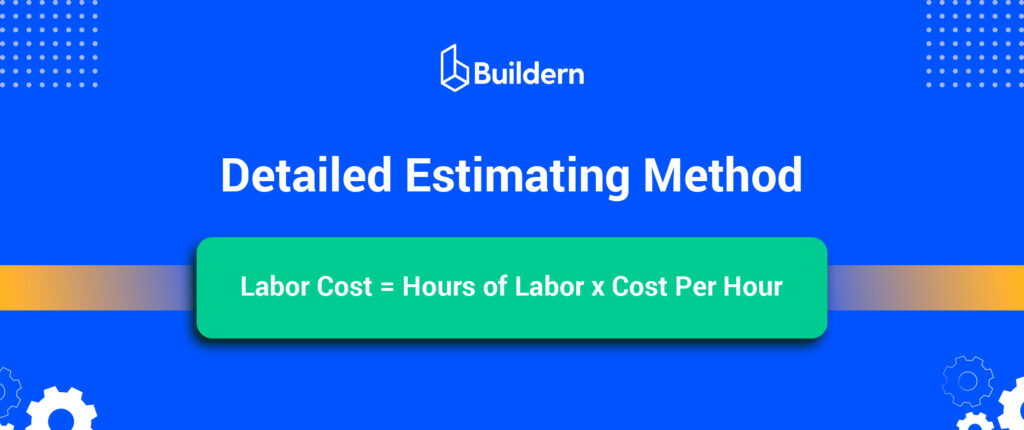
Detailed Estimating Method: Ideal for precise budgeting
Total Labor Cost Percentage Method: Useful in early-stage planning or for small jobs
Unit Rate Method: Common in standardized or repetitive projects
Each of these methods uses a different formula and is suited to different estimating styles.
Let’s explore them one by one.
1. Detailed Estimating Method
This method involves identifying the exact labor hours required for each construction activity and multiplying them by the burdened hourly rate. It’s highly accurate but requires detailed planning and access to team productivity data.
Use case: Ideal for complex projects with task-specific breakdowns (e.g., commercial buildings, large residential builds).
Step-by-Step Process:
Break the project into detailed construction tasks (e.g., framing, wiring, tiling)
Estimate the total hours needed to complete each task
Assign the appropriate team members to each task
Determine their burdened hourly rate (including overhead, insurance, and payroll taxes)
Multiply hours by rate for each task
Sum up labor costs across all tasks
Example:
Let’s say you’re estimating the labor cost for framing:
Estimated labor: 2 carpenters, 40 hours each → 80 hours
Burdened hourly rate: $45/hour
Labor Cost = 80 hours × $45/hour = $3,600
If your project has 10 such activities, you’d repeat this process for each and then calculate the total.
2. Total Labor Cost Percentage Method
Builders using this method estimate labor as a percentage of the overall project cost. It’s quicker but a bit less precise. You can use this for early-stage budgeting, feasibility studies, or simple residential jobs.
Use case: Helpful for limited labor details and estimating conceptual designs.
Step-by-Step Process:
Estimate the total project cost (materials, permits, subs, etc.)
Use historical data or industry benchmarks to determine the average labor cost percentage (typically ranges from 20-40% depending on the project type)
Multiply the total cost by the labor percentage to get the estimated labor cost
Example:
Let’s say you’re bidding mid-sized home renovation.
Total project cost estimate: $150,000
Labor cost percentage (based on past jobs): 30%
Labor Cost = $150,000 × 0.30 = $45,000
This gives you a quick, scalable labor estimate without having to drill into task-level detail.
3. Unit Rate Method
Using this method, you assign labor cost to a unit of work (per square foot, linear foot, or item) and multiply it by the number of units required. It’s efficient and easy to use for repetitive tasks or standardized construction types.
Use case: Best suited for high-volume or repetitive projects like roofing, flooring, drywall, etc.
Step-by-Step Process:
Define the unit of measurement (e.g., square foot of drywall installed)
Determine the average labor time and cost per unit
Calculate total required quantity (e.g., 2,000 sq. ft.)
Multiply by the labor rate per unit
Example:
Let’s say you’re installing drywall in a new home.
Unit labor rate for drywall: $1.50/sq. ft. (includes setup, install, cleanup)
Quantity: 2,000 sq. ft.
Labor Cost = 2,000 sq. ft. × $1.50 = $3,000
This method streamlines estimation for crews working with set productivity rates.
3 Tips for Accurate Labor Cost Estimation
Calculating labor costs requires a nuanced understanding of how real-world variables affect productivity, time, and ultimately, profit margins. The key is approaching labor not as a static number, but as a dynamic component shaped by project complexity, site conditions, and other obligations.
To improve estimation accuracy and protect your project’s financial health, consider the following practices:
1. Track historical labor performance
One of the most effective practices is to maintain a reliable database of past project performance. Include actual hours worked versus estimated hours and document team productivity across different tasks to identify factors that impact labor efficiency.
2. Use fully burdened labor rates
Don’t rely on base wages alone. Pairing this with clear labor classifications and burdened rate structures that account for indirect costs like insurance, overhead, and downtime will help you significantly reduce the risk of underbidding.
3. Plan for contingencies
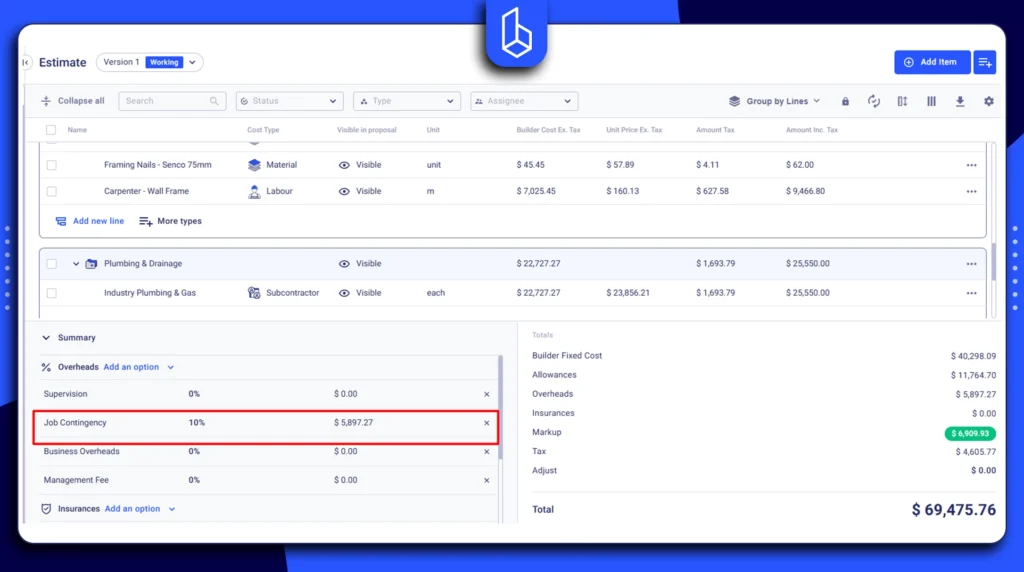
Another essential habit is scenario-based forecasting. Always build flexibility into your labor estimate. Account for construction contingencies, whether it’s seasonal labor shortages, regulatory changes, or project-specific risks like limited site access or scope volatility. Having over 5-10% labor contingency built into your estimate will make you less stressed about unexpected changes.
What is included in construction labor costs?
Labor costs in construction include all expenses associated with employing labor to complete a project. This covers direct wages, payroll taxes, workers’ compensation, liability insurance, and employee benefits. Depending on how your project is structured, you may also need to account for indirect labor costs such as supervision, administrative support, training, and safety compliance.
Which method is best for estimating labor costs?
The best method depends on your project stage and the level of accuracy required. For early-stage conceptual planning, a percentage-based method (e.g., allocating 30-35% of the total project cost to labor) is fast and reasonable. However, for detailed bids or complex projects, the detailed estimating method is recommended. It accounts for specific labor tasks and realistic productivity rates, resulting in more accurate estimates.
How do I calculate the true hourly cost of labor?
To calculate the true hourly labor cost, also known as the burdened rate, you start with the base wage and add all associated indirect expenses. This will include payroll taxes, workers’ compensation, liability insurance, benefits, and any overhead costs. For example, if a worker’s base wage is $25/hour and your total burden is 40%, the actual cost is $35/hour.
If an owner or a home builder considers that the building is “complete”, it may not always match reality. A building can look finished, but still have minor issues, incomplete systems, or pending inspections that prevent full use. From my experience in construction projects, “done” doesn’t always mean fully complete. Only having a substantial completion […]
Estimating commercial construction projects is a different discipline from residential estimating. The scale is larger, the risk exposure is higher, and the financial consequences of small mistakes are magnified. I have seen projects where a single missed scope item erased the entire margin. Meanwhile, a disciplined estimate usually creates clarity that carries through the entire […]
On paper, every construction project runs on the agreed-upon payments outlined by clear contracts. In reality, when you are not a newbie, you know that it doesn’t always work this way. A subcontractor may complete weeks of work, but face delayed payments. The same is true with suppliers delivering construction materials and waiting for weeks […]


![How to Calculate Labor Cost in Construction the Right Way [Key Formulas and Factors]](https://buildern.com/resources/wp-content/uploads/2025/07/BLOG_COVER_How-to-Calculate-Labor-Cost-in-Construction-768x501.jpg)