Extensive Guide to AIA Billing: G702 & G703 Explained Step-by-Step



AIA billing is often misunderstood as a pair of forms that need to be filled out correctly each month. In reality, it is a structured financial workflow that governs how progress turns into certified client invoices and payments.
In simple terms, the AIA Document G703 tracks the detailed math behind the Schedule of Values. The AIA Document G702 converts that math into a formal request for payment. Together, they create a controlled system that connects estimating, change orders, retainage, certification, and cash flow.
When handled properly, AIA billing protects margin and improves predictability. Yet, I often meet builders who are overwhelmed with the fragmented spreadsheets, disconnected change logs, and billing files that do not reconcile cleanly from one month to the next.
To help you avoid this, I’ll further explain how G702 and G703 function as a bundle, how data should flow between them, and how to build a repeatable workflow.
Table of Contents
- What Is AIA Billing in Construction?
- How AIA Billing Differs From Standard Invoicing
- The Step-by-Step AIA Billing Workflow
- How G702 and G703 Work Together
- AIA Billing for Builders: Strategic Considerations

What Is AIA Billing in Construction?
AIA billing is a standardized, progress-based invoicing system used primarily on commercial construction projects governed by AIA contract documents.
Unlike traditional invoicing, it does not bill a flat amount for services rendered. It bills measurable progress against an agreed GC contract structure.
At its core, AIA billing is a financial management mechanism. It ties the original estimate, approved change orders, percentage of completion, retainage, and prior payments into a cumulative record that updates each billing cycle.
This means that every application builds on the last. Such a cumulative logic is what gives the system strength and what makes precision essential.
Two documents drive this structure.
The Role of AIA Document G702
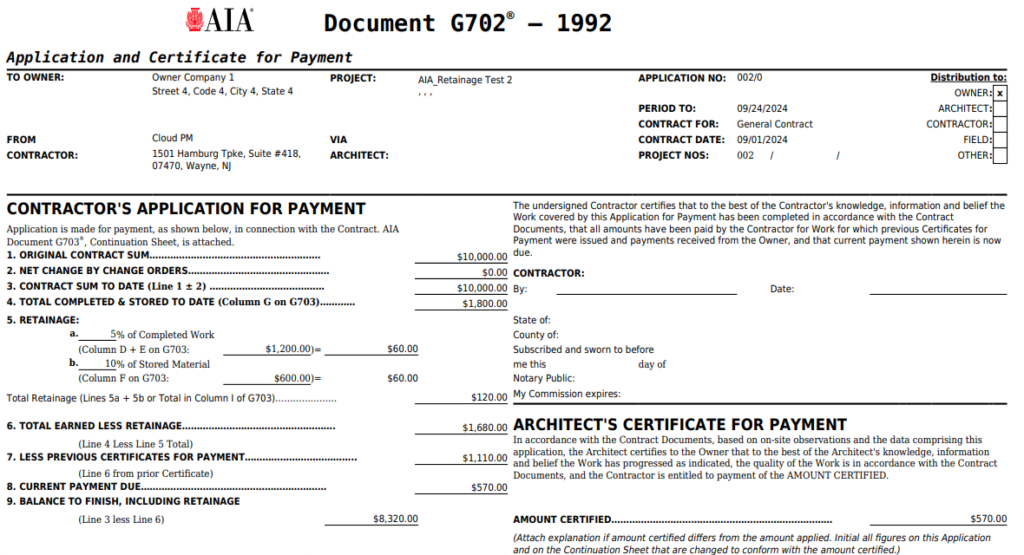
AIA Document G702 is the summary and certification document. It consolidates:
- Adjusted contract sum
- Total completed and stored to date
- Retainage withheld
- Previous payments
- Current amount due
It is the formal request for payment and the document that the architect certifies. Without certification under the G702, payment does not move forward.
From a financial standpoint, the G702 acts as the control checkpoint. It confirms that cumulative totals reconcile and that the billing aligns with contract terms.
The Role of AIA Document G703
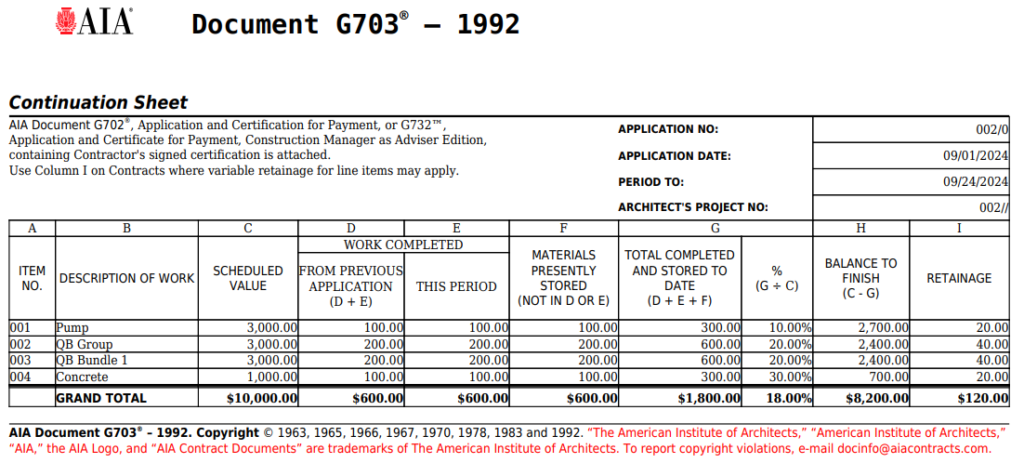
AIA Document G703 is the detailed Schedule of Values in motion. It breaks the contract into line items and tracks progress, stored materials, retainage, and balance to finish for each scope.
If the G702 is the summary, the G703 is the proof. Every number presented on the G702 must trace directly back to the continuation sheet. When the G703 math is clean and cumulative totals reconcile, certification becomes predictable.
How AIA Billing Differs From Standard Invoicing
Standard invoicing typically reflects a completed deliverable or a fixed milestone. It is transactional.
AIA billing is cumulative and percentage-based. It requires:
- A predefined Schedule of Values
- Ongoing progress measurement
- Retainage modeling
- Architect certification
- Continuous reconciliation to the adjusted contract sum
This structure creates stronger financial oversight but also demands greater discipline. It is not simply about sending an invoice. It is about maintaining a controlled financial record that stands up to architect review, lender scrutiny, and audit examination.
When implemented correctly, AIA billing transforms construction invoicing into a structured financial management process rather than a periodic billing task.
The Step-by-Step AIA Billing Workflow
AIA billing functions best when treated as a repeatable financial workflow rather than a monthly paperwork exercise. Each step builds on the prior one. If discipline breaks early in the process, certification risk increases later.
Below is the complete lifecycle I’ve seen skilled builders complete from contract setup to subcontractor payment.
Step 1: Build a Defensible Schedule of Values
The process begins with a structured Schedule of Values aligned to the estimate and contract scope. Line items should reflect measurable work divisions, realistic cost distribution, and approved contract value.
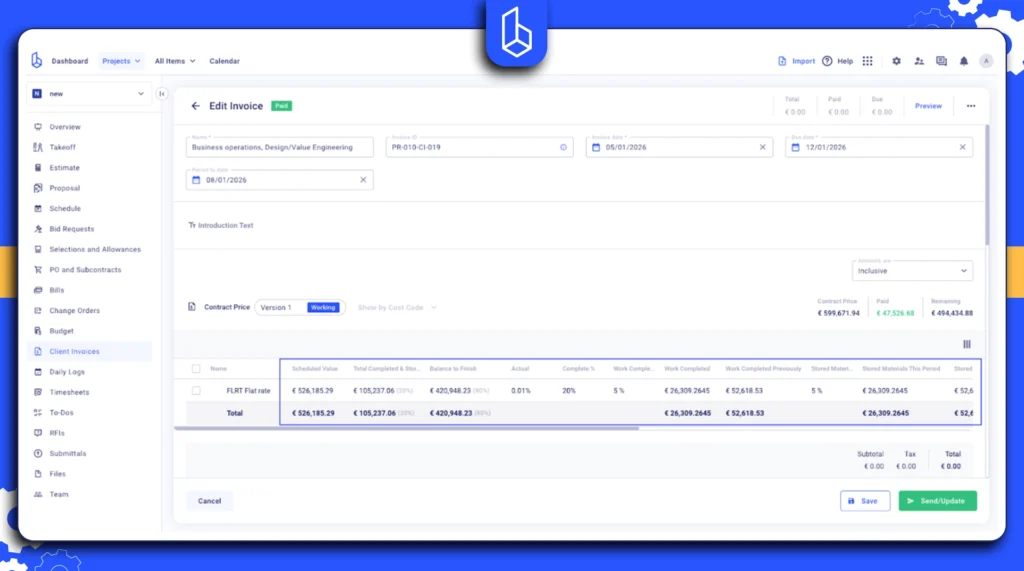
A balanced SOV becomes the financial backbone of every future billing cycle.
Step 2: Track Work in Place and Stored Materials
Progress must be measured objectively against each line item. Installed work and stored materials should be tracked separately and supported by documentation.
Step 3: Integrate Approved Change Orders
Executed change orders adjust the contract sum and must flow into the Schedule of Values immediately. Pending changes should not alter the billing structure until formally approved.
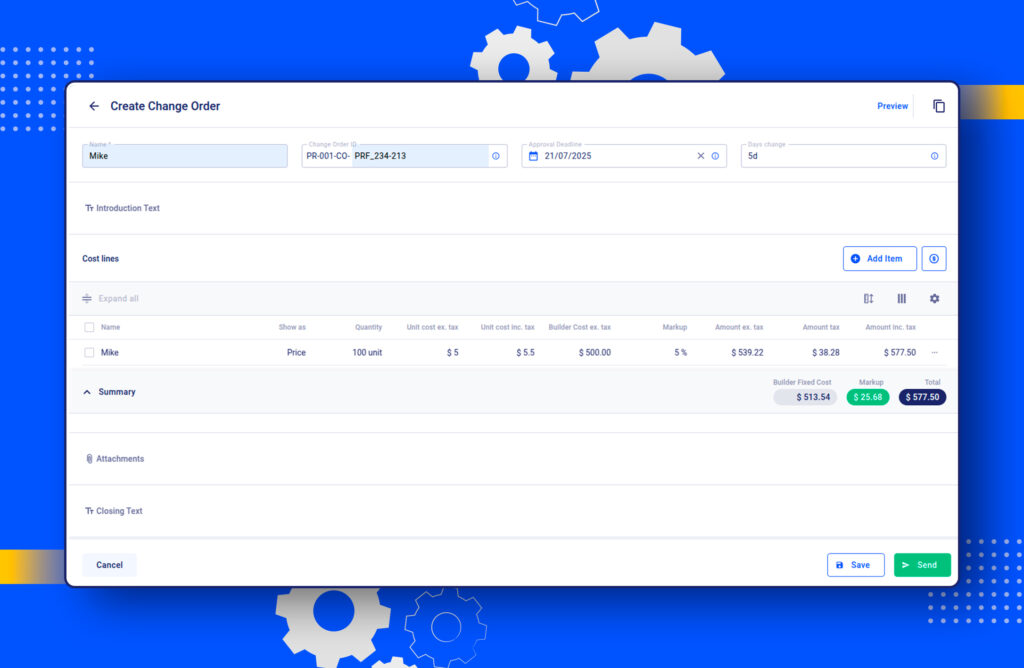
Every modification resets the contract baseline. Therefore, reconciliation at this stage prevents compounding math errors.
Step 4: Calculate Retainage and Cumulative Totals
Retainage is applied based on contract terms and must be calculated consistently across line items. Cumulative totals should reconcile cleanly with prior billing periods.
At this stage, internal math validation is critical. Note that small discrepancies can easily multiply over time.
Step 5: Prepare the G703 Continuation Sheet
The AIA Document G703 consolidates all line-item calculations: scheduled value, current progress, stored materials, retainage, cumulative totals, and balance to finish. This document is where the contractor proves the math. If totals do not reconcile to the adjusted contract sum, certification will stall.
Step 6: Generate the G702 Application for Payment
The AIA Document G702 summarizes the continuation sheet into a formal payment request. It reflects total completed to date, retainage withheld, prior payments, and the current amount due.
💡This is the certification trigger. Accuracy at the G703 level must flow seamlessly into this summary.
Step 7: Submit for Architect Review
The payment application enters formal review, where the architect evaluates contract compliance, observes progress, and documentation support. Certification may be full, reduced, or withheld. Clean cumulative math and documentation increase the likelihood of first-cycle approval.
Step 8: Certification, Funding, and Subcontractor Payment
Once certified, the application moves to owner payment processing and, if applicable, lender review. Upon receipt of funds, subcontractor payments follow according to contract terms.
This final step completes the billing cycle and establishes the baseline for the next period. The process then repeats, cumulatively, until final payment and retainage release.
When approached systematically, AIA billing becomes predictable. When treated casually, it becomes reactive. The strength of the workflow lies in maintaining structural discipline at every step.
How G702 and G703 Work Together
It’s clear that the AIA Document G702 and the AIA Document G703 are not independent documents. Functioning as a synchronized system, one provides the detailed financial record, while the other certifies that record for payment.
The relationship is linear and non-negotiable: every number on the G702 must originate from the G703.
Data Flow From Line Item to Certification
The G703 tracks each line item’s scheduled value, work completed, stored materials, retainage, and balance to finish. These cumulative totals feed directly into the summary fields on the G702:
- Adjusted contract sum
- Total completed and stored to date
- Retainage withheld
- Previous payments
- Current amount due
If the continuation sheet does not reconcile precisely, the summary cannot be certified confidently. The G702 validates and presents numbers rather than creating them.
Cumulative Integrity Across Billing Cycles
Both documents operate cumulatively. Each billing cycle builds on prior totals. Errors at the G703 level propagate into future G702 applications.
For example, if cumulative totals are overstated in one month, the next month’s balance-to-finish calculation will be distorted. That distortion flows into the G702 and may trigger reduction or rejection during review.
The system depends on continuity. Clean roll-forward logic preserves trust in the certification process.
Retainage and Change Orders Across Both Forms
Change orders first adjust the Scheduled Value structure within the G703. Once integrated, the revised contract total flows upward into the G702 summary.
Retainage is calculated at the line-item level on the G703 but appears as a consolidated figure on the G702. If retainage is misapplied within individual scopes, the discrepancy becomes visible in the summary certification.
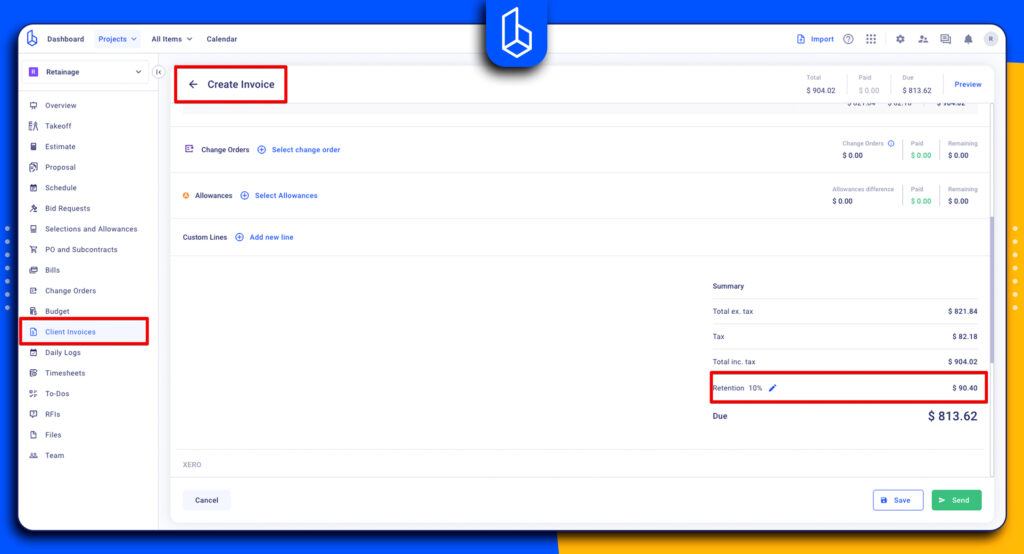
In practical terms, the G703 performs detailed construction accounting. The G702 presents the controlled financial outcome.
Together, they create a closed-loop billing system. When aligned, certification becomes predictable. When misaligned, approval friction increases immediately.
AIA Billing for Builders: Strategic Considerations
AIA billing is not only an accounting framework. It is a strategic tool. Over time, I have seen that teams that treat G702 and G703 as compliance documents struggle. The ones who treat them as financial control instruments protect margin and reduce conflict.
Below are practical considerations drawn from real-case scenarios.
Protecting Margin
Margin erosion often begins in the Schedule of Values. I have seen projects where early line items were loosely structured, percentages were estimated too optimistically, and change orders were integrated casually. The billing looked fine for a few months. By mid-project, reconciliation became painful.
What has consistently worked is this:
- Align the Schedule of Values directly with the estimate and cost codes.
- Reconcile cumulative billing against actual cost reports every cycle.
- Avoid inflating early progress to smooth cash flow.
When billing percentages mirror real progress and cost exposure, certification becomes smoother and internal financial reporting stays credible. Overbilling rarely solves a cash flow issue long-term. It usually creates a correction later.
Managing Cash Flow Timing
AIA billing introduces timing discipline. Submission dates, architect review periods, and owner payment cycles define when cash moves.
In practice, predictable cash flow comes from preparation, not speed. I have found that sending a technically complete application one day earlier with all documentation attached reduces review friction significantly.
Effective habits include:
- Closing internal cost data before preparing the G703.
- Pre-validating the change order status before billing.
- Confirming retainage terms before calculating summary totals.
- Submitting complete documentation packages in one transmission.
Avoiding Payment Disputes
Most payment disputes begin at the G703 line-item level. If percentages feel inflated, if stored materials lack documentation, or if the Schedule of Values appears front-loaded, review scrutiny increases. In my experience, clarity prevents escalation.
Practices that reduce disputes:
- Structure line items to reflect visible progress.
- Document stored materials carefully.
- Avoid billing pending change orders.
- Keep cumulative math transparent and consistent.
When the continuation sheet reads clearly and reconciles cleanly, objections decrease.
Preparing for Final Payment & Retainage Release
Final payment is where structural discipline pays off. If cumulative math has been controlled throughout the project, the retainage release becomes straightforward. If not, closeout becomes an audit exercise.
What has proven effective:
- Reconcile the total billed to the adjusted contract sum before substantial completion.
- Confirm retainage calculations at the line-item level before preparing the final application.
- Validate that all approved change orders have been fully integrated.
- Ensure documentation required for retainage release is assembled early.
💡AIA billing is cumulative from day one. Final payment is not a new calculation. It is the result of every prior one.
To Sum Up…
Stop treating AIA billing as two isolated forms. Its strength lies in discipline. A defensible Schedule of Values, accurate cumulative tracking, controlled change order integration, and consistent retainage modeling create a repeatable workflow.
Fragmented spreadsheets and informal adjustments introduce risk, while the structured processes protect margin.

How to Do AIA Billing?
AIA billing in construction is a structured, progress-based invoicing process built around two core documents: AIA G703 and AIA G702.
The billing suggests a strict process, simplified into the following steps:
- Create a Schedule of Values (SOV) aligned with your contract and estimate.
- Track progress by line item, including installed work and stored materials.
- Integrate approved change orders (COs) into the contract total.
- Calculate cumulative totals and retainage for each billing period.
- Complete the G703 with detailed line-item math.
- Generate the G702 summarizing the total completed, retainage, prior payments, and current amount due.
- Submit for architect certification and await approval.
Can AIA Billing Be Used on Fixed-Price Contracts?
Yes. In fact, it is most common on lump-sum projects where progress is measured against a predefined Schedule of Values.
How Do You Correct a Cumulative Math Error Mid-Project?
The correction should be made transparently in the next billing cycle by adjusting cumulative totals and clearly documenting the revision. Delaying correction compounds reconciliation problems.
Is It Acceptable to Revise the Schedule of Values After Project Start?
Revisions are possible but typically require owner and architect approval. Significant restructuring may raise front-loading concerns.