

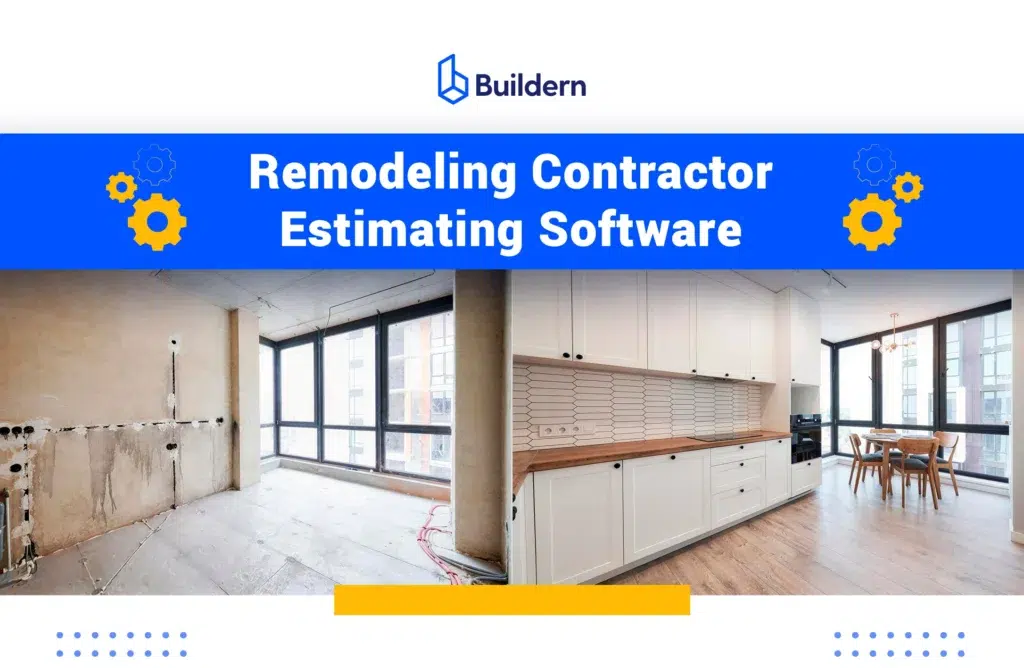
Is it easier to build something right from scratch or to fix someone else’s mistakes? Remodelers will say both are tough, especially when it comes to estimating.
Many remodeling contractors still rely on spreadsheets to create estimates. They often use templates that have been copied, edited, and reused for years.
At first, they seem flexible. But over time, formulas break, and versions multiply.
Meanwhile, remodeling contractor estimating software changes the way a remodeler can work.
In this blog article, I will highlight why spreadsheets often fail remodeling contractors and what features you really need from estimating software.
Table of Contents
- Estimating Challenges for Remodeling Contractors
- Why Spreadsheets Fail Remodeling Contractors?
- How Remodeling Contractor Estimating Software Replaces Spreadsheets
- Construction Estimating Software vs Excel
- Benefits of Estimating Software for Growing Remodeling Businesses
- Key Takeaways

Estimating Challenges for Remodeling Contractors

Estimating for remodelers is the process of calculating the costs before a project starts. A part of it is experience-based judgment and forecasting skills. However, most of it is about mathematics and the ability to break down project costs, protect profit margins, and win a job at the same time.
Recommended reading:
Remodeling estimates face unique challenges that new construction doesn’t deal with.
- Unpredictable Existing Conditions
You’re working with existing conditions, which means surprises are part of the job. For example, the kitchen renovation might uncover outdated wiring, water damage, or structural modifications from previous attempts to renovate it.
- Scope Creep During Active Work
Scope creep is another remodeling reality. Clients see the work happening and start thinking, “… you can also fix this since you are already working…”. Managing this through clear estimates and with the help of tools such as change order software is essential.
Read to learn more about whole home remodeling:
- Constant Changes to Materials and Labor Prices
Even though the market is strong in 2026, the rising costs and economic uncertainty are among the top challenges for remodelers.
Material availability, price fluctuations, and labor adjustments often occur mid-project. It usually happens that remodelers are forced to revise estimates quickly while keeping costs aligned with the original budget.
- Conflicting Documentation
Many projects begin without reliable drawings, forcing contractors to rely on homeowner-provided plans that don’t match reality. Homes with multiple additions completed over decades often come with no documentation at all. During estimation, this increases the risk of missed costs and changes.
Read more about construction documentation management:
Thus, unlike standard construction projects, remodeling work is often unpredictable. Each home, room, or renovation brings unique challenges, and estimating for remodels requires flexibility, which explains why spreadsheets do not work here.
Why Spreadsheets Fail Remodeling Contractors?
Spreadsheets seemed like the perfect estimating tool when contractors shifted from a pen and a notebook. They were easy to use and saved a lot of time handling anything.
But ask any remodeler who’s been using Excel or Google Sheets for a few years, and you’ll hear frustration. Let’s see what cannot work well when you use spreadsheets.
Every Remodel Is Unique
No two remodeling projects are ever the same. Even jobs that look similar on paper can quickly change once existing conditions are revealed. Constant changes are one of the main reasons why a construction estimating spreadsheet starts to fall apart.
Most remodelers rely on spreadsheet templates built for “typical” projects. But as soon as the scope shifts, those construction estimate templates require manual edits, copied rows, and adjusted formulas.
Instead of supporting real-world remodeling workflows, spreadsheets force contractors to constantly patch and adjust outdated templates. That makes it difficult to create accurate estimates for each unique project.
One Small Formula Error Ruins the Entire Estimate
A number one issue with spreadsheet estimating is that formulas break (often without warning). A remodeler builds a detailed estimate with labor, materials, and markups perfectly calculated.
Then a small change happens, for instance, a forgotten line item is added, or a row is deleted after a client revision. Suddenly, a SUM formula skips several costs, or a markup cell is overwritten.
💡Example:
The most dangerous is that you usually do not see the errors. For example, a $48,000 kitchen remodel might be missing a 15% labor markup because one formula stopped referencing a row. That’s over $7,000 loss, before the job even starts.
Recommended reading:
No Real Connection to Costs, Schedules, or Invoices
Another limitation is that with a spreadsheet, estimates exist in isolation. They are made at the preconstruction stage, but what happens when you win a project?
Spreadsheets are disconnected from a schedule and client invoices. A remodeler might spend hours building a detailed estimate, only to manually recreate the same numbers in a project plan.
Labor and materials are also tracked in a different spreadsheet, while invoices are sent from yet another file.
💡Example:
A $2,500 custom marble backsplash allowance is not manually copied to the “client selection” sheet. The tile sub arrives, installs the standard white subway tile, and the client is furious because they paid for custom marble. Your loss is $2,500 in rework + 2 lost days on the schedule.
Unprofessional Presentation
In addition to calculations, there is another reason to avoid spreadsheets in 2026. Even if your numbers are correct, these files rarely impress clients. A plain Excel file with tiny fonts, minimal formatting, and no branding looks dated and generic.
Clients may struggle to read or understand the estimate, which can make your business seem less professional. Lack of a customized layout means a client will hardly remember your company’s name among dozens of competitors. Let’s see what an alternative the renovation estimating software offers.
How Remodeling Contractor Estimating Software Replaces Spreadsheets
Remodeling contractor software solves the problems that occur because of manual copying and pasting hundreds of items.
These tools are designed around how remodelers actually work: unexpected conditions, constant changes, and isolation from financial workflow.
What solutions to common problems can contractor estimating software offer?
#1 Sending and Comparing Bid Requests
In Excel or Google Sheets, remodelers often have to manually copy estimates into emails or PDFs. Then comes the process of tracking responses from subcontractors in separate files and reconciling multiple versions.
Bidding software streamlines this entire process. You can send bid requests directly from the system to multiple subcontractors, track responses in real time, and compare costs side by side without juggling multiple spreadsheets.
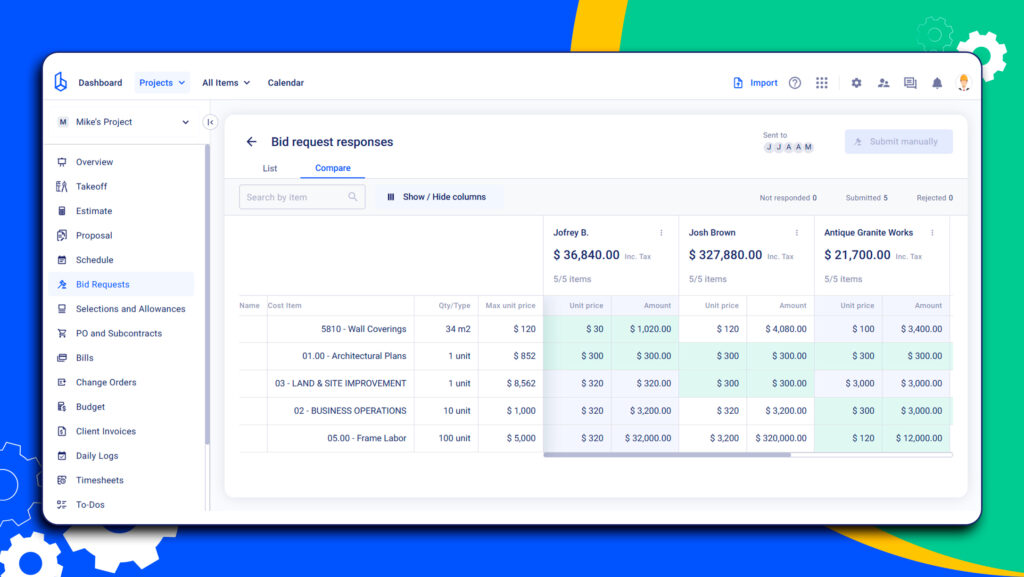
💡 Example: Instead of emailing a spreadsheet and chasing responses, a remodeler can issue a bid for plumbing work through the software. You can see who submitted the lowest accurate quote, and integrate the accepted bid into the estimate.
#2 Accurate, Error-Free Calculations Based on Takeoff
Regardless of the complexity of projects, the calculations are accurate and automated. Built-in formulas automatically handle line item costs, labor, material units, taxes, allowances, and markups. There are no broken SUMs, misreferenced cells, or lost profit.
Every active line item, including those from a takeoff software, is automatically included in the project total. Adding or removing items is seamless, and totals update instantly. Remodelers freely assign allowances, markups, and applicable taxes without worrying about manual recalculations.
Adding or removing line items is easy. The totals are calculated automatically, and a remodeler is free to choose where to include allowances, markups, and applicable taxes.
💡 Example: You are deep into a kitchen estimate and realize you forgot to add a specific wiring run. In a spreadsheet, adding that row means you must manually check that your total formula was updated to include the new row.
More about formulas here:
#3 Relying on Cost Codes
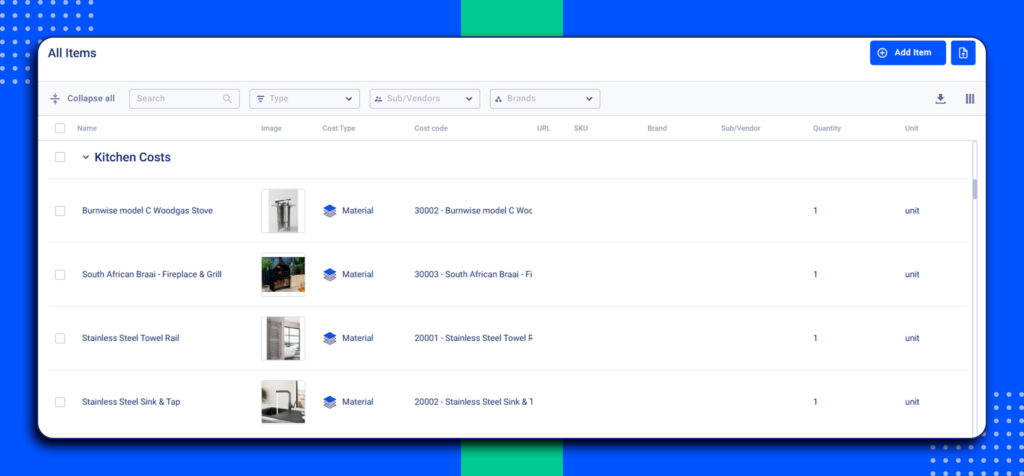
Cost codes are one of the most powerful tools that separate estimating software from spreadsheets. A construction cost catalog is a tool for remodelers to assign standardized cost codes to labor, materials, subcontractor work, and allowances from the very beginning of the estimate.
By using cost codes, the software turns estimates into structured financial data, not just numbers on a page. It allows remodelers to compare jobs, analyze profitability by trade, and continuously improve future estimates based on real historical costs.
#4 Integration With Financial Tools
With remodeling contractor estimating software, estimates are fully integrated with your financial tools.
Line items from the estimate can flow directly to purchase orders and bills, ensuring accuracy across every stage of the project. This eliminates duplicated work and is even more transparent with budgeting software that ensures real-time control.
💡 Example: A remodeler estimates $4,500 for cabinetry installation. When approved, the cabinet order is placed, and software helps automatically generate a purchase order with the correct quantity, cost, and tax.
#5 Professional Looking Estimate
An estimate is the foundation for a professional client proposal. Remodeling contractor estimating software allows you to take your estimate and turn it into a branded, polished proposal that promotes your business as reliable, precise, and professional.
It includes customization of the brand. But more importantly, remodelers have control over the level of detail shown in the final document.
You can choose whether to include or exclude markups, show or hide item descriptions, or apply or exclude taxes. The proposal software (based on estimate) communicates exactly what you want the client to see, while keeping sensitive internal calculations hidden.
Recommended reading:
Construction Estimating Software vs Excel
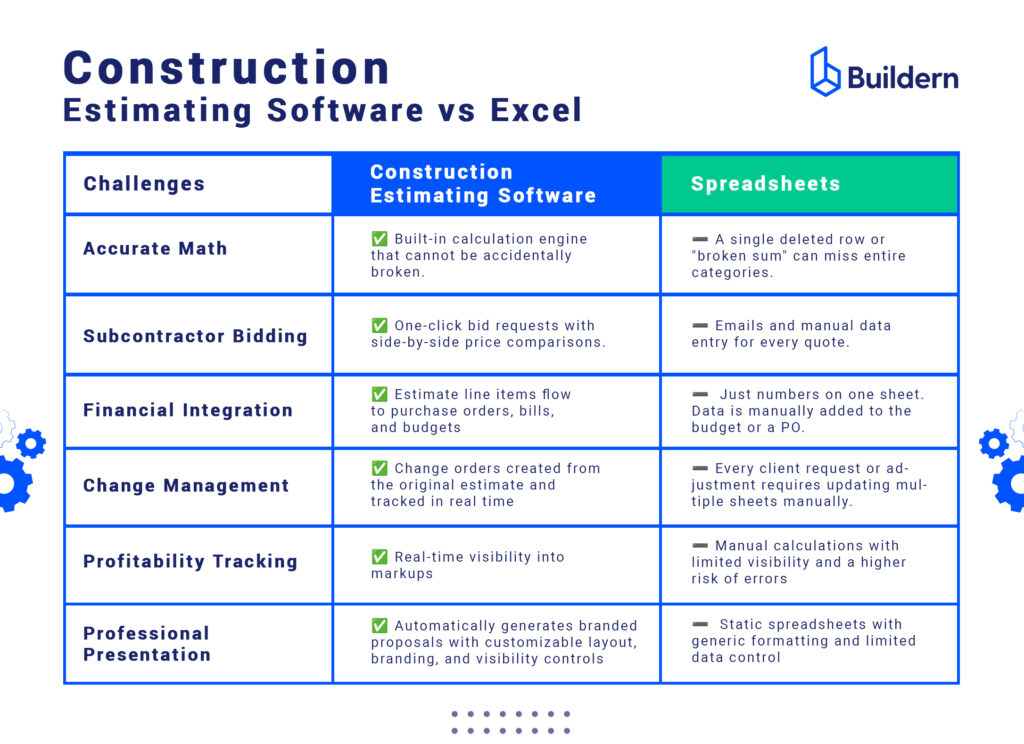
At this point, the difference should be clear. Whether you use Excel or Google Sheets, spreadsheets were never designed for the realities of remodeling work. They can store numbers, but they don’t understand construction workflows.
Let’s summarize how estimating software excels in daily operations.
Recommended reading:
Benefits of Estimating Software for Growing Remodeling Businesses
In general, home remodeling software changes how you plan, price, and present projects. It’s not only a part of day-to-day processes but also improves business strategy.
What are the clear benefits for a remodeler? The estimating software helps:
- Save Time: Automated calculations and real-time updates eliminate the need for manual edits and repeated data entry. Remodelers can focus on planning and client communication instead of struggling with spreadsheets.
- Reduce Errors: Built-in formulas, cost codes, and integration with takeoff tools ensure accurate totals. This protects profit margins and prevents costly mistakes before work even begins.
- Minimize Administrative Work: It puts an end to annoying manual work, from sending bid requests to generating purchase orders. You no longer need to reconcile multiple spreadsheets.
- Gain client trust: Attention to details make clients confident in your accuracy and reliability. Transparent estimates and polished presentations strengthen your reputation and help win more jobs.
Key Takeaways
- Software math is reliable: Dedicated remodeling contractor estimating software ensures every screw, hour of labor, and tax cent is accounted for automatically.
- All-in-one tool works better: When your estimate is integrated, that data flows instantly into your schedules, purchase orders, and invoices.
- Cost codes are secret weapons: Standardized cost codes transform your estimates into a database.
- Real-time profit protection: With automated allowance tracking and change order management, you can see your margins in real-time. You’ll never have to wait until the end of a project to find out if you actually made money.
- Customization wins jobs: Use software to give clients the transparency they want while keeping your internal margins and sensitive calculations hidden.

What is Remodeling Contractor Estimating Software?
It’s a digital tool that helps remodelers quickly create accurate estimates, manage bids, and generate professional proposals while reducing errors and saving time.
Is Estimator Software Better than Spreadsheets?
Yes, as it automates calculations, tracks changes, integrates with financial tools, and produces professional estimates without errors and broken formulas.
Is Estimating Software Good for Small or Growing Remodeling Businesses?
It’s a dynamic tool that adapts to contractors’ needs. Software saves time, protects profit margins, streamlines workflows, and scales as your remodeling business grows.