Construction CRM: What Is It and How to Choose the Best One?


Are you tired of scattered project data, missed deadlines, and communication breakdowns on your construction sites?
With your competitors growing stronger day by day, staying ahead demands more than just hard hats and blueprints. It requires a construction CRM to help you with project execution from start to finish.
But why not use a standard CRM, and how to choose the right construction CRM system for your business?
Read further to find the answers!
Table of Contents
- What is CRM in Construction
- Standard CRM vs. Construction CRM
- Core Features of Construction CRM
- How to Choose the Right Construction CRM Software
- Final Thoughts

What Is CRM in Construction?
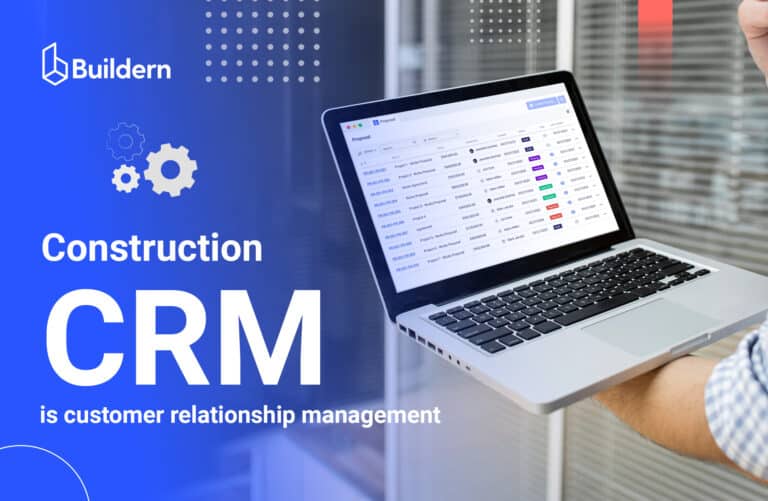
Standing for customer relationship management, CRM is simply a software solution that helps companies manage their clients. Working with CRM implies developing a systematized approach to client engagement and project management.
Your daily workflows aimed at improving your customer relationship process have a single ultimate goal, and that is to make your customers feel like they are the only ones. And that is how software automation helps.
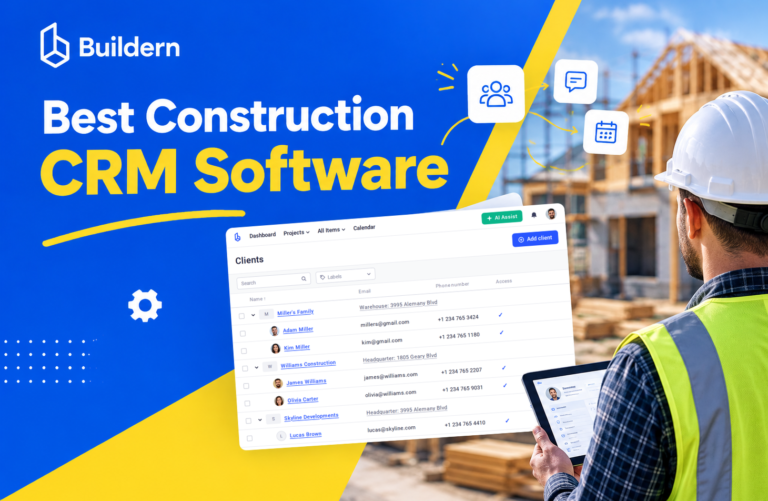
Construction CRM is nothing but a platform where builders keep track of their clients, projects, and interactions in an organized and efficient manner. It is a centralized hub for managing client information, construction-related files, etc.
The benefits of using CRM for the construction industry are numerous, to mention a few:
- Estimating the initial project costs and generating tailored proposals to win the projects;
- Acting as a single source of truth for the whole construction team;
- Integrating with third-party software to improve the workflow (i.e., accounting integrations with QuickBooks and Xero);
- Improved project management with built-in construction scheduling, milestone tracking, and resource management capabilities.
- Keeping all your clients and subs data in a single place,
- Creating cost catalogs and databases to make the workflow and later selections easier and simpler.
This centralized database streamlines the decision-making process, ensuring quick access to vital information and facilitating effective communication across all project participants.
Standard CRM vs. Construction CRM
If you think about what will happen if using a standard CRM, there are some key points you need to know. Traditional systems are designed to help manage customer relationships in the industries like retail, sales, or services where interactions with clients have a different nature.
Construction, however, is far more complex. The project timelines are longer, there are multiple stakeholders, changing budgets, and document-heavy workflows. Here comes the difference.
| Features | Standard CRM | Construction CRM |
| Primary Goal | Closing sales | Long-term relations with customers |
| Users | Sales and marketing teams | Contractors, project owners, project managers |
| Project Management | Minimal or not included | Scheduling, milestones, task tracking |
| Integrations | Email, social media | Accounting |
| Financial | Basic invoicing | Budgeting, cost tracking, change orders |
| Client communication | Basic client management | Client portals, approvals, selections |
Why Construction CRM Matters Today
Construction industry statistics show that:
- 92% of businesses believe that CRM technology is crucial for achieving their goals
- 91% of companies employing over 10 workers use CRM on a daily basis
This makes a significant portion of the construction industry embrace CRM solutions. Your direct competitors are most probably using CRM for builders, and you cannot simply miss out.
Recommended reading:
Core Features of Construction CRM
CRM platforms nowadays go far beyond simple contact management. They bring together essential project, client, and financial workflows into one connected environment. An end-to-end CRM can support the full cycle of construction contact management from the preconstruction stage to communication.
Let’s see the core features of CRM platforms, starting from proposal creation to client collaboration tools.
Custom-Made Proposals for All New Clients
A construction proposal is a document that outlines the scope of work, conveying the proficiency and willingness to work seriously. Moreover, proposals can make or break your business.
A well-crafted proposal helps builders present all their expertise, capabilities, and commitment to potential clients in a clear and compelling manner. By detailing project requirements, timelines, and deliverables, a professional proposal sets the stage for a successful collaboration and helps to avoid any misunderstandings during the project completion phase.
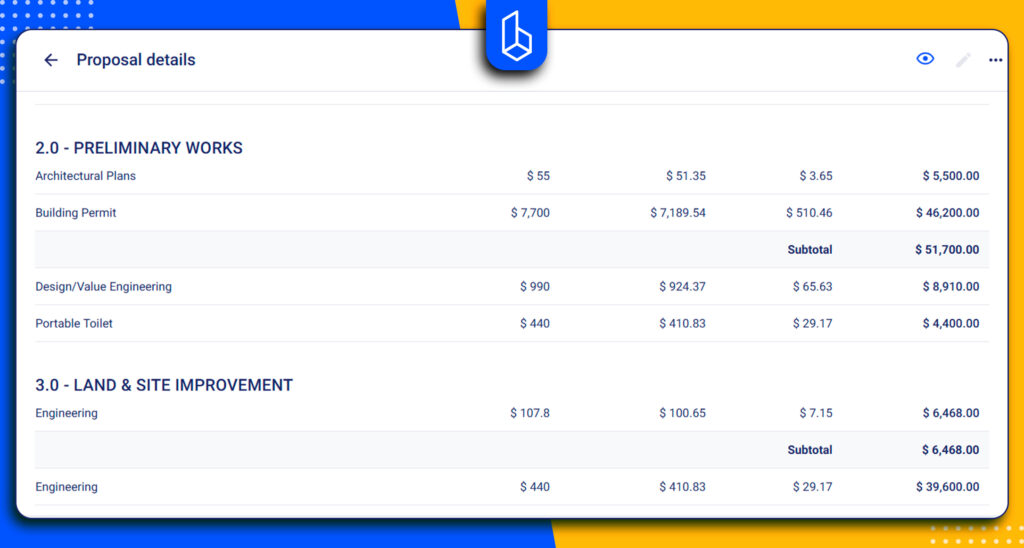
On the other hand, a poorly designed proposal can create more questions than answers.
The reason for this can be different in various cases. One thing is that proposals serve as both a sales brochure and a contract. It is crucial to provide accurate information while also talking your clients into choosing your services.
Recommended reading:
A poorly constructed proposal may lack clarity, fail to addresses key concerns, or contain inaccuracies that erode client confidence and trust.
Thus, it is important to have a customizable document that will serve as a strategic tool that sets the tone for the entire client-builder relationship. Customizable is not only related to the design, but to whether to include overheads, allowances, payment schedules, or any other core components of the proposal.
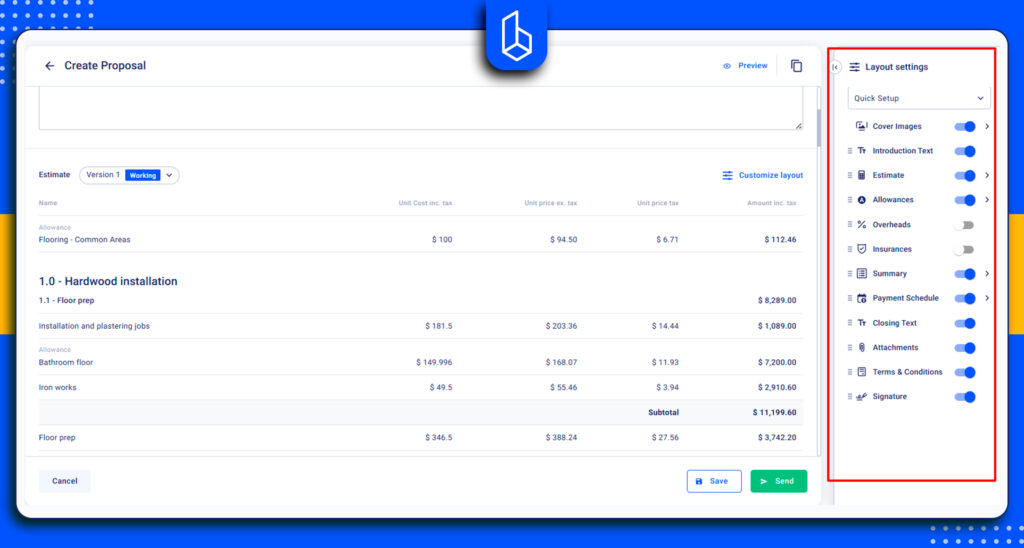
Remember: A well-crafted proposal sets the stage for success. Consider setting realistic goals with definite payment milestones, have the finances outlined as precisely as possible, and include a terms and conditions section to secure all parties in case of unexpected changes.

Client Portal
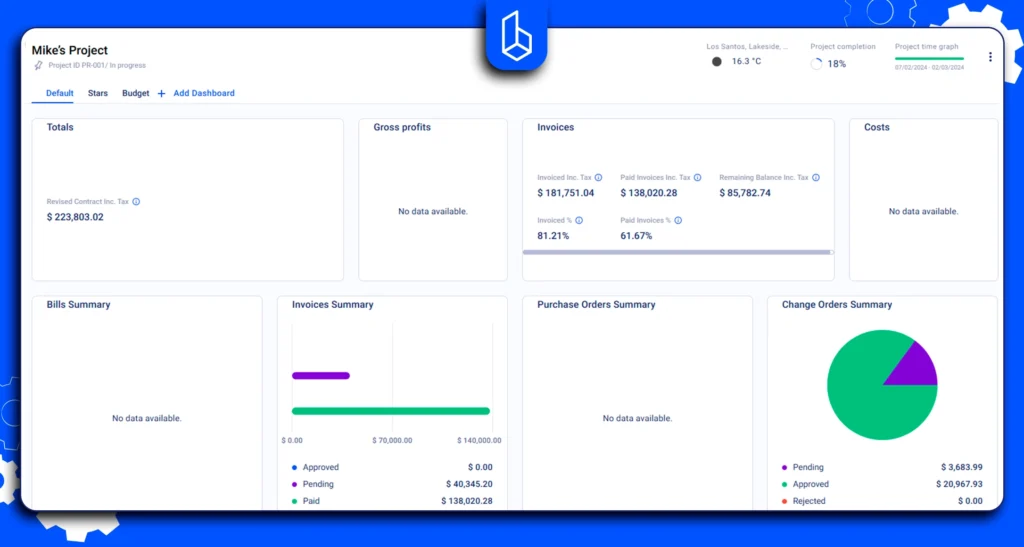
The software with a dedicated client portal offers clients a comprehensive overview of their projects, providing transparency and clarity every step of the way.
Through a client portal, clients can:
- View project progress and updates in real time
- Access proposals, invoices, and change orders
- Review selections and approvals
- Browse documents, photos, and daily logs
Recommended reading:
Every time you issue an invoice or send a selection, your client will receive a notification via email.
Flexible Document Management System
Document management of the CRM offers users a dynamic and intuitive platform to streamline document control and enhance collaboration. At the heart of this system lies a hierarchical folder structure similar to Google Drive, providing users with a friendly interface to organize and access critical documents.
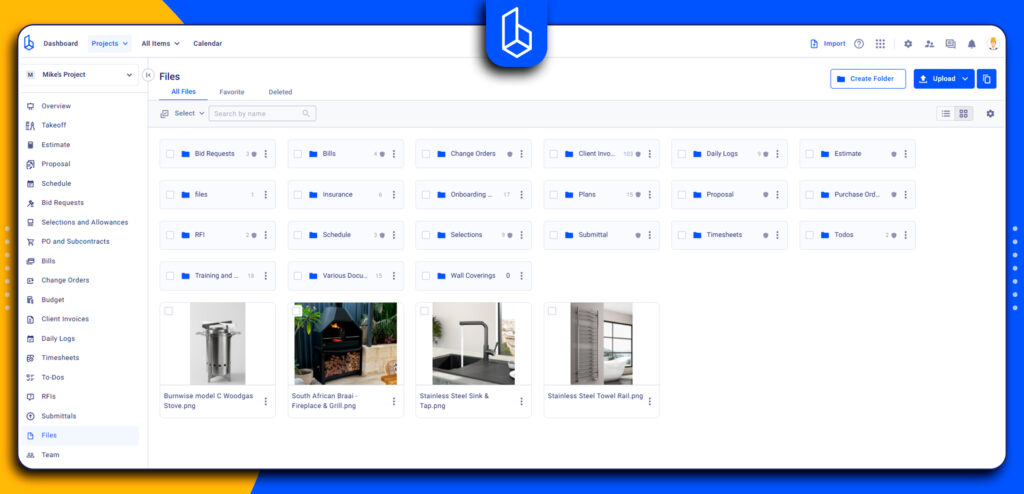
Contractors can upload all their project-related documents, files, drawings, and images to have the stuff neatly organized in one place.
Changes reflected in real-time through the construction and financial project documentation are the key to adequate day-to-day progress.
💡Recommended Reading: What Is Construction Document Management, And How to Do It Right
Messaging
Communication has always been a challenge in construction. When there are updates in different channels, including emails, phone calls, and third-party apps. CRM platforms address this by introducing built-in messaging tools.
Instead of switching between platforms, all stakeholders can communicate directly within the CRM. Messages can be linked to specific projects, tasks, documents, or approvals.
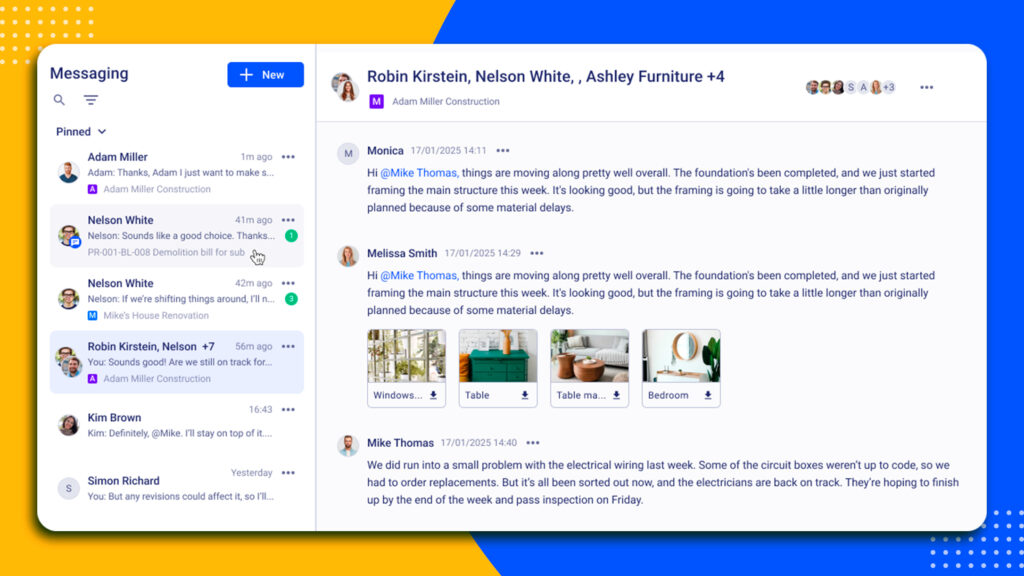
This approach reduces miscommunication and shortens response time considerably. When all interactions are in one place, teams stay aligned and maintain a clear record of every discussion throughout the project lifecycle.
How to Choose the Right Construction CRM Software
With so many options available, choosing the right construction CRM can quickly become overwhelming. Instead of focusing only on feature lists, it’s more effective to evaluate software based on how well it aligns with your business needs and workflows.
Here are the key factors to consider.
Goals
Start by clearly defining what you want to achieve with a construction CRM. Identify the gaps in the current workflow. It may be poor client communication, disorganized data, inefficient project tracking, or all of them simultaneously.
Ask the following questions:
- What problems am I trying to solve?
- Which processes need improvement?
- What outcomes do I expect from implementing a CRM?
Having clear goals will help you filter out tools that don’t directly support your priorities.
Budget
Construction CRM software comes with varying pricing models, from basic subscriptions to more advanced, feature-rich platforms. The best for construction are integrated tools, not with a limited set of functions but all-in-one software.
Balancing cost with value is essential as cheaper solutions may lack critical functionality, while more expensive ones should justify their price with efficiency gains.
Integration
A CRM should not operate in isolation. Most importantly, it shouldn’t force you to rely on multiple disconnected tools in the first place. Some contractors struggle with switching between software for estimating, project management, communication, and accounting.
That’s why all-in-one construction platforms with integrated CRM offer more valuable solutions. Instead of integrating multiple tools, they bring core workflows into a single system. Thus, teams manage projects, finances, and client communication in one place.
With an all-in-one approach, you benefit from:
- A single source of truth for all project and client data
- Fewer tools to manage, reducing complexity and training time
- Better visibility across the entire project lifecycle
- Less manual data transfer and fewer errors

Final Thoughts
Choosing the right construction CRM should focus not on the most features but on finding one that fits the way your business operates. We have put together a list of the best construction CRM software tools for you to check out and help you in the decision process.
In the case of construction, this means software managing client relationships, organizing project data, and improving communication.
Before making a decision, take the time to evaluate your current processes, define clear goals, and identify where certain gaps exist. If possible, test platforms through demos or trials, as seeing how a system works in practice is often the best way to determine whether it’s the right fit for your team.
A CRM should streamline workflows to ensure smooth project execution through better coordination, accuracy, and timing.